“Part of Strategy to Counter US Dollar and Promote Trilateral FTA”
According to a report by the South China Morning Post (SCMP) on October 22, China is in discussions with Korea and Japan regarding the possibility of establishing a trilateral currency swap agreement to strengthen the regional financial safety net and expand the use of the yuan.

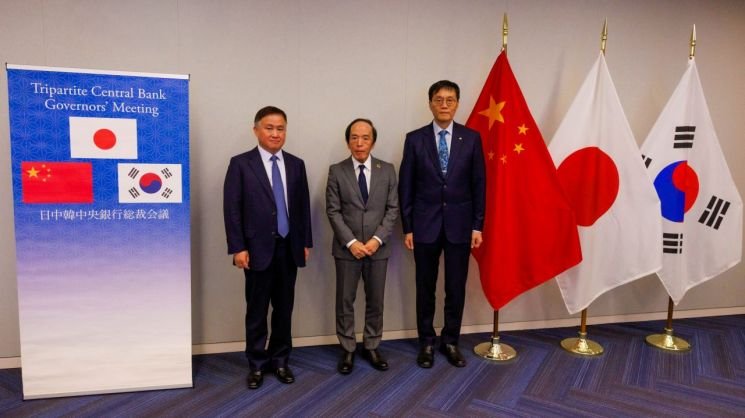
On the 15th (local time), at the 14th China-Japan-Korea Central Bank Governors’ Meeting held in Washington DC, USA, Pan Gongsheng, Governor of the People’s Bank of China (from left), Kazuo Ueda, Governor of the Bank of Japan, and Lee Changyong, Governor of the Bank of Korea, are taking a commemorative photo. Photo by Yonhap News
SCMP, citing anonymous sources, reported that Pan Gongsheng, Governor of the People’s Bank of China, recently met with Lee Changyong, Governor of the Bank of Korea, and Kazuo Ueda, Governor of the Bank of Japan, during the World Bank and International Monetary Fund (IMF) Annual Meetings held in Washington DC, USA, to discuss the issue of a currency swap agreement.
A currency swap is a contract that allows countries to exchange different currencies at a pre-agreed exchange rate. Such agreements not only serve as a safeguard against sudden volatility in financial markets but also provide fiscal support in the event of a debt repayment crisis. SCMP noted that it remains unclear whether the agreement will take the form of a bilateral currency swap or be included in the Chiang Mai Initiative Multilateralization (CMIM), a regional currency swap arrangement launched in May 2000. The outlet projected that further discussions may take place during the upcoming Association of Southeast Asian Nations (ASEAN) Summit and the Asia-Pacific Economic Cooperation (APEC) Summit scheduled for later this month.
SCMP also interpreted the significance of these talks as part of China’s long-term strategy to reduce its dependence on the US dollar by expanding the overseas use of the yuan and to promote a free trade agreement (FTA) among the three Northeast Asian countries.
According to SCMP, as of the end of last month, China had established currency swap agreements with the central banks of 32 countries worldwide, with a total value reaching 4.5 trillion yuan (approximately 903.2 trillion won). Korea and China signed a five-year currency swap agreement worth 400 billion yuan in October 2020, which is set to expire this month. China and Japan have a three-year currency swap agreement worth 200 billion yuan, signed in October 2024.
Previously, Governor Pan stated in a submission to the International Monetary and Financial Committee (IMFC) that “trade tensions are undermining global financial stability,” emphasizing the need to strengthen the global financial safety net. An official from the Macroprudential Policy Bureau of the People’s Bank of China also recently told Financial News, a media outlet under the central bank, that “the scope of currency swap cooperation will be systematically expanded in the future, and cooperation with countries and regions that have close economic and trade relations with China will be strengthened.” The official added that “swap funds will be primarily used to expand liquidity supply and promote trade and investment.”
Hot Picks Today
© The Asia Business Daily(www.asiae.co.kr). All rights reserved.