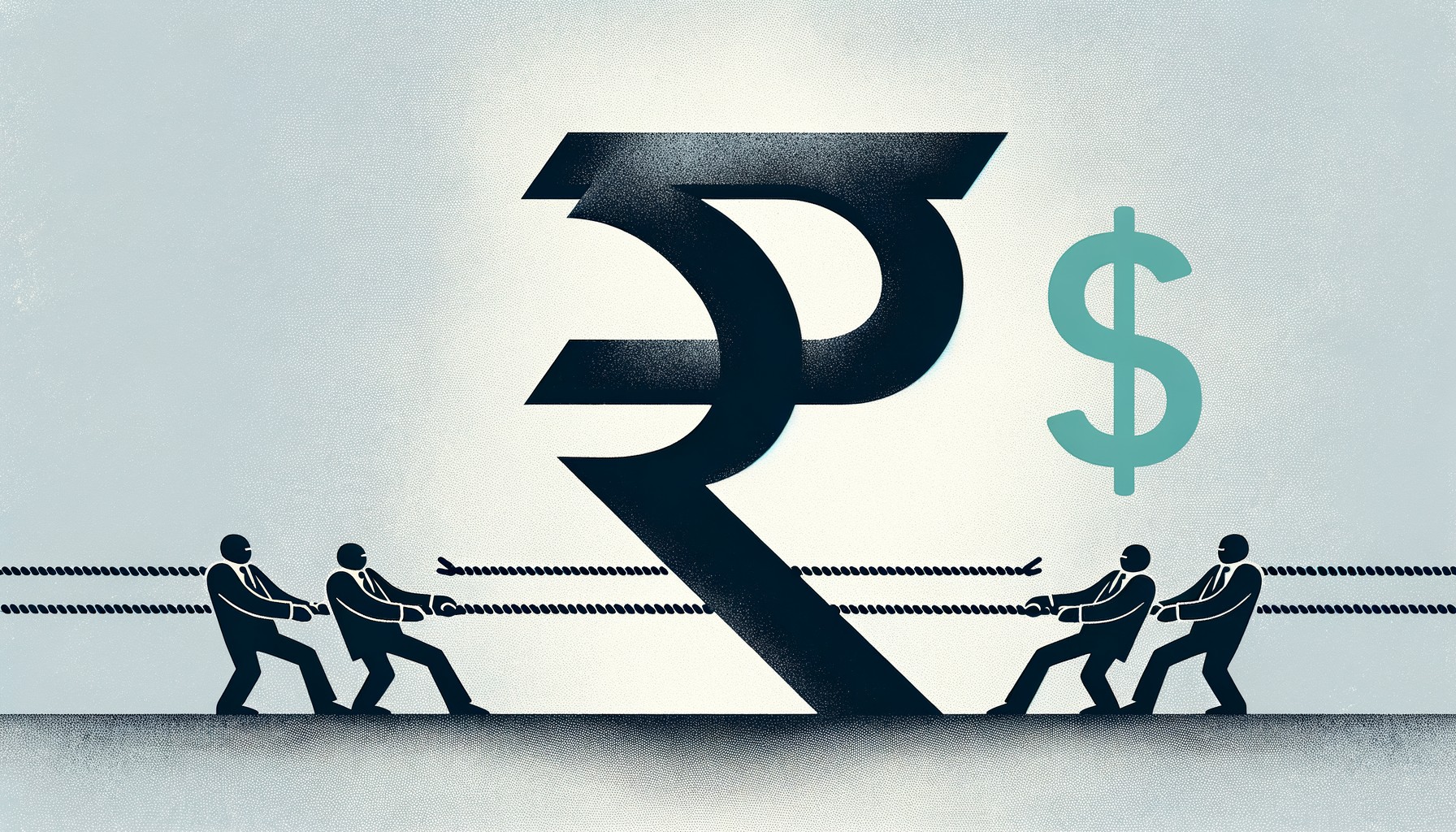
The Indian rupee is likely to remain under pressure this year due to widening trade deficits and the lack of clarity over the US trade deal, experts say.
Latest data forecasts that the rupee-dollar parity is likely to move towards 92.00 by third quarter of 2026 due to its continued underperformance in recent times.
“We now forecast that USD-INR rising towards 92.00 by 2026, from our previous expectation of 90.80. This implies continued INR underperformance against key G10 and Asia forex crosses, but with the pace of INR weakness slowing relative to last year given much cheaper forex valuations,” according to MUFG.
In its recent report, Union Bank of India (UBI) said the Indian rupee could gradually weaken and move towards the psychological level of 90 per US dollar by March 2026.
“The currency’s trajectory will continue to be shaped by both fundamental and technical factors, with the broader depreciation trend likely to persist during the year,” according to UBI report.
The Indian rupee finished the year 2025 at 89.87, marking a annual 4.72 per cent decline, its worst showing since 2022, when it dropped nearly 10 per cent.
In an analytical report, MUFG said the Indian rupee faces a capital inflow problem, and has become much more dependent on volatile foreign portfolio inflows than in the past.
“Foreigners are taking profits on existing investments with the strong IPO market and the private equity/VC exit cycle, leading to increasing outflow pressure on INR. Our analysis that shows one important contributor to Indian Rupee weakness has been the strong IPO market in India, with rising exits from PE/VC funds taking profits on existing investments, while also reflected in increasing gross FDI repatriation,” the report said.

Sharp Weakness of INR
Vijay Valecha, Chief Investment Officer at Century Financial, said the rupee has experienced sharp weakness over the past five years, depreciating by around 20 per cent against the US dollar since 2021. After Covid-19 pandemic, the Fed began raising interest rates, which pushed FIIs to shift capital towards higher-yielding US bonds. In addition, tariffs imposed by President Trump have added pressure. India is currently facing tariffs of around 50 per cent, and the lack of progress in trade talks between New Delhi and Washington has further weighed on the rupee.
The RBI has stepped in at times to stabilise the currency, mainly during periods of high volatility, but its interventions have been measured rather than aggressive. The RBI typically intervenes when rupee volatility increases. We anticipate further weakness in 2026 due to tariff concerns. However, at a fundamental level, most of these risks are already priced in.
“India’s economy remains fundamentally sound, with real GDP projected at around 7.4 per cent, inflation stable and sufficient forex reserves. A weaker rupee aligns with the RBI’s preference, as it makes India’s exports more competitive. We anticipate an annual depreciation of around three per cent,” Valecha told Khaleej Times.
Challenges for Indian rupee
The Indian rupee ended 2025 with a nearly five per cent decline to 89.83, attributed mainly to record equity outflows, the lack of a US trade deal, and widening trade deficits. Foreign investors withdrew almost $18 billion from Indian markets in 2025.
Although India has experienced strong real GDP growth, subdued nominal growth has dampened corporate earnings expectations, thereby prompting foreign investors to sell. Going ahead, Valecha said the rupee is expected to face volatility and here are some key challenges critical to monitor closely.
Trade deal & Policy risks – According to UBS, the impact of the trade deal announcement on Indian rupee appreciation is likely to be temporary. This is because the RBI is expected to restore its forex reserves during periods of stability, limiting the upside for the INR.
Current account deficit (CAD) – One of the significant reasons for depreciation in 2025 was the widening of the CAD. According to ICRA, net financial flows declined to $0.7 billion in Q2 of FY26 from $8.1 billion in the previous quarter due to lower FDI inflows. Forex reserves were also depleted by $10.9 billion, compared with $4.5 billion in Q1. Hence, any widening of the deficit in the year may impact the currency.
Inclusion of Indian bonds in the Bloomberg Global Aggregate Index – According to recent news, the inclusion of Indian bonds in the index was delayed for further evaluation. This was expected to be one of the triggers for an increase in foreign inflows, supporting the rupee.
On the positive front, RBI, under the new chairperson, may intervene in the forex market to avoid the buildup of one-sided speculative positions and to manage depreciation expectations. This was observed in mid-December. The rupee fell to 91, prompting the RBI to intervene to curb depreciation.
INR, FDI and Remittances
Looking at the role of the Indian rupee in attracting foreign direct investment, the rupee’s value has a dual impact on FDI: a weaker rupee makes Indian assets, labour, and production costs cheaper for foreign investors in dollar terms, potentially encouraging investment aimed at export markets. On the other hand, a strong rupee would be a sign of a strong, growing economy, which could also attract foreign capital.
Now, looking at the role of the Indian rupee in attracting inward remittances, it is clear that a depreciation of the rupee would favour remittances, as NRIs would be able to send more rupees for the same amount of non-INR currency, thereby incentivising them to send more money back home.
“For any nation, FDI and inward remittances strengthen the country’s economy. Empirical evidence suggests that FDI has played an ambiguous role in contributing to economic growth,” Valecha said. According to a 2003 study in the Journal of International Economics, FDI has had a statistically significant impact on economic development at the 85 per cent confidence level.
“In India, a one per cent increase in FDI has historically led to a 0.02 per cent increase in GDP. In practice, a one per cent increase in FDI typically lifts GDP growth by 0.02%–0.08% in large emerging economies, and in significant economies, the effect would be much more pronounced.”
India opened its economy to the rest of the world in 1991. Post this, India’s FDI increased from $15 billion for 1990-99 to $161 billion for 2000-09, $372 billion for 2010-19, and $158 billion for 2020-22 during the pandemic, and for the post-pandemic period from 2023-24 it was clocked at $152 billion. The impact of the foreign affiliates on GDP increased from 10.5 per cent in 2010 to 21.8 per cent in 2021. However, despite the increase, India still lags in the impact of FDI intensity on the economy, as the previous paragraph shows.
“India’s FDI stock-GDP ratio is only a third of the median for economies in UNCTAD’s FDI database, ranking 179th or 199th. Looking ahead, however, this is set to change mainly owing to the policy reforms. Examples include permitting 100 per cent ownership in the aircraft maintenance, repair and overhaul sector, raising the sectoral cap for the insurance sector from 74 per cent to 100 per cent, among others.”
Currency Swap Agreements Role
In theory, such arrangements can prop up the Indian Rupee, but only marginally, unless other supportive factors come into play. These could be in the form of higher transaction volumes and a favorable balance of payments. For instance, since India imports over 85 per cent of its crude oil, if oil prices remain stable, then it could limit India’s dollar outflows.
“In other words, it could lower dollar demand in the forex market, thereby easing selling pressure on the rupee. Equally, other parameters, such as consistent foreign inflows and favorable global risk trends, would help increase the likelihood of foreign inflows over outflows and thus aid the stability of the Rupee’s value. Therefore, it would not be wrong to say that currency swap arrangements would help mitigate Rupee weaknesses rather than reinforcing rupee strength,” Valecha said.
He said there is a clear distinction between India’s currency swap agreements with the UAE and with Russia. These arrangements were never primarily meant to defend the rupee during periods of strain. Instead, the intended purpose was to promote bilateral trade and financial transactions in local currencies through formal banking channels and other operational frameworks.
“India’s arrangement with the UAE serves a dual role as a local currency settlement framework and a payment connectivity initiative. If the existing framework that facilitates the use of INR and AED for cross-border transactions is scaled up further, then it could lower transactional demand for the dollar and enhance the rupee’s role in trade finance, remittances, and liquidity management. Bilateral trade between India and the UAE reached $100.06 billion in FY 2024-25, marking a 19.6 per cent year-on-year growth. If this base widens further, then the currency swap agreement could become more meaningful in supporting the rupee,” he said.
With regards to Russia, a rupee-oriented trade settlement infrastructure is in place through Special Rupee Vostro Accounts (SRVAs). These allow Russian banks to accept rupee payments for exports, particularly energy, and come in handy when Western sanctions curb dollar- and euro-based payment channels. India’s SRVA balances account for only a small portion of its total FX markets and trade volume, suggesting this mechanism is not yet large enough to prop up the rupee on its own in the long run.
“In conclusion, currency swap agreements with trading partners are structurally positive for the rupee. But they are not necessarily direct catalysts for rupee appreciation all by themselves. They help lower dollar dependence marginally and ease some of the depreciation pressure on the rupee. However, they can prove more useful when paired with a favorable balance-of-payments environment,” Valecha said.