The RBI recently announced measures to encourage foreign currency deposits from non-resident Indians (NRIs) and ease external commercial borrowing (ECB) rules. Gupta expects these initiatives to bring substantial foreign capital into the country, improving India’s external finances and supporting the rupee.
“I think it’s fair to say that INR has probably bottomed out for the time being, unless there is any global shock,” Gupta said. “We don’t see INR depreciating further, and we do expect INR to probably appreciate by one to 2% over the next few months.”
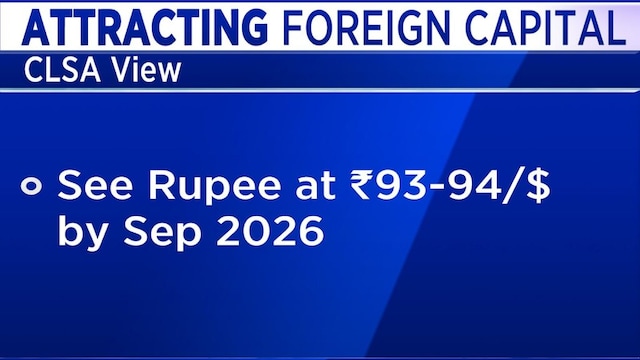
CLSA estimates that the Foreign Currency Non-Resident (FCNR) deposit scheme alone could attract at least $30 billion in inflows, similar to the programme launched in 2013. The ECB-related measures could bring in another $5-10 billion, taking total inflows to as much as $40-50 billion.
These inflows could significantly improve India’s balance of payments (BOP) position. Before the RBI’s announcement, CLSA was expecting a BOP deficit of around $70 billion this year, assuming average crude oil prices of $95 per barrel. Fresh dollar inflows could reduce that deficit sharply.
Another potential boost could come if India is included in the Bloomberg Global Aggregate Bond Index, a move that could attract additional foreign investment into Indian debt markets. While Gupta said uncertainty remains, he believes the probability of inclusion has improved.
Despite the improved outlook, crude oil remains the biggest risk for India’s economy. The country imports nearly 89% of its crude oil requirements, making it vulnerable to any sharp rise in global energy prices.
“As a rule of thumb, every $10 per barrel rise in crude oil prices rises the current account deficit by about $20 billion,” Gupta noted.
Watch the full conversation here

Beyond oil, weather conditions could also become a challenge. Gupta warned that a possible El Niño event and a weaker-than-normal monsoon could hurt agricultural output and slow economic growth next year. While reservoir levels remain comfortable after two good monsoon seasons, a prolonged rainfall shortfall would be a key risk to watch.
For now, however, the combination of RBI support measures, expected foreign inflows and relatively stable oil prices has improved the outlook for both the rupee and India’s external balances.
Catch all the latest updates from the stock market here