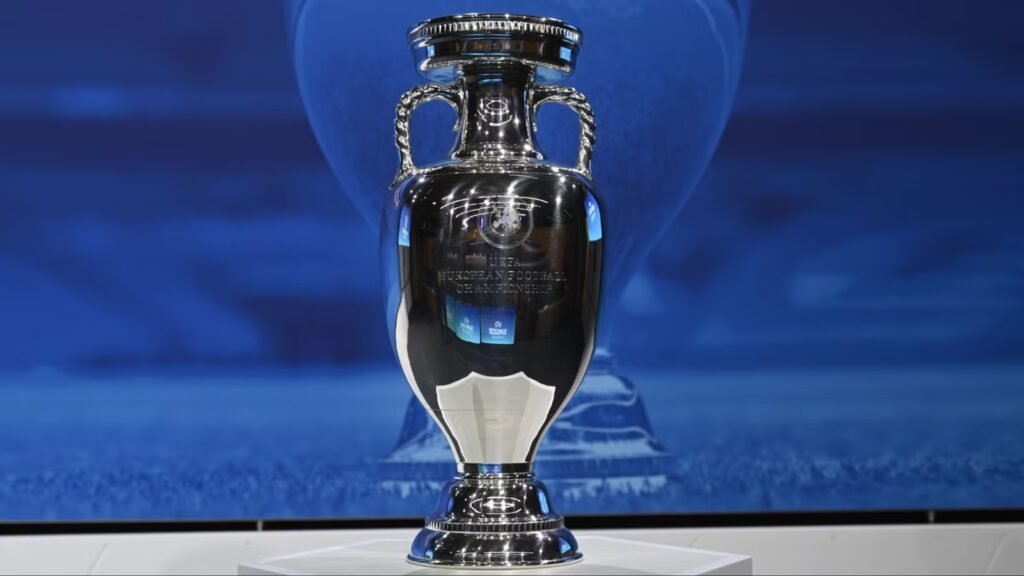
The road to UEFA Euro 2028 will look very different from previous editions, with the tournament’s four co-hosts no longer guaranteed a place in the finals.
Instead of receiving automatic qualification, England, Scotland, Wales and the Republic of Ireland will have to earn their spot through the qualifying campaign, although UEFA have introduced a safety net to ensure no more than two nations will miss out on the opportunity to play at a home tournament.
The shift away from the traditional qualification methods has left plenty of supporters wondering exactly how qualification will work. With reserved host places, a revamped qualifying format and a revised playoff system all coming into effect, the path to the tournament is more complex than ever before.
So what is the new qualifying format, how do the four co-hosts fit into it, and how will the remaining places be decided?
Do Euro 2028 Hosts Qualify Automatically?

After seeing their joint bid voted through unanimously in October 2023, the 2028 UEFA European Championships will be co-hosted by England, Scotland, Wales and the Republic of Ireland.
The tournament will be played across nine stadiums with quarter-final games at Cardiff’s National Stadium of Wales, Ireland’s Dublin Arena and the iconic Hampden Park in Glasgow. Wembley Stadium, the home of England’s national team, will also host a quarter-final, before providing the setting for both semi-finals, as well as the final on 9th July.
A full list of dates and venues for Euro 2028 can be found here.
⚽
World Cup History Quiz
You scored
out of 20
Traditionally, the host nation(s) would receive automatic qualification to the Euros tournament, as was the case for the USA, Canada and Mexico at the 2026 FIFA World Cup. However, in a move away from the norm, the four host countries will not receive automatic entry to the tournament, and will instead have to go through qualifying, but with a twist.
As a way of a safety net, UEFA announced that two spots in the final tournament will be reserved for the two best-ranked home nations that did not qualify on merit.
For example, if two home nations qualify by finishing top of their groups, or as one of the eight best runners-up, then the other two sides will fill the reserved spots. Therefore, it would mean that the only way in which a host misses out, is if only one, or none, of the other nations make it through the qualification stage.
How Will Euro 2028 Qualification Work?

The repaved road to the 2028 European Championships will see 12 qualifying groups, each consisting of four or five teams. The group winners from each mini-league, as well as the eight best-performing second-placed teams will receive their official invite to the tournament.
The remaining runners-up will then enter a playoff with the best-ranked 2026/27 UEFA Nations League nonqualified group winners, to decide which nations will be assigned to one of the two-to-four final slots, which itself is determined by the performances of the four host nations.
If both of the reserved home nation slots are used, in the case that one or none qualify on merit, then eight teams will compete across two paths for the last spots, with single-leg semi-finals and finals.
Should only one reserved allocation be used, 12 teams will face-off across three different paths, again with single-leg semi-finals and finals, for the three final tournament places.
|
Euro 2028 Qualification Summary |
|
|---|---|
|
Qualification Method |
Number of Teams |
|
Group Winners |
12 |
|
Best Group Runners-up |
8 |
|
Host Nations Who Fail to Qualify |
0-2 |
|
Play-Off Winners |
2-4 |
|
TOTAL |
24 |
In the case that all four home nations finish at the top of their group, or are one of the eight best second-placed teams, then eight teams will be drawn to contest a single opponent, both home-and-away, with the winners advancing.
Irrespective of whether the playoffs contain eight or 12 teams, the remaining runners-up will first be ranked according to their positions in the overall European Qualifiers rankings, before the teams that qualified via the Nations League are ranked based on their positions in the interim, overall 2026/27 UEFA Nations League rankings.
These teams are then divided into four pots, with each playoff route composed of two semi-final pairings of a seeded team and an unseeded team, meaning pot 1 plays pot 4, with the teams in pot 2 facing off against those in pot 3.
A total of 24 teams will compete at Euro 2028, with 54 UEFA nations scheduled to compete in the qualification phase.
This comes as a change from the qualification procedures used ahead of Euro 2024 in Germany, where 53 UEFA member nations were divided into ten groups, with seven groups of five, and three containing six. Similarly to the new rules, all ten table-toppers qualified automatically, but unlike Euro 2028, so did all of the runners-up.
Another difference, which can also be seen from the new qualification route, is that, ahead of the 2024 tournament, the teams selected to play for the remaining three slots were decided exclusively based off of their performance in the 2022-23 UEFA Nations League, as opposed to those who had just fallen short in the previous stage.