The Indian economy is encountering mounting challenges amid heightening external pressures. Despite its consumption-led nature, weakening merchandise exports due to the additional US tariffs imposed since April 2025 and the ongoing West Asia conflict have further aggravated the outlook for inflation and growth.
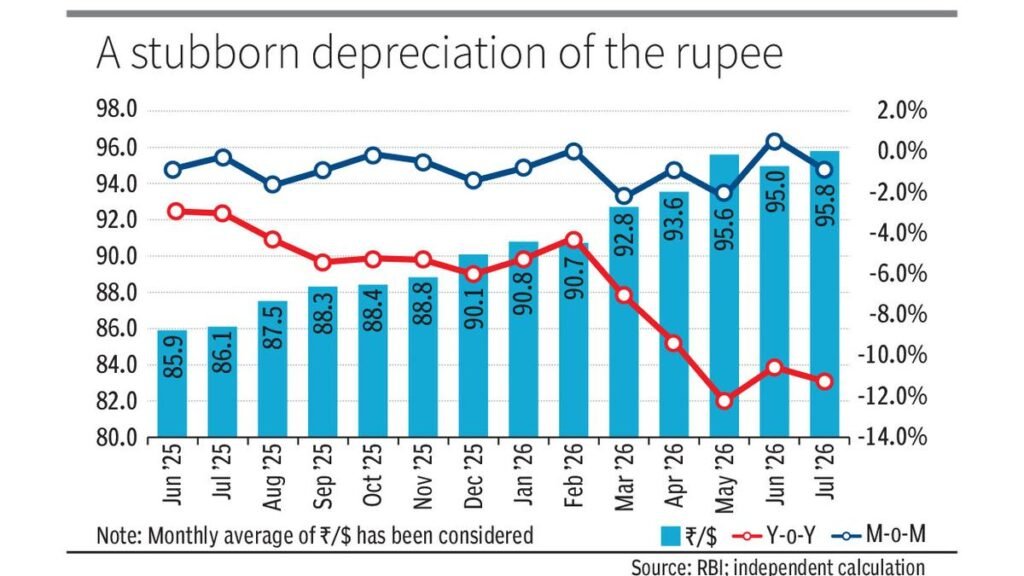
The rupee has remained under pressure against the dollar, steadily depreciating by 9 per cent from around ₹87.5 per dollar in end-July 2025 to about ₹95.4 by end-July 2026.
It is worth noting that the rupee was already on a weakening trajectory even before the tensions in West Asia intensified in late February. Between April 2025 and February 2026, the rupee depreciated by over 6 per cent — from ₹85.6 to ₹90.7 per dollar. This decline was primarily driven by the imposition of additional US tariffs of up to 50 per cent since August 2025, sustained foreign portfolio outflows, and a narrowing of interest rate differentials. However, even with the reduced additional tariffs of 10 per cent since February this year, India’s external sector continues to navigate an uncertain global trade environment.

The outbreak of the West Asia conflict further intensified these pressures by pushing up crude oil prices and increasing the safe-haven demand for the dollar. This led to net portfolio outflows of $13.1 billion in March alone, largely from the equity segment. Cumulative portfolio outflows stood at $17.8 billion in 2025-26, as global investors become increasingly selective towards emerging market economies. With the prolonged West Asia conflict, except for a fragile peace agreement leading to a temporary reopening of the Strait of Hormuz in June, FPIs continued to record net outflows of $5.5 billion from April till July 20.
The weakening of the rupee is also evident in the ‘real effective exchange rate’ (REER), a trade-weighted measure of bilateral nominal exchange rates adjusted for inflation, which fell by around 9 per cent in March, 10.6 per cent in April and 11.7 per cent in May. This decline placed the rupee among the weakest-performing major global currencies consecutively for the three months, second only to the Japanese yen.
On a year-on-year basis, the rate of depreciation of the rupee in real effective terms moderated to 8.3 per cent, aided by softer crude oil prices and improved foreign capital inflows following policy measures undertaken by the Reserve Bank of India (RBI) and the government.
In contrast, several emerging market peers, including Brazil (9 per cent), Mexico (9.8 per cent) and South Africa (10.3 per cent), recorded sharp REER appreciation, while key trading partners such as China (7 per cent) and Malaysia (4.8 per cent) also saw their REER strengthening.
The decline was moderate even in economies that experienced REER depreciation, including the US (-0.2 per cent), UAE (-0.6 per cent), and the Euro area (-1.2 per cent).

While the rupee’s sharper REER depreciation ideally implies improved export competitiveness, the gains may remain constrained by rising import costs, particularly for raw materials and intermediate goods, which could add to inflationary pressures if the trend persists.
Import burden
The rupee’s sustained fall has a gripping impact on India’s goods, which will have a spillover effect on inflation, thereby impacting the repo rate. In fact, this is largely because of the deep structural vulnerabilities that the country faces.
Despite emerging as a leading hub for smartphone assembly, the country continues to be critically dependent on imported electronic components — a weakness clearly reflected in the widening trade deficit in this segment. Key industries such as pharmaceuticals, chemicals, and machinery remain heavily reliant on imported intermediates and essential raw materials like API and solvents, organic chemicals, critical minerals, and so on.
A closer look at the composition of the deficit reveals the structural challenges, wherein 36 per cent of India’s exports are dependent on imports; hence the sustained rupee fall has ramifications on CAD.
As the rupee weakens, the cost of imports escalates, amplifying input costs and eroding competitiveness across sectors, thereby exposing the fragile foundations of India’s manufacturing growth story.
The underlying reason is the divergence between export and import growth — while exports grew marginally by 0.2 per cent in 2024–25 and 0.9 per cent in 2025–26, imports expanded much faster at 6.2 per cent and 7.7 per cent, respectively.
India’s merchandise exports posted a strong 16.1 per cent year-on-year growth in the first quarter of FY27 (April-June) reaching $129.5 billion, supported by robust performance across major export categories. Petroleum product exports surged by 36.6 per cent year-on-year; electronics goods, including smartphones, recorded a growth of 22.6 per cent; and engineering goods expanded by 18.1 per cent.
Yet, this momentum on the export front has not been sufficient to offset the broader imbalance in India’s external trade. Despite a sustained depreciation of the rupee by around 6 per cent over the past two years, typically expected to support export competitiveness, India’s merchandise trade deficit has continued to widen, reaching $333.6 billion in 2025–26. The trade deficit widened further to $86.9 billion in the first quarter of 2026-27 (April-June), from $68.7 billion a year earlier, as imports grew 20 per cent year-on-year, outpacing export growth.
This currency weakness is now feeding into broader macroeconomic pressures, with essential imports — including crude oil, coal, and edible oils — becoming costlier, raising concerns about inflationary pressures in the economy.
Way ahead
The weakness in the rupee has emerged as a key factor in the recent uptick in inflation. India’s headline retail inflation accelerated to 4.38 per cent in June, its highest level in 18 months, eroding consumer purchasing power and shaping market expectations around the RBI’s future monetary policy path.
Wholesale price inflation also inched up to 9.9 per cent in June from 9.7 per cent in May, signalling a continued pass-through of rising input costs to manufactured goods.
The effects of elevated energy prices and ongoing supply chain disruptions are becoming increasingly evident in inflation indicators, adding to concerns over the persistent price pressures in the economy.
Meanwhile, the US Federal Reserve’s decision on July 29 to leave interest rates unchanged has reinforced expectations that the RBI may also opt to maintain the status quo at its upcoming Monetary Policy Committee (MPC) meeting in August. However, policymakers are likely to remain cautious amid lingering inflationary pressures, global uncertainties, and a still-muted domestic growth outlook.
Against this backdrop, the rupee appears to be trading in what cricket enthusiasts would call the “nervous nineties”. While crossing the 100-mark once brought jubilation on the cricket field, most memorably through Rahul Dravid’s iconic innings, a similar milestone for the Indian currency would be far less welcome, signalling significant depreciation and raising broader macroeconomic concerns.

Rahul Majumdar

Srejita Nandy
(The writers are economists with India Exim Bank. Views are personal)
Published on August 3, 2026