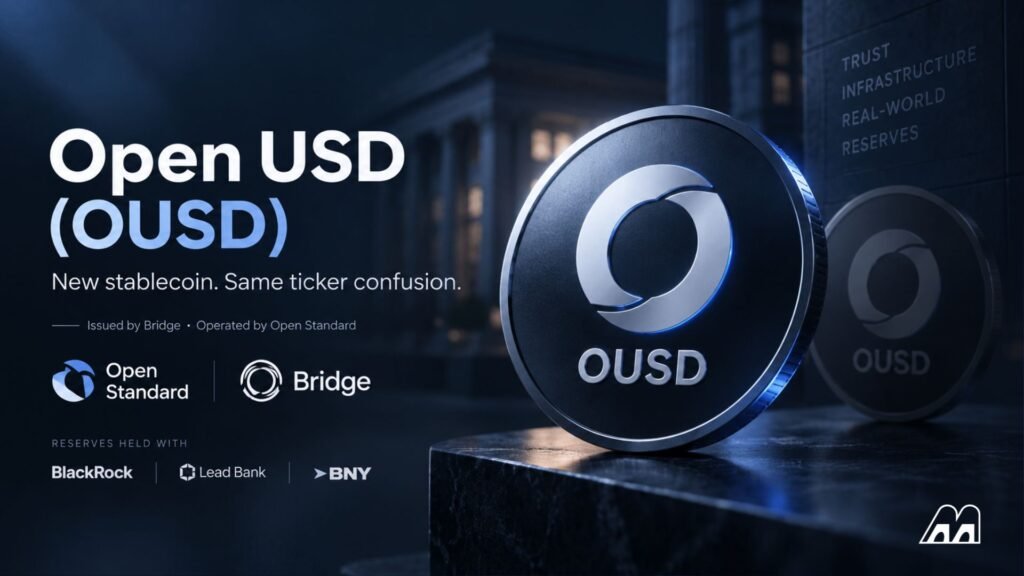
Open USD, the dollar stablecoin backed by Coinbase, Mastercard, Shopify, Stripe and Visa, went live on September 30 across Ethereum, Base, Solana and Tempo, three months after a June announcement that knocked roughly 17% off Circle’s share price in a single day. Anyone who types its ticker into a crypto price tracker this week, however, is likely to land on a different coin entirely, because OUSD has belonged to a small DeFi stablecoin called Origin Dollar since 2020, and some of the largest price pages still point there.
That confusion is a useful place to start, since it captures how much of Open USD is still unclear to anyone outside its partner network. This guide sets out what OUSD is, how it differs from the older token that shares its ticker, who can actually use it today, and which details Open Standard has confirmed and which it has not.
What Open USD (OUSD) Is and Who Earns From It
Open USD is a dollar-backed stablecoin designed as shared payment infrastructure for businesses, and its distinguishing feature is that the interest earned on its reserves goes to the companies that distribute it rather than to the issuer. Open Standard, the company led by former Bridge co-founder Zach Abrams, runs the network, while Bridge, which Stripe bought for $1.1 billion in 2024, issues the token itself. According to Solana Compass, reserves sit with BlackRock, Lead Bank and BNY, and Bridge has promised monthly attestations on a dedicated reserves page.
The economics are what separate OUSD from USDT and USDC, and they run through two separate mechanisms that are easy to blur. The first is reserve income, since businesses can mint and redeem OUSD at a fixed 1:1 rate against dollars with no fee and no volume cap, and Open Standard’s original announcement says partners keep the full income from the reserves once a small management fee is deducted, although it has not published how that income is divided among them. The second is ownership of Open Standard itself, because Abrams told CoinDesk that most of the company’s equity will be handed out over four to five years according to how much OUSD supply and transaction activity each partner generates. The five founding partners each took an equal initial stake and together made a liquidity commitment of more than $1 billion over the coming months, and the network has since grown from the 140 companies named in June to more than 200, including UBS and Japan’s SBI Holdings.

The Other OUSD: Origin Dollar Has Used the Ticker Since 2020
Origin Dollar is an unrelated yield-bearing stablecoin that Origin Protocol launched on Ethereum on September 18, 2020, and it still trades under the OUSD ticker and the ousd.com domain. CoinDesk’s own OUSD price page lists Origin Dollar with a market capitalisation of about $6.1 million and daily volume under $10,000, and Coinbase’s price page for “OUSD” also shows Origin Dollar rather than Open USD.
The difference matters beyond tidiness, because the two tokens carry very different risks. Origin Dollar earns its yield by deploying deposits into DeFi strategies, and it lost about $7 million in an exploit in November 2020, less than two months after launch, whereas Open USD is a fiat-reserved token whose issuer, Bridge, has preliminary conditional OCC approval to establish a national trust bank but has not yet received final approval. Anyone buying OUSD should confirm the contract address through Open Standard’s or Bridge’s official channels rather than a search result, check that the issuer is listed as Bridge, and treat a market cap in the single-digit millions as a sign that they are looking at the older token.

Who Can Actually Use OUSD Right Now
Open USD is built for businesses first, and that shapes who benefits from it. Companies can mint and redeem through four integration paths, namely Stripe, the Visa Stablecoin Platform, Mastercard-owned BVNK and Coinbase, whose integration opens on October 1, and Stripe has made OUSD the default stablecoin across its payment products, which Crypto Briefing reports covers settlement, treasury balances, cards and wallet transfers.
For individuals, launch coverage says OUSD is initially being made available through Coinbase, Kraken and Uniswap, although buyers should check that a venue lists Open USD rather than Origin Dollar before trading. Holding it does not entitle them to any of the reserve income, which flows to partner businesses under the revenue-sharing model. In practice, a retail user holding OUSD gets a dollar token that behaves much like USDC, while the yield that makes the project unusual stays with the companies that distribute it.
What Open Standard Has Disclosed, and What It Still Hasn’t
Open Standard has confirmed the issuer, the reserve custodians and the chains, but several details that matter to anyone assessing the token remain undisclosed or inconsistent across sources on launch day. The table below tracks each item as of October 1, 2026.
| Item | Status | What is known |
| Issuer | Confirmed | Bridge, a Stripe company, issues OUSD while Open Standard operates the network |
| Reserve custodians | Confirmed | BlackRock, Lead Bank and BNY |
| Reserve attestations | Promised | Monthly reports on a Bridge reserves page |
| Chains | Confirmed | Ethereum, Base, Solana and Tempo |
| Management fee | Not disclosed | Described only as “small” |
| Equity threshold for partners | Not disclosed | Partners above an unstated minimum earn equity |
| Partner network | Claimed / disputed | Open Standard says 200+, up from 140 in June, while some previously listed companies, including Samsung, have said they had not formally agreed to take part |
| Launch liquidity | Partly disclosed | $1 billion+ liquidity commitment over the coming months, over $400 million on Tempo at launch, 18.01 million OUSD on Solana across 47 wallets on day one |
| Issuer’s federal charter | Pending | Bridge won conditional OCC approval for a national trust bank charter in February, with no final approval date announced |
The gap between the $1 billion commitment and the supply visible at launch is not a red flag on its own, since the founders pledged that liquidity over the coming months, but it does mean the network’s scale is still a promise rather than a measurement. Paradigm co-founder Matt Huang put Tempo launch liquidity above $400 million, and the first attestation will be the earliest independent check on total reserves.

Why OUSD Competes for Distribution Rather Than Users
OUSD’s real target is the arrangement that lets Circle and Tether keep most of the interest on more than $300 billion in reserves while depending on exchanges, fintechs and payment firms to put their tokens in front of users. Those distributors already extract part of that income through private deals, and FinanceFeeds noted that Coinbase earned $305 million in stablecoin revenue in the first quarter of 2026 while holding roughly a quarter of all circulating USDC. Open USD turns that bargaining position into ownership, and that distribution model helps explain why investors treated the June announcement as a threat to Circle’s economics rather than simply another stablecoin launch.
Circle’s chief executive Jeremy Allaire has argued that USDC’s regulatory standing and integrations amount to network effects that take years to build, and he has said the company’s relationship with Coinbase remains strong, even though Coinbase now sits on both sides. Whether the consortium holds together is the open question, because more than 200 partners with different incentives have to keep routing volume to OUSD rather than to whichever stablecoin offers them a better deal tomorrow. It is the same distribution logic Memeburn explored in Binance’s $100 million Circle investment, and it reflects a wider point that in crypto, distribution is the moat that matters more than the token itself.
FAQs
What is Open USD (OUSD)?
Open USD (OUSD) is a dollar-backed stablecoin launched on September 30, 2026, operated by Open Standard and issued by Stripe’s Bridge, with reserves at BlackRock, Lead Bank and BNY. It passes reserve income, minus a management fee, to partner businesses such as Coinbase, Mastercard, Shopify, Stripe and Visa.
Is Open USD the same as Origin Dollar?
Open USD and Origin Dollar are different tokens that share the OUSD ticker. Origin Dollar is a yield-bearing DeFi stablecoin launched by Origin Protocol on Ethereum in 2020, while Open USD is a fiat-reserved stablecoin launched by Open Standard in 2026, so buyers should check the contract address and issuer before trading.
Can I buy Open USD?
For individuals, Open USD is initially being made available through Coinbase, Kraken and Uniswap, so buyers should confirm the listing is Open USD rather than Origin Dollar. Minting and redeeming directly at 1:1 with no fee is available only to businesses through Stripe, Visa, Mastercard’s BVNK and Coinbase.
Does Open USD pay yield to holders?
Open USD does not pay reserve income to ordinary holders. The earnings from its reserves, minus an undisclosed management fee, go to the partner businesses that mint, distribute and transact with it.
Who backs Open USD?
Open USD’s five founding partners are Coinbase, Mastercard, Shopify, Stripe and Visa, which together made a liquidity commitment of more than $1 billion over the coming months, and the wider network includes more than 200 companies such as UBS and SBI Holdings.