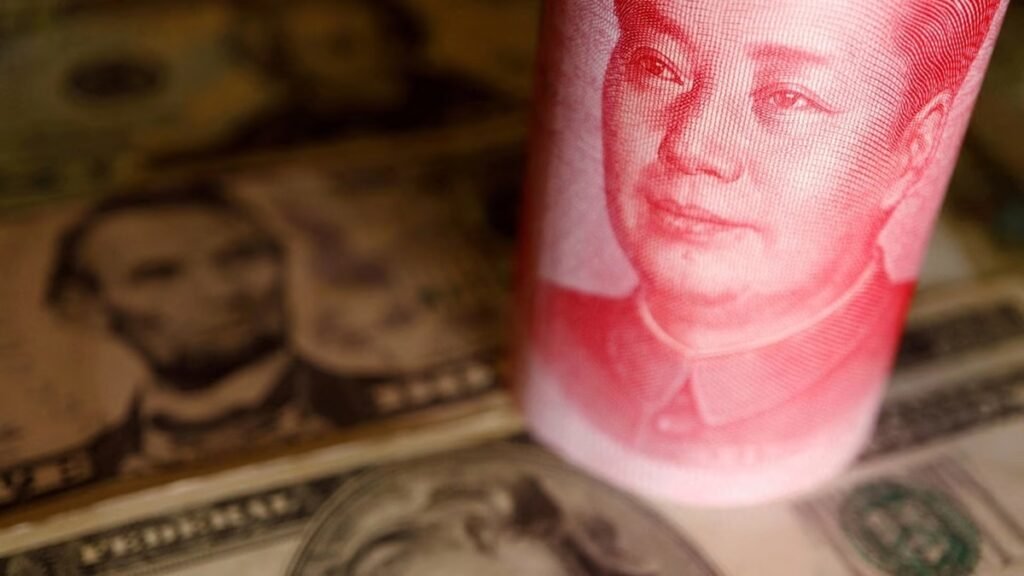
The rapid rise of China as a global Artificial Intelligence (AI) hardware powerhouse is reshaping the country’s economic strategy and changing Beijing’s long-standing approach toward its currency, with the yuan heading for its longest winning streak against the US dollar in over a decade, Bloomberg reported.
According to reports, the Chinese onshore yuan is on track for a sixth straight quarter of gains against the dollar, a streak not seen since 2013, even as policymakers show little urgency to slow the currency’s appreciation despite concerns over slowing growth and fragile domestic demand.
Analysts say the shift shows a deeper transformation in China’s export engine, driven increasingly by high-value AI-linked technology exports rather than traditional low-cost manufacturing.
Boom in AI changes China’s export equation
For years, China reportedly depended heavily on labour-intensive industries such as garments, furniture and household goods, where thin profit margins made exporters highly sensitive to currency movements.
Traditionally, a stronger yuan worried Beijing because it made Chinese exports more expensive globally and threatened manufacturing competitiveness. But the global AI investment surge is now rewriting that equation.
Demand for semiconductors, servers, AI chips and advanced computing hardware has emerged as a powerful new export driver for China, reducing the economy’s dependence on ultra-cheap manufacturing exports. As a result, Chinese policymakers appear more willing to tolerate and possibly even welcome a firmer yuan.
“What has changed is exports appear less sensitive to currency moves than previously thought, meaning the benefits of currency appreciation carry more weight in exchange-rate policy,” Bloomberg quoted Duncan Wrigley, chief China economist at Pantheon Macroeconomics, as saying.
Yuan climbs despite economic weakness
The yuan has strengthened to its highest level since 2023 even as China’s broader economy continues to face pressure from weak domestic demand, prolonged property sector stress, slowing global growth and trade tensions.
In earlier periods, Beijing would likely have intervened aggressively to weaken the currency and support exporters. Instead, the People’s Bank of China (PBOC) has maintained daily currency fixings near their strongest levels in nearly three years.
Exporters have also reportedly started converting more of their dollar earnings into yuan, suggesting expectations that the Chinese currency may strengthen further.
Semiconductor exports drive trade growth
The latest trade data of China shows how dramatically the export mix has shifted. Exports hit another record in April, with nearly half of export growth reportedly driven by semiconductors and computer-related products. Meanwhile, traditional export categories such as clothing, furniture and household goods either remained flat or declined.
Imports have also surged, especially purchases of chips and semiconductor manufacturing equipment. Analysts at Deutsche Bank reportedly noted that previous periods of rapid import growth, such as 2010-11 and 2017, also coincided with yuan appreciation, partly because a stronger currency lowers import costs.
China’s trade surplus still surging
China’s trade engine has expanded dramatically over the past decade. Since 2013, China’s trade surplus has grown from about $260 billion to nearly $1.2 trillion and the yuan weakened from around 6 per dollar to beyond 7 during several phases. Beijing often tolerated or encouraged weakness during economic slowdowns.
By contrast, when the yuan strengthened sharply during 2020-21, Chinese authorities actively intervened through verbal warnings, FX reserve requirement adjustments and measures to discourage one-way appreciation bets.
Analysts turn bullish on yuan
The changing dynamics have allowed several global financial institutions to issue bullish forecasts for the Chinese currency. Goldman Sachs estimated the yuan may be more than 20% undervalued and expects it to strengthen to around 6.5 per dollar within the next year.
Others are even more optimistic as Macquarie Group predicts the yuan could rise to 5 per dollar while Alpine Macro strategist Yan Wang sees potential for it to move toward 4 over the longer term. The yuan was trading around 6.79 per dollar on Thursday.
Stronger yuan also helps Beijing strategically
Beyond trade, a stronger yuan serves several broader Chinese policy goals. It helps reduce imported inflation, cushion the impact of rising global energy prices, support Beijing’s push to internationalise the renminbi and reduce reliance on the US dollar-dominated financial system.
The stronger currency also aligns with President Xi Jinping’s ambition of building a more “powerful” yuan globally.
Chinese officials have increasingly encouraged greater use of the renminbi in international trade, investment settlements and central bank reserves.
A firmer yuan could additionally help soften Western criticism that China artificially suppresses its currency to boost exports, accusations that intensified during earlier trade disputes with the United States.