SINGAPORE: The dollar found its footing in Asian trading on Tuesday, as traders digested U.S. President Donald Trump’s announcement that he had paused a planned attack against Iran to allow negotiations. The U.S. dollar index, which measures the greenback’s strength against a basket of six currencies, was up 0.1% at 99.076, attracting bids after snapping a five-day winning streak on Monday as fears eased of an escalation in the war.
“The overreaction is being walked back around these headlines we saw overnight,” said Tony Sycamore, market analyst at IG in Sydney. “Traders have become well-accustomed to this cycle of weekend tensions followed by talk of progress on Monday.”
The yield on the U.S. 10-year Treasury bond was down 2.4 basis points at 4.5974%, after hitting its highest level in a year, as lower oil prices eased inflation fears. Brent crude futures slumped 2% to $109.84 per barrel.
The dollar had risen during the past week amid an escalation of the war in the Middle East and a selloff gripping global bond markets, as investors repriced the risk that central banks would have to tighten policy to contain inflation with the Strait of Hormuz remaining closed and energy markets disrupted.
Fed funds futures are pricing an implied 37.4% probability of a 25-basis-point hike at the U.S. central bank’s two-day meeting on December 9, compared to a 0.5% chance a month ago, according to the CME Group’s FedWatch tool.
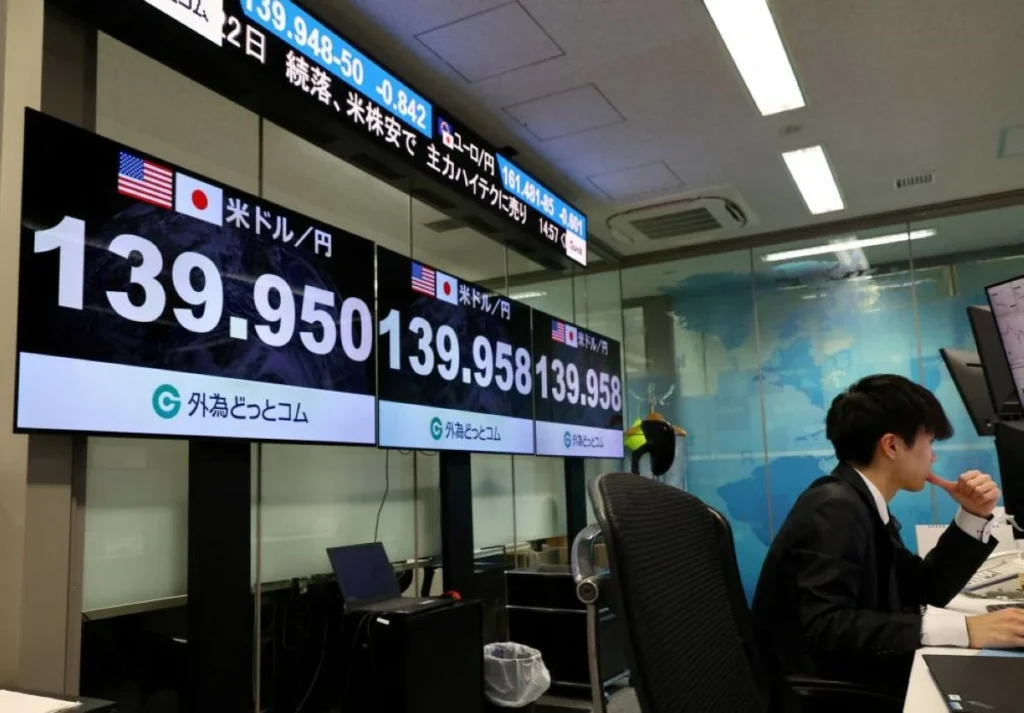
Against the yen, the U.S. dollar was up 0.1% at 158.95 yen after government data showed on Tuesday that Japan’s economy grew by an annualised 2.1% in the first quarter, compared with the median market forecast for a 1.7% gain.
The data “should help alleviate stagflation concerns”, analysts from DBS wrote in a research note. Japanese Finance Minister Satsuki Katayama told reporters on Monday that Japan stands ready to act against excessive foreign exchange volatility, while ensuring that any intervention to support the yen and sell dollars is conducted in a way that avoids pushing up U.S. Treasury yields.
Investors have been on watch for further signs of intervention to support the yen, which is a little stronger than it was before Japanese officials last month began their first foray into the market in almost two years. Tokyo may have spent nearly 10 trillion yen ($63 billion) since launching its latest round of yen-buying intervention on April 30, central bank data indicates.
The Australian dollar was down 0.5% at $0.71345 after the release of minutes from the Reserve Bank of Australia’s meeting on May 5 showed the central bank judged interest rates to be restrictive following three hikes this year, giving itself space to watch how the Iran war plays out when assessing whether growth and inflation trends will worsen.
“The minutes of the RBA’s May meeting confirmed that the Board considered the option of leaving rates on hold alongside a 25bp hike,” analysts from Capital Economics wrote in a research report.
“Looking ahead, the Board didn’t provide any clear signal as to its next move,” they said, adding “we still think the RBA will err on the side of tighter policy.”
The kiwi slipped 0.4% to $0.5854 in sympathy with the Aussie.
The euro was down 0.1% at $1.1644, while the British pound was down 0.2% at $1.3411.
Against the Chinese yuan, the U.S. dollar was up 0.1% at 6.8031 yuan in offshore trade. Bitcoin was down 0.2% at $76,734.76, while ether gained 0.6% to $2,128.65.