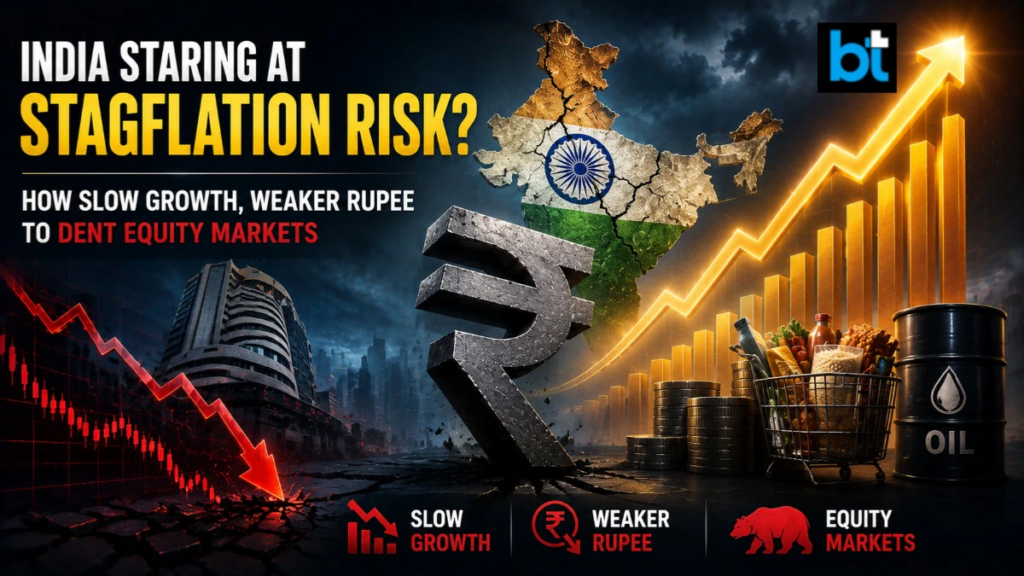
Amid the rising volatility in the Indian equity markets, led by the rising geopolitical risks, elevated crude oil prices, persistent FII outflows and weakness in the Indian rupee, concerns for the subdued economic growth are rising among the experts. The focus has shifted towards the defences like FMCG and pharma counters.
As the fuel prices are hiked for the second time in a week, fears of inflation continue to loom around the Indian economy. Speaking at the SNB-IMF Conference, RBI Governor Sanjay Malhotra said on Monday that uncertainty is the biggest reality in monetary policy at the current juncture. The RBI chief highlighted that a tight policy becomes necessary if second-round effects intensify.
With WPI inflation surging, official CPI forecasts will soon align with the more realistic 6–7 per cent range for 2HFY27. The mix of slowing growth, widening BoP stress, and sticky inflation will complicate the RBI’s job, likely forcing a sharper rupee breach beyond Rs 100 and a reversal of last year’s monetary accommodation, said Systematix Institutional Equities.
The stagflationary dynamic is now unmistakable, and its transmission is uneven across sectors, which makes the aggregate picture more, not less, concerning. Markets will face pressure from rising rates and a weaker currency, particularly in rate-sensitives like BFSI, real estate, and capital-intensive industries, it said.
Industry and manufacturing are absorbing the brunt of the supply shock: energy, logistics, and input costs are compressing margins across chemicals, packaging, textiles, consumer goods, aviation, and transport. A slowdown in the private capital expenditure revival is a real risk if cash flows remain under pressure for an extended period, Systematix noted.
To recall, India has been the worst performing emerging market in 2026 so far with Nifty50 falling nearly 10 per cent. The Indian rupee has been the worst performing Asian currency during the period with FPIs dumping Indian stocks worth over Rs 27,000 crore in the first half of May, taking the overall outflow to Rs 2.2 lakh crore on a year-to-date basis.
If the Strait of Hormuz remains closed until September 2026, energy prices spike further, supply chain bottlenecks amplify, said Elara Capital. “Tariffs along with surge in energy and food prices would keep inflation elevated and sticky. A runaway inflation is not our base case scenario this time, because the support to private demand via fiscal transfer payments akin to C Y22 is missing.”
The recent government’s actions to manage the economic fallout of the ongoing West Asia war may not be adequate to address India’s growing macroeconomic challenges, said Kotak Institutional Equities. “The continued stalemate in the West Asia war with the blockade of the Strait of Hormuz may require further measures from the government, all of which will likely impact growth.”
Kotak has increased the weight in Bharti Airtel, Cipla, Indus Towers, ONGC by up 600 bps and cut weight of Adani Ports and Larsen & Toubro by 100-320 bps. The high valuations of the Indian market and of most sectors and stocks provide for slim pickings in the Indian market, noted the brokerage firm.
Similarly, Emkay Global Equities see significant downside risk for Indian equities until the resolution of the Gulf conflict and reopening of Strait of Hormuz. However, it expects normalcy to return in the coming weeks and see any weakness as an entry opportunity, with discretionary and industrials as key overweights.
Rupee at fresh lows
The Indian rupee extended its weakness on Tuesday, hovering near it an all-time low, amid high oil prices that have been a persistent drag for several weeks. Weakness in Asian peers amid subdued risk appetite and high US yields is set to add to the pressure on the currency. The Indian rupee opened 2 paise weaker at 96.37 per US dollar on Tuesday.
Rupee breaching one level after another is more a reflection of sentiment-driven weakness than any serious deterioration in macro fundamentals. But the real risk is that, if left unchecked, this loss of confidence can turn into a self-fulfilling vicious cycle – triggering pressure on the rupee that is not warranted by underlying fundamentals, said N ArunaGiri, CEO at TrustLine Holdings.
“If one looks at India’s macro position today, the situation is far from alarming. The current account deficit remains manageable, forex reserves are reasonably comfortable with import cover of nearly eight to nine months, and the fiscal deficit trajectory continues to remain relatively stable. Given these macro metrics, there is little justification for such a sharp depreciation in the rupee,” he said.
Disclaimer: Business Today provides stock market news for informational purposes only and should not be construed as investment advice. Readers are encouraged to consult with a qualified financial advisor before making any investment decisions.