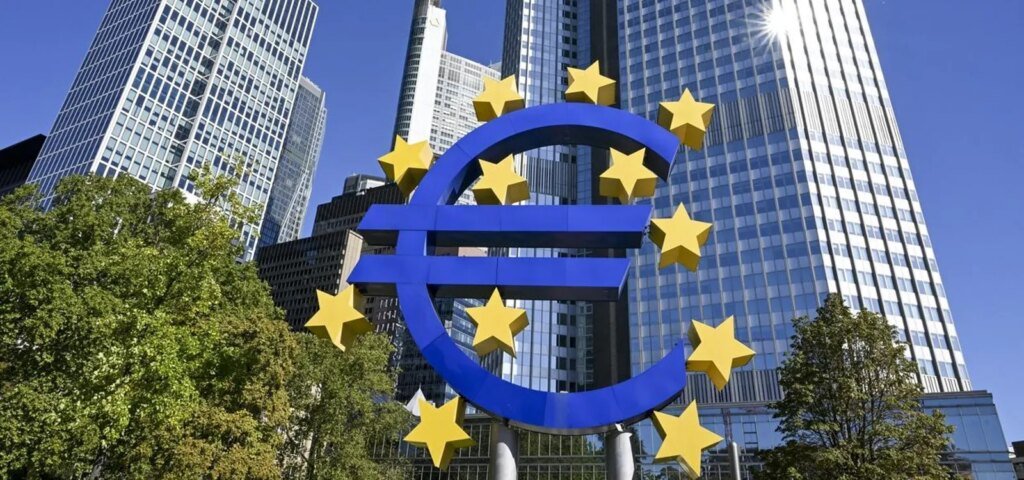

The Euro zone is making strong inroads into launching competitors to dollar-backed stablecoin leaders
Anadolu via Getty Images
Europe is quickly becoming a testing ground for the next phase of digital money, and two developments highlight how this transition is taking shape. The European Central Bank is emphasizing that a digital euro would provide the strongest privacy protections that current technology can support. Simultaneously, Revolut has begun rolling out EURR, its first euro-backed stablecoin, to eligible customers in selected European markets.
Despite the similar euro focus, these projects are fundamentally different. A digital euro would be issued by the central bank and represent public money, whereas the EURR is a privately issued stablecoin designed to maintain a value of one euro. Still, both initiatives respond to the same underlying trend in as much that consumers and businesses increasingly expect money to move instantly, operate across digital platforms, and connect with emerging blockchain applications.
The timing of these developments is also important. Dollar-backed stablecoins have dominated the stablecoin marketplace, giving U.S. assets and companies an early advantage in blockchain-based payments. Despite a slower start, Europe now appears increasingly focused on developing alternatives that reflect its own regulatory priorities, monetary sovereignty, and privacy standards.
For financial institutions, accountants, and policymakers, the key issue is no longer whether money will become more digital. The real questions concern who will issue it, how transactions will be governed, and which products will earn the trust of users.
Privacy Is Becoming A Competitive Feature
Privacy has long been one of the most significant concerns surrounding central bank digital currencies. Critics have warned that a government-issued digital currency could provide central banks with unprecedented visibility into consumer activity. The ECB is trying to address that concern directly by placing privacy at the center of the digital euro’s design.
ECB Executive Board member Piero Cipollone stated that the digital euro would provide the maximum level of privacy supported by current technology. Specifically, offline payments would reportedly be visible only to the payer and recipient. For online transactions, the Euro system and network would not be able to identify the individuals involved, although participating banks would retain access to information needed for anti-money laundering compliance. The ECB describes this as a model in which it cannot directly connect digital euro transactions to specific individuals
These specifics will matter because consumers are unlikely to adopt a digital currency simply because a central bank issues it. They will want confidence that the product is convenient, secure, and not designed as a surveillance tool. Privacy, once treated mainly as a regulatory requirement, is becoming a competitive feature in digital payments.
Private Stablecoins Are Not Waiting
While the digital euro remains under development, private companies are moving forward. Revolut has started a phased rollout of EURR to eligible users in Denmark, Poland, and Portugal, with broader availability across the European Economic Area expected in the future. The stablecoin is launching on Ethereum and is designed to maintain a stable value of one euro.
EURR is issued by Bridge Building, a Stripe company, rather than directly by Revolut. It gives users an on-chain option for moving between traditional currency, crypto assets, external wallets, and supported blockchain networks. That infrastructure illustrates how fintech companies can combine recognizable consumer platforms with blockchain infrastructure that many users would otherwise find difficult to navigate.
Revolut’s advantage is distribution and scale. Stablecoins become more useful when they are available inside applications that consumers and businesses already use. An existing customer base, familiar interface, and integrated exchange functionality can make adoption easier than asking users to begin with a separate crypto wallet. This also creates pressure on traditional banks. If fintech platforms can offer deposits, payments, crypto trading, and stablecoin transfers in one location, banks will need to explain what value their own digital payment products provide.
Europe Is Building Two Digital Money Models
The digital euro and EURR should not necessarily be viewed as direct substitutes. They represent two different layers of the developing digital financial system. A digital euro would be a central bank liability intended to function as a digital form of public money as opposed to the EURR, which is a private instrument whose value depends on its issuer, reserve arrangements, operational controls, and regulatory compliance.
Both models can serve useful purposes. A digital euro could provide a common payment option across the euro area, support offline transactions, and reduce dependence on non-European payment providers. Privately issued stablecoins can support faster innovation, interact with blockchain applications, and respond more quickly to changing customer demands. Competition between these models could encourage better products, clearer rules, and stronger privacy protections.
For accountants and financial professionals, however, greater choice also means additional work. Organizations will need policies for custody, transaction authorization, financial reporting, reserve verification, cybersecurity, and compliance. The label “digital euro” will not be enough to determine the accounting or risk treatment of an asset, as U.S. based stablecoin issuers have encountered during the sluggish progress toward greater market certainty via the CLARITY Act.
Europe’s digital money market is therefore developing along two tracks. Public institutions are building infrastructure centered on trust and monetary sovereignty, while private firms are testing products in the market today.
The model that succeeds will be the one that combines privacy, usability, regulatory clarity, and real economic value.