Most American investors keep their portfolios almost entirely in domestic stocks, and for the past 15 years that concentrated bet has generally rewarded them.
One of the most recognized investors on television just went public with a case for looking north of the border instead.
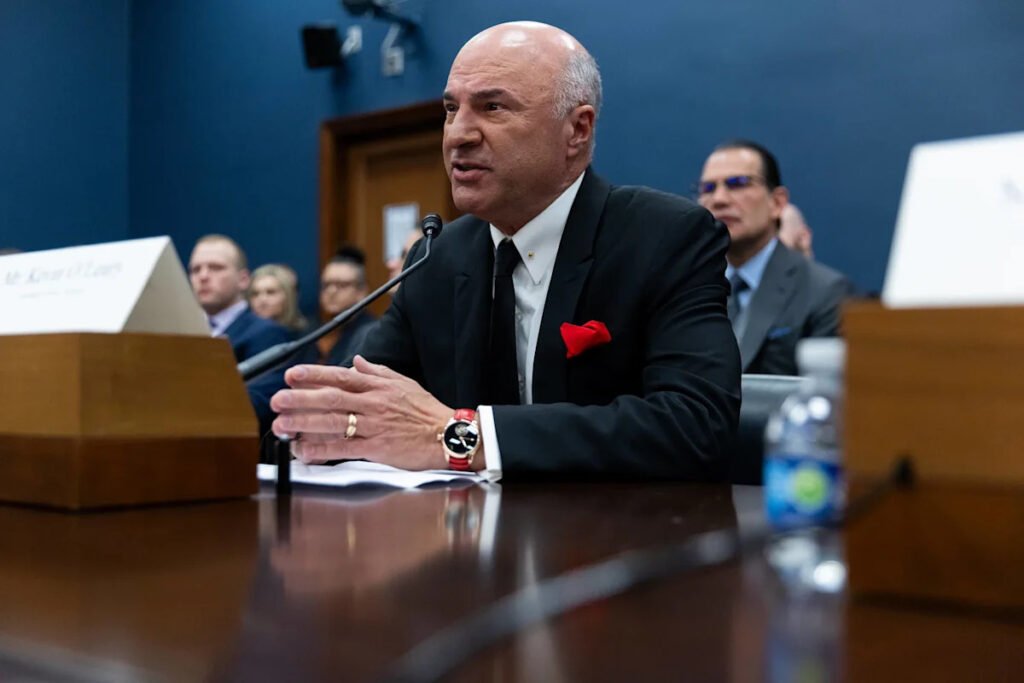
Kevin O’Leary, the Shark Tank investor and Canadian-born businessman, confirmed on X in early November 2026 that he is maintaining a 10% portfolio allocation to Canada.
He revealed the position through a single exchange-traded fund (ETF) tracking the country’s 60 largest companies, declaring the trade a “contrarian” success.
That reaffirmation matters because the United States and Canada have spent most of 2026 engaged in an escalating tariff fight over trade policy.
O’Leary’s returns, and the risks still embedded in his position, show what diversifying beyond the S&P 500 looks like in practice.
O’Leary is staying long on Canada’s largest stocks
O’Leary directed his Canadian allocation into the iShares S&P/TSX 60 Index ETF (XIU) on the Toronto Stock Exchange. BlackRock, which manages the fund, reports net assets of roughly 23.7 billion Canadian dollars as of November 2026 and charges a 0.17% expense ratio.
The fund’s predecessor launched in 1990 as the world’s first ETF, giving it one of the longest track records available to equity investors.
O’Leary, who co-founded his first business in Toronto in 1986 and built his early career in Canadian tech, said his team took “the contrarian view” by buying a 10% weighting in XIU at a moment when American investors were pulling back from Canadian exposure.
He framed the trade as a bet that Canada’s economic fundamentals would hold despite escalating political friction between Washington and Ottawa.
You wish you had made that trade. It has beat the S&P 500 by 158 basis points. I’m so happy I’m long Canada and I’m staying long,
Year-to-date, XIU has surged 16.09% while the S&P 500 has climbed 11.30%.
That local-currency spread exceeds 158 basis points, and the narrower gap O’Leary cited reflects the impact of converting Canadian-dollar returns into U.S. dollars.
How XIU’s holdings compare to the S&P 500
XIU’s returns stem from a sector mix dominated by Canadian banks and energy companies, leaving minimal overlap with the tech-heavy S&P 500.
Energy producers such as Enbridge, Canadian Natural Resources, and Suncor account for approximately 17% of the fund, while material companies, including Agnico Eagle Mines, contribute another 13% through basic materials exposure.
More Kevin O’Leary:
Banks, energy, and materials together account for about 71% of the fund, giving XIU a return profile that differs fundamentally from the S&P 500 benchmark.
That structural difference gives XIU a return profile tied to commodity prices and interest rate cycles, forces that drive Canadian financials and energy producers more directly than the tech-heavy S&P 500.
The fund also pays a quarterly dividend yielding approximately 2.1%, an income stream that most S&P 500-heavy portfolios do not generate at current prices.
XIU’s heavy exposure to Canadian banks, energy, and materials sets it apart from the tech-driven S&P 500 and offers distinct dividend income.Javier Zayas Photography / Getty Images
How the U.S.-Canada trade war shapes the risk behind O’Leary’s bet
O’Leary reaffirmed his Canadian position at a moment when the trade relationship between Washington and Ottawa has deteriorated to its lowest point in decades.
Bilateral trade talks collapsed on August 21, 2026, and President Trump responded by threatening 50% tariffs on Canadian vehicles and steel, AP News reported.
Prime Minister Mark Carney accused Washington of trying to destroy major Canadian industries, and Canada imposed retaliatory tariffs on hundreds of American products at rates reaching 50%, effective September 8, Canada’s Department of Finance confirmed.
Despite that severe escalation, Canadian equities are still up for the year, a sign the market expects the two governments to eventually reach a resolution.
O’Leary said he planned to stay invested “regardless of how long” the dispute between Trump and Carney continued, Yahoo Finance reported.
His thesis frames the tariffs as temporary friction between two deeply connected economies, a bet that holds only if formal trade negotiations eventually restart.
How Fidelity, Vanguard, and the SEC frame international stock allocation
For American investors considering O’Leary’s approach, buying foreign stocks introduces another consideration that headline returns may overlook: currency risk.
The U.S. Securities and Exchange Commission (SEC) warns that exchange rate movements can increase or reduce returns from international investments, making currency fluctuations an important part of the decision-making process.
Scott McAdam, an Institutional Portfolio Manager at Fidelity’s Strategic Advisers, suggests a 70% domestic and 30% international split within the stock portion of a portfolio.
Vanguard takes a similar approach, recommending that at least 20% of an investor’s stock allocation sit in international equities, with about 40% needed to capture the full diversification benefits.
Against those benchmarks, O’Leary’s Canadian exposure falls below broader institutional targets, suggesting he views it as a targeted investment rather than a complete international strategy.
That distinction matters because Canadian stocks also carry sector concentration risks. Financial companies and energy businesses account for significant portions of XIU, meaning their earnings cycles can heavily influence the fund’s performance, as BlackRock’s documentation shows.
The SEC therefore advises investors to consider currency movements, political conditions, and transaction costs before committing money to foreign markets.