


UN News: How much freedom do the workers have?
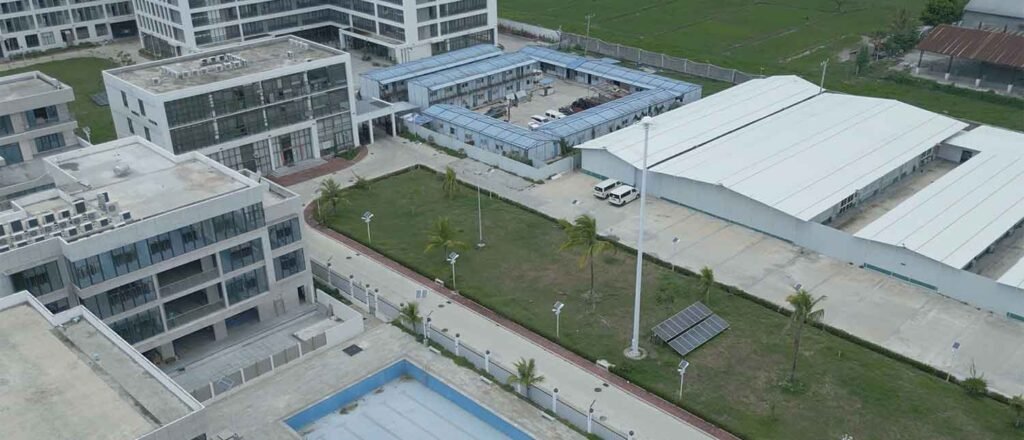
The people who work here are basically fenced off from the outside world. All their daily necessities are met. There are restaurants, dormitories, barbershops and even a karaoke bar. So, people don’t actually have to leave and can stay here for months.
However, even if they wanted to leave, they could not, as we’ve heard from people who were rescued from these centres. Some have been tortured and been subjected to unimaginable violence on a daily basis as punishment for wanting to leave or for failing to reach their daily quota in terms of money scammed from victims. There’s a huge amount of human suffering on this compound.
There are multiple types of victims, the people who are being scammed around the world, but also the people who are trafficked here held against their will and who are exposed to violence.
UN News: Who is behind these massive operations?
Southeast Asia is the ground zero for the global scamming industry. Transnational organised criminal groups that are based in this region are masterminding these operations and profiting most from them.
They work with different actors, with people who control territory, for example, in the Mekong border areas of Myanmar, or they might work with local power structures.
UN News: What range of crimes are being committed here?
Many of the more established scam farms in the Mekong region, which borders Thailand, Laos and Myanmar, started out as casinos tied into the regional money laundering of the proceeds from drug trafficking and other criminal activity.
But there has been a significant evolution, especially during the COVID-19 pandemic, in which casinos have changed their business model and moved into the online space, especially scamming and cyberfraud.
They are essentially turning into criminal service providers by selling cybercrime, scamming and money laundering services, but also data harvesting and disinformation.
Technology, like generative artificial intelligence (AI), is evolving so quickly, and that will really change the way these places operate by creating new opportunities for the scammers to make money.
UN News: How concerned should we be about what’s happening now and what could happen in the future?
These scam farms are places of innovation in a way because they’re far ahead of other parts of the economy, and that really doesn’t bode well for the future.
AI expands the scope and the scale at which a scam farm can operate. You’re not going to need a thousand people to run scams on a text-based cell phone; you just need a well programmed application to do it for you.
That’s where the real threat for the future lies. It’s a great concern for us from the UNODC as it has potentially serious implications for people around the world.
UN News: How are countries responding?
There is a growing gap between the speed these technologies are developing and being adopted by organised crime networks and the responses that governments in the region have at their disposal to address these issues. It is a regional problem with global implications. These scam operations are still predominantly based in this region, however, we do see some small operations in places like South America and Africa.
This is an extremely complex issue. It is not possible for one country by itself to address it, not least because these operations, even if you address them in one place, will just move to another country where there is less enforcement pressure on them.
So, what is needed is a regional response, and UNODC can support that effort. We can bring countries together and help them to agree on priorities and strategies to fight organised crime.
UN News: How much political will is there to do that?
At the moment, we see a strong push in the region to cooperate on addressing this issue. The Philippines, as well as countries in the Mekong region and China, are working together, conducting joint operations, discussing priorities and exchanging information at a scale that in the past was not the case. That is very positive.
At the same time, we continue to see a law enforcement-focused response to these issues rather than a more strategic whole-of-government response. The more countries work together, share expertise and information, and the more countries in the region also receive support from countries elsewhere in the world and organizations like UNODC, the better they can be prepared to address this issue.
Getting ahead of this issue will be incredibly difficult. We have no illusions that it will take a very long time, time that we don’t have with this technological change.