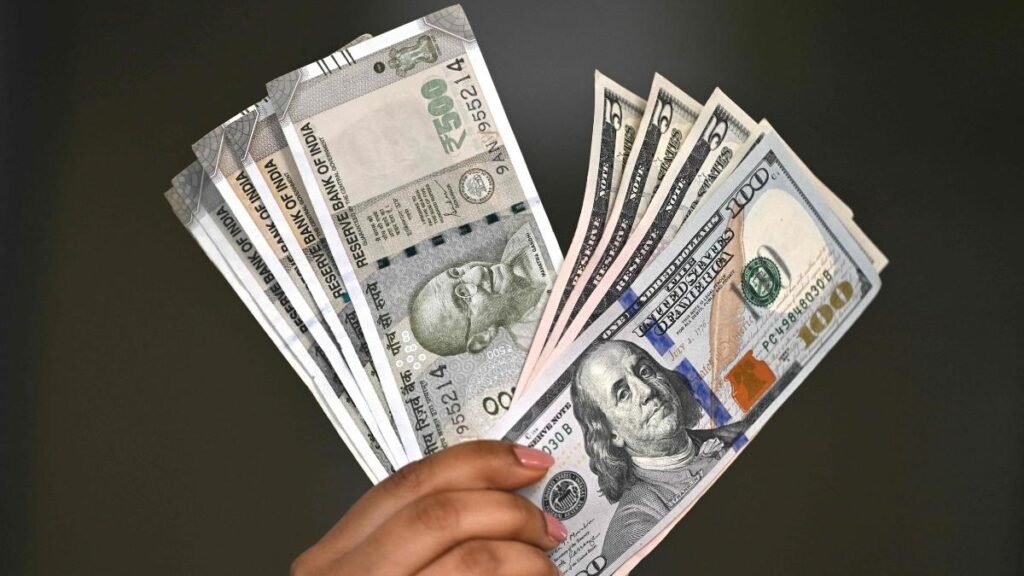
India’s falling rupee is not an illusion. Nor is it some harmless technical fluctuation to be explained away by the same regime that once treated every decline in the currency as proof of national ruin. There was a time when Narendra Modi and Nirmala Sitharaman sermonised endlessly about the rupee. Back then, when the dollar was in the low sixties and crude was nowhere near the levels India has had to confront in recent weeks, the BJP built an entire political theatre around the currency’s weakness. The rupee, we were told, reflected the nation’s dignity! A falling rupee was not merely an economic event. It was a moral indictment of the government in office. That sanctimony has now aged pretty badly.
Also Read: Middle East War: When brinkmanship becomes policy
In late March 2026, the rupee sank past 94 to the dollar and then past 95 in offshore trading before the Reserve Bank of India scrambled to curb speculative positions. Reuters reported that the rupee lost 4.24 per cent in March alone, its worst monthly fall in six years.
The RBI has since tightened derivatives rules and moved to shut down channels through which speculative and arbitrage pressure had intensified the slide. These are not the actions of an economy serenely in command of its external position. These are emergency measures taken when pressure is already visible, and confidence has begun to fray.
Of course, a falling currency does not by itself prove that an economy is collapsing. Exchange rates move for many reasons. Oil prices matter, the strength of the dollar matters, capital flows matter, and interest differentials matter. But then, that is precisely the point. India is not a detached observer of these pressures but is deeply exposed to them. She still depends on imports for roughly 85 to 90 per cent of its crude needs. When oil surges, India pays more in dollars, the import bill swells, inflation risks rise, foreign investors get nervous, and the rupee comes under strain. This is not abstract macroeconomics; it is a structural vulnerability.
The political obscenity lies elsewhere. For years, the Union government milked fuel taxes with extraordinary greed. Official data from the Petroleum Planning and Analysis Cell show that central taxes and duties on crude oil and petroleum products yielded enormous sums year after year. Excise duty alone jumped dramatically after 2014 and remained an enormous source of extraction.
Also Read: India at the edge of the Strait
The subtotal for central taxes and duties on crude and petroleum products from 2014-2015 through 2024-2025 exceeds a staggering 34 lakh crore rupees, and the excise duty component by itself accounts for a massive share of that haul. Even if one uses narrower public formulations, the broad point remains the same. To put it plainly, the Centre has treated fuel as a fiscal sponge, squeezing households relentlessly.
Now comes the familiar electoral ritual. Oil spikes, the rupee weakens, and elections loom. Suddenly, the government discovers compassion and announces a cut in the special additional excise duty. The March 27 cut was also intended to cushion state-run oil companies that were incurring losses because retail prices had not fully reflected the surge in crude prices. In other words, this was not some benevolent deliverance for the common citizen, but a tactical adjustment under pressure.
In some cities, consumers saw little relief because changes elsewhere in the price structure blunted the effect. The same government that spent years fattening its revenues on fuel now wants applause for trimming one corner of the burden when global turmoil leaves it with little room to manoeuvre.
The defenders of the regime will say that the present rupee fall has been triggered by the Iran war, high crude prices and capital outflows, and on that narrow point, they are not wrong. Many foreign investors dumped Indian equities and bonds at a record pace after the oil shock, with over 12 billion dollars fleeing equities in March. But that defence only carries the argument halfway.
Also Read: Israel–US war on Iran leaves India a silent spectator
External shocks expose internal weaknesses, but do not create them from nothing. A resilient economy absorbs stress better, while a fragile one buckles faster. When a country is this vulnerable to imported energy, this dependent on foreign capital sentiment, and this compelled to let the central bank tighten market rules in haste, the currency is telling you something very important.
It is telling you that the claims of strength have outrun the foundations of strength. That is where the credibility question becomes unavoidable. The argument is no longer merely that the government spins. All governments spin. The problem is that India’s headline growth story itself has been under sustained challenge from serious economists.
While Arvind Subramanian’s earlier intervention on GDP overestimation was already uncomfortable for the establishment, the newer 2026 paper by Abhishek Anand, Josh Felman and Arvind Subramanian goes further. It argues that growth between 2012 and 2023 may have been overestimated by roughly 1.5 to 2 percentage points on average, and that the economy may have actually grown closer to 4 to 4.5 per cent rather than the reported 6 per cent over that period.
Whether one accepts every element of that argument or not, it would be absurd to dismiss it as crankery. These are not social media grumblers. They are serious economists engaging directly with the machinery of measurement. Again, that is why the IMF giving India’s national accounts data (including GDP) a second-lowest ‘C’ rating (due to methodological shortcomings) matters. Not because the IMF is infallible, nor because one letter grade settles the question forever. It matters because it punctures the official fantasy that all doubts about India’s GDP data are malicious inventions.
The IMF explicitly said that the old national accounts framework had methodological weaknesses serious enough to hamper surveillance. It flagged the outdated base year, weak deflators, discrepancies between approaches, and poor capture of the informal sector. For a government that has built its legitimacy on the spectacle of unstoppable growth, this is not a minor embarrassment. It is a warning that the numbers themselves have not enjoyed unquestioned credibility.
So yes, the rupee’s fall reflects a sad state of the Indian economy. Not in the childish sense that one exchange rate alone summarises a nation. But in a much deeper sense, the fall reveals exposure, hollowness and accumulated bad faith. A government that once equated a weak rupee with national humiliation now pleads for nuance.
A regime that harvested lakhs of crores from fuel is now chest-thumping over modest duty cuts and staging it as statesmanship. And an administration that boasts of growth without end now carries the burden of doubts raised by economists and, in part, validated by the IMF’s own assessment of the old GDP framework. The rupee is not the whole story, but it is certainly part of it. And right now, it is speaking more honestly than the government.
The author is a National Award winner for Best Narration and an independent political analyst. Views expressed are personal.