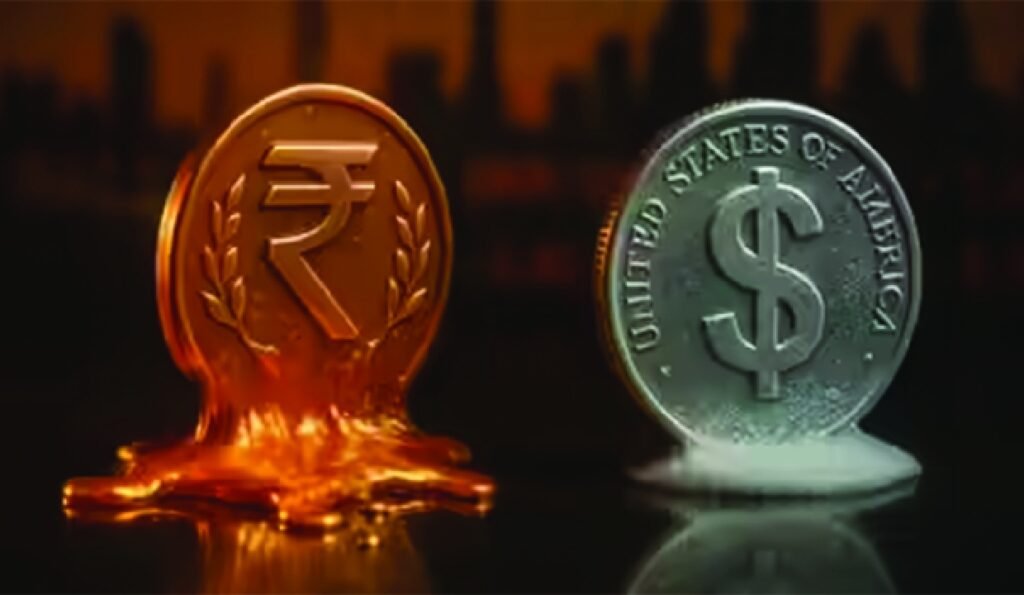
Indian rupee is trading above 95 a dollar, having depreciated over 7 per cent in 2026 alone. Since 2025, it has been the worst-performing currency in Asia, even Pakistani rupee has performed better despite the economic turmoil in that country.
The rupee had touched an all-time low of 96.84 against the dollar on May 20, and the ominous 100-mark now looms within sight. There are several factors that affects the like G-Sec yield spread between India and US and the inflation differential, which in fact are narrowing because of India’s strong macroeconomic performance. The current fragility of the rupee is largely due to India’s extensive energy dependence and the disruption of the Iran War.
India imports almost 90 per cent of its crude, roughly half of which transits through the Hormuz Strait.
Every $1 increase in crude prices adds approximately Rs 15,000–16,000 crore to India’s annual import bill, and at our current import of 5 million barrels a day, a rise of US $10 in crude prices widens the current account deficit (CAD) by 0.4-0.5 per cent of GDP.
The rupee has been falling since mid-2025, and since the War broke out in February, crude prices have climbed from US $69 per barrel to well above US $100 for much of the period, touchinga peak of almost US $120 earlier, and now trading at around US $90. For a country heavily dependent on imported crude, the oil shock now compounds currency weakness, raising risks to trade deficit, inflation, and overall growth.
That the Rupee’s fall has not yet unsettled fiscal deficit or headline inflation is because we have several strong macroeconomic cushions now, unlike in 1991. In FY 2026, the merchandise trade deficit was US $333 billion (8 per cent of GDP), of which roughly a third was due to oil, over a quarter due to electronics and around a fifth due to gold. The huge deficit was substantially offset by the surplus in services trade of US $214 billion, leaving the overall trade deficit at around US$119 billion or, 0.6 per cent of GDP. Inward remittances also provide a cushion, and despite high trade deficit, our balance of payments (BoP)—the difference between inflows and outflows—was a surplus of $14 billion in FY2025, which has turned into a deficit of $23.6 billion in FY26, exposing the rupee to further stress.
The CAD is estimated to be around 1.7 per cent of GDP in current fiscal because of soaring energy prices, while the trade deficit may triple, affecting growth, estimates of which has already been curtailed by 0.2-0.4 per cent to around 6.6 per cent.
This is unlikely to improve even if the war is to end soon, because the Hormuz closure has cut 10 per cent of global oil production and 20 per cent of global natural gas production.
The Crude oil and gas prices are up by over 50 per cent, and fertiliser by over 65 per cent. Given the massive supply disruption and damages caused to refineries and infrastructure in the gulf, it will take many months to restore the pre-war equilibrium.
Volatility of the rupee is also causing tumult in the stock market. As global capital shifts to AI and semiconductor—heavy markets such as Taiwan, South Korea and the US, areas where India remains a laggard, FPIs have withdrawn over $30 billion in 2026, exceeding the entire outflow during 2025. Unlike FPI capital, FDIs areas relatively insulated from short-term geopolitical shocks, but even here, the highly overvalued India’s stock market has provided attractive exit valuations, and FDIs are repatriating substantial gains following the strong stock market rally. In the first nine months of 2025-26, the net FDI inflow was only US $3 billion, against total FDI of US $74 billion.
Though it is a sign of India becoming a mature investment destination that should witness both inflows and exits, it is again putting stress on the rupee.
RBI has used the $33 billion of our forex reserves to stabilise the rupee since February without much success, and to stem the deluge of outflowing dollars, both the Government and the RBI have recently announced a slew of measures.
RBI has put curbs on speculative dollar positions, and liberalised the Fully Accessible Route (FAR) for foreign investors in Government securities, making all new 15-year, 30-year and 40-year Government securities freely accessible to foreign investors, to attract FPIs into Indian Government debt.
It has increased investment limits for NRIs and OCIs and simplified their direct participation in Indian equity markets.
It offered concessional forex swaps for overseas borrowings, and announced a Special FCNR(B) deposit scheme to absorb the full hedging cost for banks in raising such deposits, replicating the successful 2013 “Raghuram Rajan scheme” that attracted large dollar inflows during the taper tantrum. The current scheme is estimated to mobilize $35-40 billion from non-residents.
On its part, the Government has increased the effective import duty on gold from 6 per cent to 15 per cent, capped imports at 100 kg per licence, and moved the import gold, silver and platinum jewellery from “free” to “restricted”, requiring Government approval/ licences for their import, following the PM’s appeal to citizens to avoid buying gold for a year. It removed capital gains tax on eligible FAR Government securities held by foreign investors, while exempting interest income on such securities from tax.
Will these measures deliver? Credit rating agency ICRA estimates that they will yield a surplus BoPof $5-10 billion. The rupee briefly cheered, gaining 84 paise and recovering tosub-95 level, before paring the gains.
The textbook response to currency pressure is to tighten: raise rates, attract capital, defend the exchange rate — a route taken by other oil-importing peers—Indonesia, the Philippines and Sri Lanka, which tightened credit and weakened consumption.
The RBI has chosen a different route to manage the currency through the external sector, without disrupting the domestic situation, banking upon India’s strengths of stable and resilient macroeconomy, well-capitalised banks, and healthier corporate balance-sheets. It might work.
The writer is Former Director General, CAG of India; Views presented are personal.