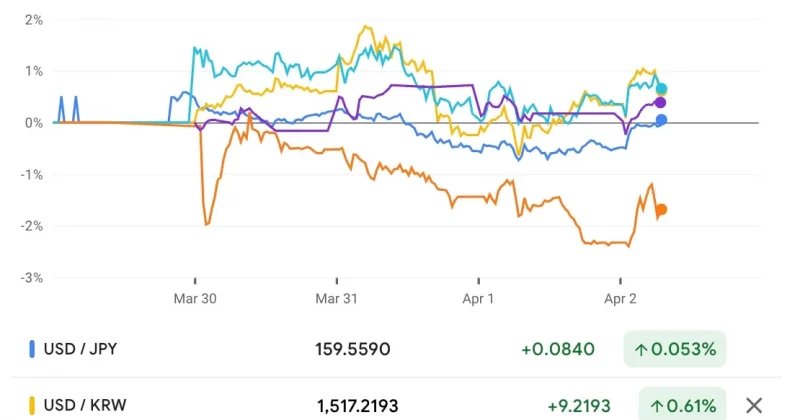
Several major Asian currencies, including the Indian rupee, Indonesian rupiah, Thai baht, and Philippine peso, have slid to multi-year lows against the dollar. The catalyst is a one-two punch of rising crude prices and climbing US Treasury yields, both of which are pulling capital back toward dollar-denominated assets and away from emerging markets.
Oil is the accelerant
Brent crude has pushed above $100 per barrel, driven in part by escalating US-Iran tensions. For net oil-importing economies across Asia, that price level is more than an inconvenience. It’s a direct hit to trade balances, inflation forecasts, and central bank planning.
The rupiah has been one of the more dramatic casualties. Indonesia’s currency weakened past the IDR 17,600 per USD mark, touching an intraday low of 17,612. A weaker rupiah makes imported goods more expensive, feeding directly into consumer price inflation in Southeast Asia’s largest economy.
Bank Indonesia has responded by intervening in both spot and derivative foreign exchange markets to stabilize the currency.
India’s rupee and Thailand’s baht are facing similar headwinds, both grappling with record or near-record lows against the greenback.
The yield gap compounds the problem
Rising US Treasury yields are making the situation worse. When yields on US government debt climb, the interest rate differential between dollar assets and local Asian bonds narrows, or in some cases flips entirely. That gives global fund managers less reason to hold rupiah- or rupee-denominated debt and more reason to park money in Treasuries.
Selling pressure in regional stock markets reflects the broader reassessment of what growth looks like when energy costs are elevated and financial conditions are tightening.
What this means for investors
The current dynamic is a stress test for Asian emerging market positioning. Investors with exposure to local currency bonds or equities in import-heavy Asian economies are facing a double headwind: currency depreciation erodes returns in dollar terms, while the underlying assets themselves are under pressure from tighter conditions and higher input costs.
If Brent crude stays above $100 per barrel for an extended period, the pressure on Asian currencies is unlikely to ease meaningfully. Central bank interventions, like Bank Indonesia’s current efforts in spot and derivative markets, can smooth volatility but cannot sustainably counteract a fundamental shift in terms of trade.