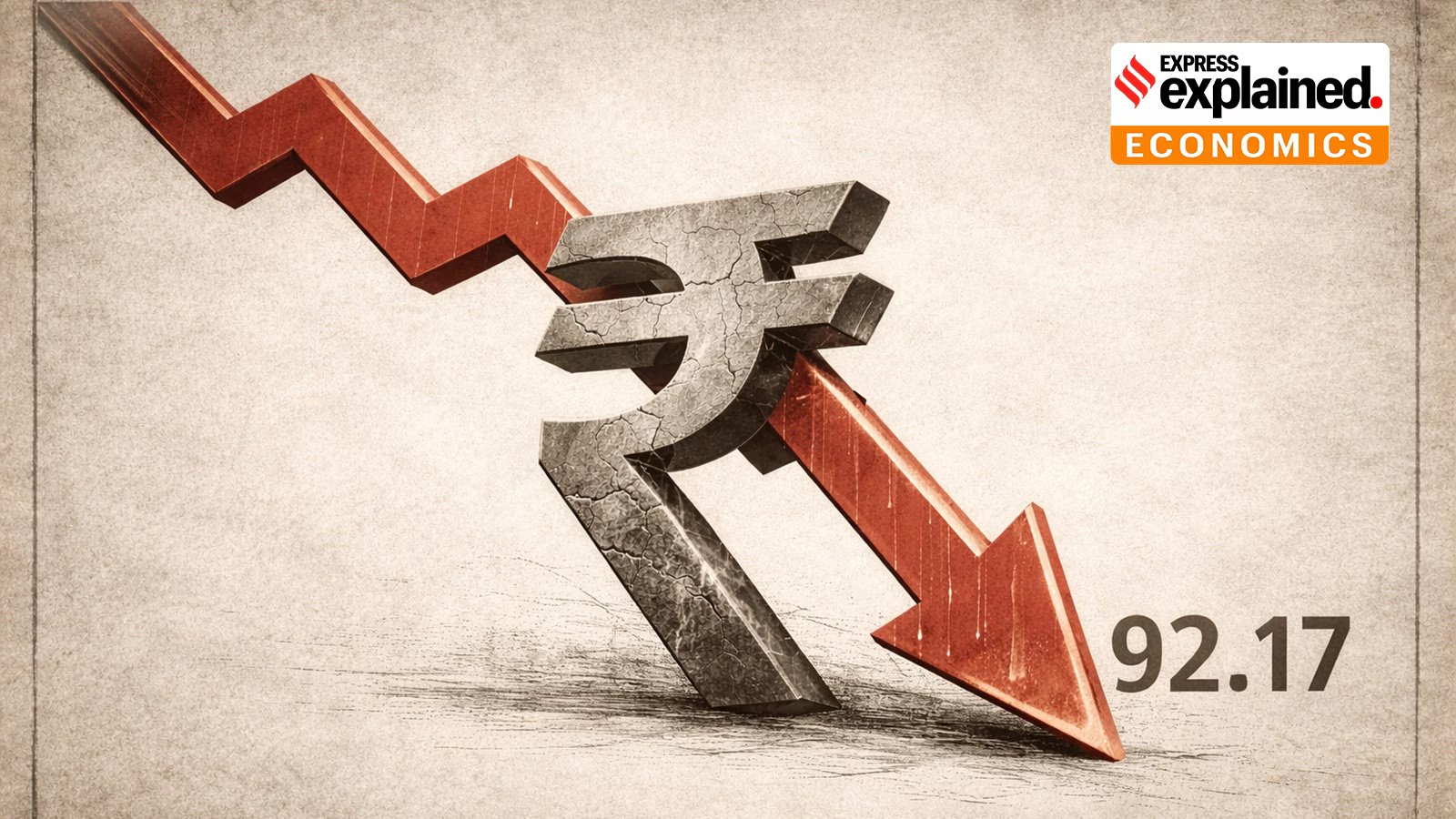


India could face the challenge of managing rupee strength rather than weakness in FY28, as an improvement in global energy prices and a possible reversal in capital flows from AI investments in developed markets could strengthen the country’s growth and investment outlook, Chief Economic Adviser V Anantha Nageswaran said on November 18.
“Our problem next year may be one of managing rupee strength rather than rupee weakness in FY28,” Nageswaran said while delivering the keynote address at the industry body FICCI’s annual general meeting in New Delhi.
The rupee has recovered from its record low of 96.96 against the US dollar, hit in May 2026, but remains weaker than its level at the beginning of the year. It closed at 93.44 against the dollar on November 18, down around 4% since the beginning of January. The currency has gained around 3.6% from its record low, supported by a recent recovery in foreign portfolio inflows and softer crude oil prices.
He said FY28 could turn out to be a fairly good year for India in terms of economic growth and capital flows, provided global oil price forecasts and developments in AI valuations move in the country’s favour.
Lower oil prices could boost growth
The CEA said several agencies expect Brent crude prices to fall below $80 a barrel next year, which could provide a significant windfall for India.
“Next year, if consensus forecasts are right, at the moment we don’t make a forecast for crude oil, but there are many other agencies and everybody anticipates a price of about below $80 for Brent crude,” he said.
“If that happens to be the case, then India will have a huge windfall in terms of lower energy prices next year, which will naturally spill over into lower input costs, lower inflation, and higher growth as well,” he added.
He said India had managed supplies of crude oil, natural gas and fertilisers despite higher energy prices this year.
Nageswaran said the country would have to balance three priorities in its energy strategy: energy cost, energy security and energy transition.
“This is the triangle we need to manage: energy cost, energy security, and energy transition,” he said.
AI valuation correction could redirect capital
The CEA said a possible cooling of AI valuations in developed markets could reverse some of the capital flows that have moved towards AI-related investments in the US and Northeast Asia.
“With the AI bubble in the developed world sort of slowly letting air, I think the kind of capital being sucked in by the AI-related investments, whether it is in Northeast Asia or in the United States, that will now actually flow in the reverse direction,” he said.
Nageswaran pointed to the improvement in foreign portfolio flows into India in July and August, when concerns about AI safety first emerged.
Net foreign institutional investor flows stood at around $10 billion in November up to the previous day, he added.
Indian equities perform better following overnight weakness in US technology stocks.
Nvidia, whose chips power much of the global artificial intelligence (AI) infrastructure build-out, has become a key barometer of investor sentiment towards the AI boom. Its shares fell more than 30% from their October record high amid concerns that spending on AI data centres could slow, raising questions about whether the scale of investment in the sector can be sustained. The correction also weighed on other AI-linked stock.
India has a play in AI applications
Despite India’s relatively limited presence in frontier AI models, the country has opportunities in the application of the technology, Nageswaran said.
“It’s not that India has no play in the AI space, by the way,” he said, adding that India could have many more applications to showcase over the next 12 months.
He also stressed the importance of developing skills that are less vulnerable to automation.
“AI-insulated trade skills and human-centric services will be the key,” he said.
Exports could approach $1 trillion
The CEA said India’s exports stood at $560 billion in the first seven months of FY27 and could approach $1 trillion for the full financial year.
“Those of us who are not that mathematically challenged, we can easily extrapolate this to a 12-month number and say that we will be close to achieving a trillion dollars this year,” he said.
He said exports would account for close to 25% of an economy expected to be worth around $4.2-4.3 trillion by March 2027.
Excluding petroleum products and gems and jewellery, export growth stood at 18% in the first seven months, he added.
He also stressed the need for India to strengthen its position against global supply disruptions.
“India has to build resilience and leverage,” he said, identifying food processing, labour-intensive services and manufacturing trade skills as potential sources of leverage.