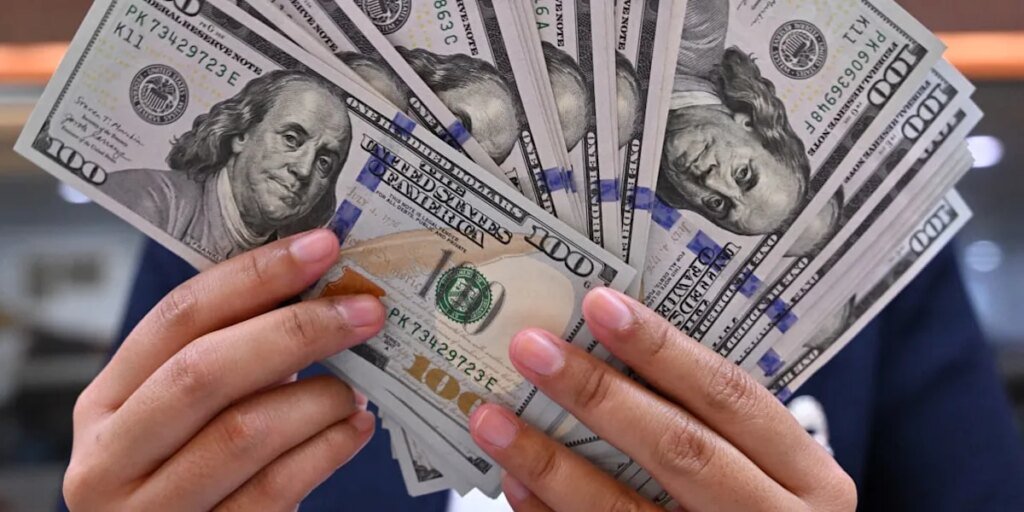
Morgan Stanley expects more bang for the buck. – adek berry/Agence France-Presse/Getty Images
Surging Treasury yields have not only been in sharp focus for equity investors of late; they’ve also made their impact on the foreign exchange market, helping push up the U.S. dollar.
The dollar index DXY, which measures the greenback against a basket of currencies, hit an eight-week high around 101.40 this week.
Most Read from MarketWatch
The stronger buck may be good news for Americans looking to travel abroad, but it can be a drag on U.S. companies whose products become more expensive for foreign buyers. Indeed, just this week President Donald Trump raised the issue of the yen’s weakness against the dollar with Japanese Prime Minister Sanae Takaichi.
The dollar’s rally has also caught many on Wall Street off-guard. “We were wrong,” said a team of Morgan Stanley currency strategists led by David S. Adams.
In a note published Friday, they admitted their rationale for forecasting a weaker dollar has come unstuck. They expected the dollar’s descent to continue into the second half of the year before bottoming near the end of the year, then turning higher in 2027.
“This was premised on a convergence in U.S. rates with those abroad as the Fed remained on hold and other central banks caught up,” said the Morgan Stanley team.
This dollar weakness would also cheapen foreign-exchange hedging costs, they believed, allowing foreign investors concerned about the U.S. dollar’s long-run status to bolster their foreign-exchange hedges, which in turn would amplify the buck’s weakness.
Under this scenario, Morgan Stanley predicted that the dollar index would end this year at 96. The dollar would weaken to 1.20 per euro EURUSD, slip to 1.38 per British pound GBPUSD, and the Japanese yen would be 157 per buck USDJPY.
They’ve now had to shift those targets to reflect dollar strength, to DXY 102, EUR 1.12, GBP 1.30, and JPY 159. And the reason the U.S. currency has been rallying should be clear to most market watchers — an unexpected jump in the chances of higher interest rates in the U.S., which can make the dollar more attractive.
“Elevated energy prices, robust U.S. [economic] data, and a hawkish Federal Open Market Committee reaction function has generated not just a rate hike but likely further hikes to come,” said Morgan Stanley.
Currently, interest-rate-futures traders are pricing in a 68.6% chance the Fed will raise borrowing costs by 25 basis points, to a range of 4.00% to 4.25%, at its October meeting, according to CME FedWatch. Another such hike in December is priced at 54.8%.
“The market has ample capacity to price hikes well beyond what economic fundamentals would justify for a modal expectation, which only further bolsters the greenback,” said Morgan Stanley.
Looking into mid 2027, they see the DXY at 104 as the EUR drops to 1.10 amid revived fiscal and political concerns in Europe. The bank suggested maintaining a long position on the USD/JPY at 158, a bet on dollar strength versus the yen, with a target of 163 and a stop at 150.
–
However, Morgan Stanley had some caveats for its dollar-strength call.
The buck’s gains will mostly come from lower-yielding currencies that will continue to be used to fund carry trades — the strategy by which investors borrow in those currencies to seek higher returns elsewhere — such as the yen, euro and Swiss franc. They also think the pound will be weak, but so-called commodity currencies, like the Australian dollar AUDUSD and Norwegian krone USDNOK, will be strong.
Morgan Stanley also accepted that the moves they are outlining are not particularly large. “Take our forecast of EUR/USD to 1.10 in mid-2027, for example. At the time of writing, the market-implied probability of EUR/USD reaching 1.10 by mid-2027 is about 35%, suggesting it’s a pretty foreseeable event for investors,” they say.
Finally, Morgan Stanley recognized the dollar can be hit badly by shocks such as Trump’s “liberation day” tariff announcement and yen intervention.
“We’re worried that [U.S. dollar] longs may be ‘stopped out’ [forced to close a position] by an unexpected shock down the line, even if the fundamental case for USD strength is greater and the most likely outcome is a stronger USD over time,” they said.
The markets
U.S. stock-indices SPX DJIA COMP are higher at the opening bell on Wall Street as Treasury yields BX:TMUBMUSD10Y dip. The dollar index DXY is lower, as oil futures CL.1 slip and gold futures GC00 trade around $4,329 an ounce.
Key asset performance
Last
5d
1m
YTD
1y
S&P 500
7704.13
0.87%
-0.35%
12.54%
16.65%
Nasdaq Composite
26,939.37
1.97%
1.50%
15.91%
20.35%
10-year Treasury
5.171
17.40
45.40
99.90
99.50
Gold
4328.9
-1.97%
-3.89%
-0.08%
14.23%
Oil
92.68
-2.92%
11.07%
61.44%
42.17%
Data: MarketWatch. Treasury yields change expressed in basis points
Iran has offered the U.S. a new “7-day” proposal to reopen the Strait of Hormuz and to restart broader talks towards a final resolution to the war, according to the Financial Times.
U.S. durable-goods orders for August were flat month-on-month, but better than economists’ forecasts of a 0.3% contraction. The University of Michigan final consumer survey for September is published at 10 a.m.
Cleveland Fed President Beth Hammack speaks at 2 p.m.
A chart of 2-year Treasury yields BX:TMUBMUSD02Y from 2022 to the present “shows why 5% for this maturity is very likely the equity market’s proverbial ‘line in the sand,'” according to Nicholas Colas, co-founder of DataTrek Research. If the 2-year yield breaches that level, equities will discount incremental recession risk since this scenario suggests that Fed policy rates will be higher than at any point in recent memory, according to Colas. Investors may remember that the dot-com bubble started to burst in the first half of 2000 when the Fed took rates to new cycle highs. “This started the process of compressing equity valuations, and the same is certainly possible now,” Colas added.
Top tickers
Here were the most active stock-market tickers on MarketWatch as of 6 a.m. Eastern.