Brics backs local-currency trade and cross-border payment links, but stops short of a common currency to challenge the dollar
Brics has answered the dollar question without proposing a dollar replacement. The grouping has backed greater use of local currencies and work on linking cross-border payment systems, while stressing that there will be “no one-size-fits-all approach” to how its members reduce reliance on the US dollar.
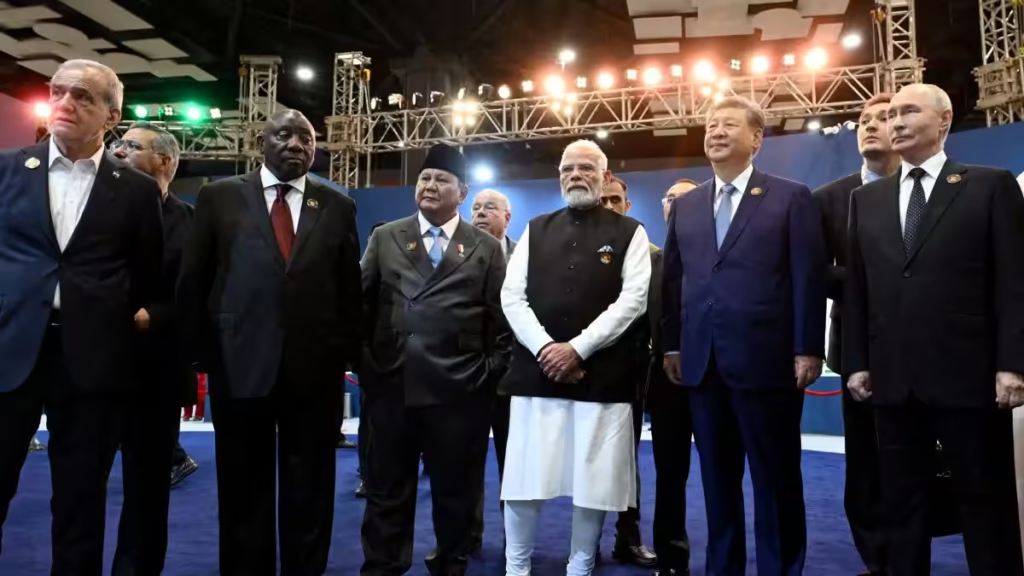
The New Delhi Declaration 2026, adopted at the Brics summit in New Delhi, stops short of endorsing a common Brics currency or a single alternative to the dollar. Instead, it backs greater use of local currencies for trade and investment among the grouping’s 11 members.
The declaration says discussions are underway on using local currencies for trade settlements and investments. It also calls for continued work on cross-border payment solutions that are, “fast, low-cost, accessible, efficient, transparent and safe”.
That makes payment connectivity, rather than a new currency, one of the most important economic outcomes of the summit.
What Brics is actually proposing
According to the declaration, the Brics Payment Task Force has been studying ways to make the payment and messaging systems of member countries work better with one another. The task force has been asked to continue work on practical cross-border payment arrangements and the interoperability of national payment systems. The declaration also says technical work will continue on settlement and depositary infrastructure.
 More from Business
In simple terms, the objective is to make it easier for a company in one Brics country to pay a supplier in another without every transaction having to rely on the same dollar-based payment route.
India has been pushing a similar approach. New Delhi has advocated greater use of local currencies in bilateral trade and has also backed discussions on linking central bank digital currencies, or CBDCs, among Brics members for cross-border payments.
Why there is no common Brics currency
A common Brics currency would be far more complicated.
The 11 member economies have different inflation rates, interest-rate regimes, capital controls, monetary policies and levels of currency convertibility. Their financial markets also differ significantly in size and liquidity.
The US dollar, meanwhile, remains deeply embedded in global trade and finance.
The Bank for International Settlements said the dollar was on one side of 89.2 per cent of all foreign-exchange transactions in April 2025. The Chinese renminbi accounted for 8.5 per cent.
The dollar also represented 57.13 per cent of global foreign-exchange reserves in the first quarter of 2026, according to the IMF.
These figures explain why reducing dependence on the dollar is different from replacing it.
For Brics, the more realistic route is diversification — creating more options for trade, payments and financing while the dollar continues to play a major role in the global financial system.
India’s position
India has generally favoured greater use of local currencies in bilateral trade rather than a bloc-wide currency arrangement.
A common Brics currency would require members to agree on a much deeper monetary framework. Bilateral or country-specific arrangements allow individual members to decide how far they want to use their national currencies.
For India, this could create greater scope for the rupee in trade and investment without requiring New Delhi to support a single Brics currency.
India has also built a large domestic digital payments ecosystem through UPI, creating experience that could support cross-border payment links. But connecting national payment systems involves much more than technology.
Regulators would need to address issues including anti-money-laundering checks, sanctions compliance, data rules, currency convertibility, settlement risks and responsibility for fraud.
Currency-swap arrangements could also become important because countries trading in local currencies need mechanisms to manage differences between the value and availability of those currencies.
The China factor
China is the largest economy in Brics and the renminbi is the most internationally used currency among the grouping’s members.
That creates another complication for any attempt to reduce dollar dependence.
For India, greater use of local currencies does not necessarily mean replacing dollar dependence with dependence on the Chinese currency. A system based on multiple bilateral arrangements gives members more flexibility over which currencies they use.
This is also why the declaration’s “no one-size-fits-all approach” is important.
The grouping can pursue greater local-currency settlement without requiring all members to move at the same pace or adopt the same currency.
Beyond payments
The financial agenda in the New Delhi Declaration is part of a broader push to deepen economic cooperation among Brics members.
The bloc has backed measures to strengthen supply chains and increase the participation of emerging economies in higher-value manufacturing. It has also endorsed a Brics Global Value Chains Action Plan for 2026–2030 and called for greater trade facilitation and digitalisation of trade documents.
For smaller businesses, the declaration refers to the Jaipur Consensus and work on an invoice-discounting mechanism. Such a mechanism could help businesses unlock working capital tied up in unpaid invoices and support their participation in international trade.
The grouping is also seeking to expand local-currency financing through the New Development Bank.
A gradual shift, not a dollar break
The outcome is therefore less dramatic than the idea of a Brics currency replacing the dollar, but potentially more practical.
Brics is seeking to build a financial system in which its members have more choices: more local-currency trade, more cross-border payment links, more local-currency financing and greater interoperability between national payment systems.
That does not mean the dollar is about to lose its central role in global finance.
But if Brics can make local-currency transactions easier and cheaper, its members could gradually reduce their dependence on the dollar for some trade and investment flows.
The New Delhi Declaration therefore shifts the debate from whether Brics can replace the dollar to a more practical question: how much of the bloc’s trade and investment can eventually be conducted without having to rely on it?
For now, Brics has chosen diversification over displacement.