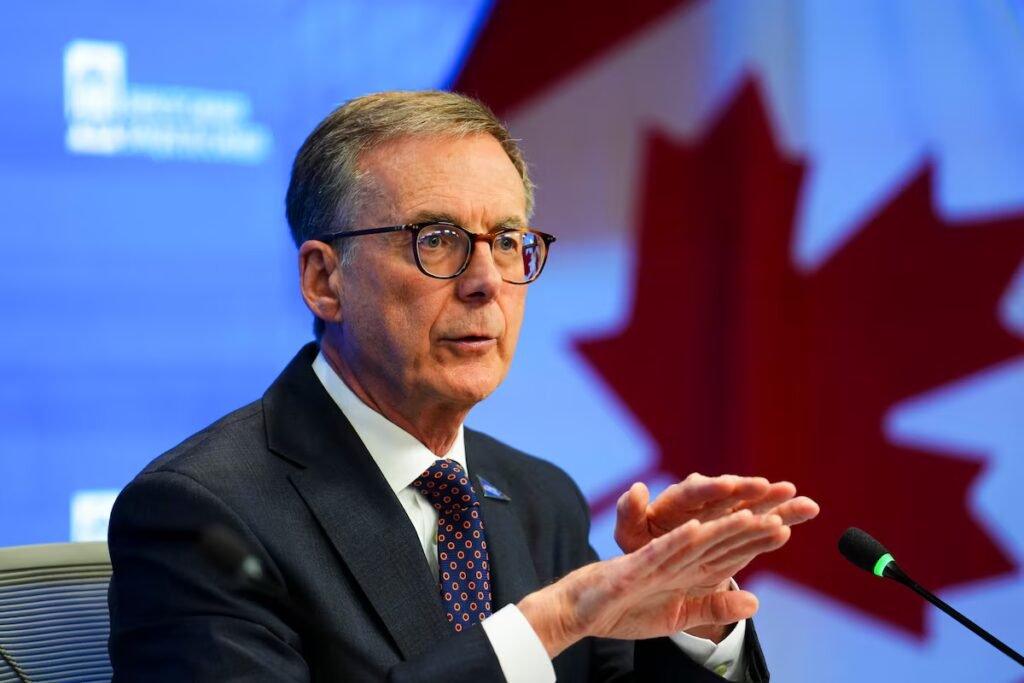
Bank of Canada Governor Tiff Macklem in Ottawa in October, 2025.Sean Kilpatrick/The Canadian Press
Late last year, I turned positive on the Canadian dollar for the first time in eons. And indeed, the loonie did recover from around 70 US cents back then to just above 74 US cents as of last week.
My issue now is that I am suffering from a case of buyer’s remorse. This was a case of pure luck and completely a reflection of the “debasement trade” in the U.S. dollar, with the greenback having sold off sharply against all the major world currencies. When you look at the Canadian dollar on a trade-weighted basis excluding the greenback, it has done nothing over the past two months and, in fact, has badly lagged against many currencies, including its commodity-exporting brethren in Australia and New Zealand.
In fact, the loonie is down more than 4.0 per cent against both these currencies since mid-November. Why? Because Australia and New Zealand have sufficient internal demand dynamics to sustain relatively high interest rates, do not impose obstacles on their resource development, and have closer ties to the overall Asian economy, which remains the primary engine of global growth. Canada shares none of these attributes, sad to say.
When I made the turn on the Canadian dollar call, I was hopeful that the economy would have started to respond to the Bank of Canada’s cumulative rate cuts of 275 basis points, what appeared to be a détente on trade issues with the United States (we can throw that out the window since the Mark Carney speech in Davos), and what at least was the appearance of fast-tracking natural resource projects.
But the latest round of economic data show that the Bank of Canada is pushing on the proverbial string and that lower interest rates are not that effective of an antidote for a seemingly permanent rupture in business and consumer confidence created by the souring in trade relations with the United States. The interest-sensitive sectors remain in a deep funk.
Indeed, if interest rate cuts were working, then we would not be seeing residential construction flatten like a beaver tail over the past year. Home prices nationwide would not have declined or stagnated in each of the past ten months, leaving them down by 2.0 per cent on a year-over-year basis. New home sales in the Greater Toronto Area reached an all-time low (going back 45 years) in December (just 5,314 units in all of 2025). And the region’s condo market is in a complete mess – sales plunged by 60 per cent from year-ago levels in the fourth quarter to the lowest level since the deep recession of 1991.
Loonie on a wild ride as global investors reassess the greenback
Opinion: One grand bargain to fight Canada’s housing crisis
If interest rates were working their magic as they have done in the past, we also would not have seen retail sales volumes slump through 2025 at a pace we have only seen one other time since the 2008 Great Recession. In fact, the monthly data thus far suggest that real retail sales contracted in the fourth quarter on top of a third-quarter slump, so here we have a critical cyclical segment of the consumer spending arena that has re-entered a recession along with the beleaguered industrial sector.
All of this suggests that the Bank of Canada’s job is not yet done. I understand that monetary policy can only do so much when lingering high trade-related uncertainty has frozen business capital spending and hiring intentions, but especially with most measures of core inflation well within the central bank’s tolerance range, the window is wide open for more relief. I am surprised that the futures market and most Bay Street economists believe that, given the current lacklustre economic environment, the Bank is done with this rate-cutting cycle. Beyond some fiscal stimulus policy gimmicks, there does not appear to be much in the way of any economic vitality to this economy, and neither the Bank of Canada nor the re-election of a Liberal government with a new flashy leader has managed to change any of that.
After all, the proof of the pudding is always in the eating. On our hands, we have a real GDP trend of +0.6 per cent over the past year, and even with population growth slowing amidst the new tighter immigration curbs, the economy is still contracting in real per capita terms as it did throughout the Justin Trudeau era. While interest rate cuts have so far been insufficient to reignite interest-sensitive spending, it can also be said that the Canadian dollar may be too strong at its current level in terms of how the currency-sensitive sectors are performing.
My second-guessing over my earlier attempt to turn bullish on the Canadian dollar came via these statistics, which are certainly cause for pause: Manufacturing activity is down by nearly 5 per cent from year-ago levels, having sagged to a five-year low in volume terms. Exports have fallen by 3 per cent over the past year and are lower now than they were in the spring of 2022, despite the firming in most resource prices – and the trade surplus has swung back to a deficit over the past two months. Speaking of commodities, despite all the bravado over fast-tracking mining development, there has been no growth in Canada’s resource patch since the turn of the year. Go figure.
But what is most striking are the numbers that Tiff Macklem & Company provided us at the last policy meeting and the more-or-less sanguine view on where interest rates are headed from here. When you benchmark the Bank’s GDP forecasts to its own estimates of potential growth and the existing amount of economic slack, the disinflationary output gap fails to close at any time between now and the end of 2027. Yet the commentary from the central bank is that it is in a prolonged policy pause. We’ll see how long that lasts. Something tells me not for very long.
Then tack on what CEOs are telling us about the intermediate-term macroeconomic landscape. A Pricewaterhouse survey shows that only 27 per cent see domestic economic improvement over the next 12 months, down from 42 per cent this time last year. For those who are bulled up because of American trade policies, rest assured that over half the business community says that this is the most important hurdle ahead, with 35 per cent expecting their bottom-line performance to erode in 2026. That does not bode well at all for the capex or hiring outlook, and all of this comes at a time when the economy showed renewed signs of slippage in last year’s fourth quarter. Aside from all that, Mrs. Lincoln, how was the play?
From my lens, the current unemployment rate level of 6.8 per cent is almost a full percentage point above its equilibrium (full employment) level, and as that gap widens, with limited fiscal support, monetary policy is really the only game in town. The broadest form of unemployment, the R-8 metric, sits at 8.5 per cent. The economy has barely generated any growth at all in full-time jobs over the past six months, and these are the crucial generators of personal income and consumer confidence. There are now nearly three unemployed Canadians for every job opening out there, a near record, so one can reasonably expect nominal wage growth to start cooling off materially before too long. How the Bank of Canada can sit on its hands indefinitely remains a good question. Something tells me it will be forced to go back to the drawing board.
So, here we have an economy that has barely expanded over the past year, lingering trade uncertainty, stagnant full-time job creation, a rising path in the unemployment rate, and underlying inflation comfortably within the Bank of Canada’s comfort zone. And yet, the swaps and money market and the swath of Bay Street economists believe that the BoC is done – not just done, but that the next policy move may be a hike. What planet these people live on is truly anyone’s guess, but my bet is in the other direction.
I’m abandoning my prior bullish view on the Canadian dollar. Even if it manages to benefit from any further “debasement trade” in the greenback (less likely now if Kevin Warsh gets confirmed as Fed Chairman), there are other currencies across the globe that have far more appealing characteristics.
David Rosenberg is founder of Rosenberg Research.