Last Updated:
China might take other measures such as imposing tariffs on US poultry and agricultural products, banning Hollywood films, targeting US services sector and halting fentanyl cooperation to hit back at Trump

As US, China try to inflict pain on each other, the rest of the world is seen as collateral damage in their trade war. (AP File Photo)
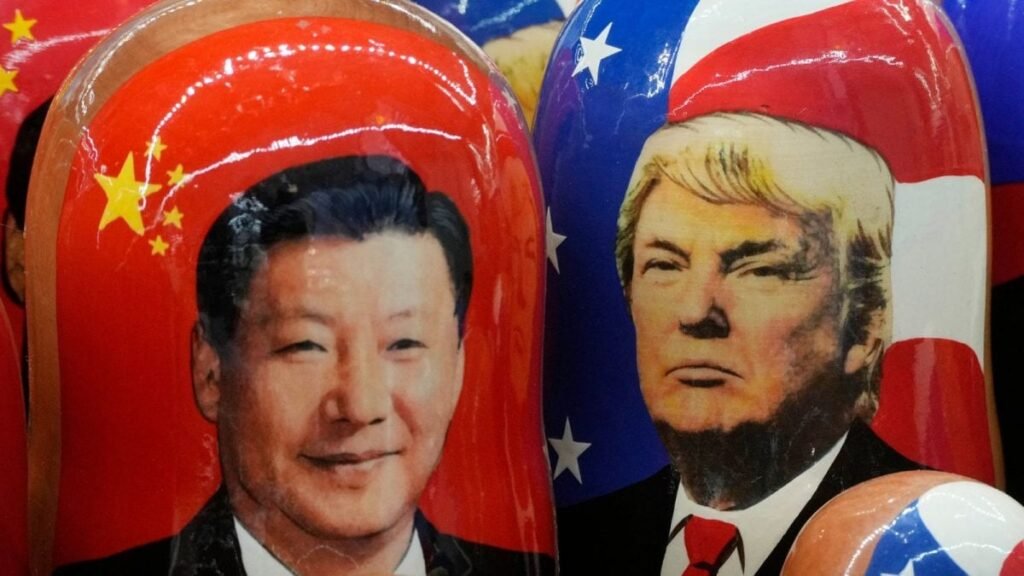
The trade war between the US and China spiralled when Beijing imposed an additional 50% tariff on imports from Washington on Wednesday, hiking its duties on American imports to 84%.
The tit-for-tat escalation came after President Donald Trump levied 104% tariffs on Chinese imports, which went into effect from April 2. Later, on Wednesday, Trump jacked up the overall US tariff on Chinese goods to 125%, even as he paused higher targeted tariffs on other countries for 90 days while keeping a 10% baseline tariff in place for all countries.
How Did China React To Trump Additional Tariffs?
China’s foreign ministry on Thursday issued a statement, reprimanding the US for the tariffs. “US tariffs seriously damage rules-based multilateral trading system, and seriously impact the stability of the global economic order. This is a blatant act that goes against the will of the world and goes against the whole world,” foreign ministry spokesperson Lin Jian said during a press briefing.
On Wednesday, China’s Customs Tariff Commission said in a statement that the world’s two biggest economies should “resolve differences through equal dialogue based on mutual respect.”
“I don’t think they can match in the economic realm, because the relationship is so unbalanced,” Rick Waters, the Singapore-based director of the Carnegie China think tank told NBC News. “So, what they tend to do is move into adjacent realms to exact a price.”
So, What Are China’s Options?
Currency Devaluation: Domestically, a currency devaluation would be the simplest way to cushion the tariffs’ impact but that could trigger capital outflows. It could also alienate trade partners China may try to court in other markets such as Europe and Asia. China has so far allowed very limited yuan depreciation.
Export Tax Rebates: More subsidies, export tax rebates or other forms of stimulus could be on the cards, but this also risks exacerbating industrial overcapacity and fuelling more deflationary pressures. Analysts have advocated for years for policies that would boost domestic demand.
Tariffs On US Poultry: China could greatly increase tariffs on U.S. agricultural products, or even stop importing them completely. Soybeans, which are crushed to make protein-rich animal feed ingredients and vegetable oils, have been at the heart of the U.S.-China trade dispute for some time. US exports of soybeans to China fell 75% after China imposed a retaliatory 25% tariff on them in 2018, during Trump’s first-term trade war with Beijing.
Hollywood Movies: China is the crucial market for Hollywood films. Though China has a cap on the number of foreign movies that can appear in its theatres, it could ban Hollywood films altogether. There were no Hollywood films among China’s 10 highest-grossing movies in 2023, in stark contrast to 2012, when seven of the top 10 highest-grossing movies were US-made, according to Maoyan, a Chinese movie-ticketing and data platform.
Services Sector: China could target US services sector by excluding American companies from government procurement processes or restricting their cooperation with Chinese firms. US lists China as its fifth-largest export market for services, according to a report by China’s State Council. The US has long accused china of stealing intellectual property. But Beijing could investigate US companies in China in order to protect them.
Fentanyl Cooperation: China and US have made progress on cooperation on fentanyl, some of which originate in China and then processed into opioid in Mexico before being smuggled into the US. Cooperation on fentanyl restarted as a result of a November 2023 summit between then-US President Joe Biden and Chinese President Xi Jinping, after a two-year hiatus. But China could bring that cooperation to a halt in response to Trump’s tariffs, as per NBC News.
What Would A Deal To De-Escalate Look Like?
With Washington and Beijing trying to inflict increasing pain on each other and the rest of the world seen as collateral damage in their trade war, it is hard to imagine how a grand deal to de-escalate would look like.
Economists say Trump’s goal of balancing trade with China is unfeasible in the short-to-medium term, given that one side is the world’s leading producer while the other is the biggest consumer.
China, which was hit earlier this year by a 20% tariff hike justified by fentanyl precursors rather than its trade surplus, is confused about Trump demands and rejects attempts of containment, even as it declares readiness for talks.
Thousands of protesters gathered in Washington and other cities across the US at the weekend to protest Trump, who is also facing heavy criticism from Wall Street for the global market turmoil his tariffs caused.
Chinese President Xi Jinping is unlikely to face similar resistance in his tightly controlled country, and can line up monetary and fiscal stimulus for later this year to ease some of the social stress if needed.
How Much Is The Trade Between US And China?
Trade between the world’s two largest economies is enormous. Sales of Chinese goods to the US last year totalled more than $500 billion — 16.4% of the country’s exports, according to Beijing’s customs data.
And China imported $143.5 billion in goods from the US in 2024, according to the office of the US Trade Representative.
That trade was dominated by agricultural products, primarily oilseeds and grains, according to the US-China Business Council. Oil and gas, pharmaceuticals and semiconductors are also among major US exports to China.
China’s trade surplus with the US reached $295.4 billion last year, according to the US Commerce Department’s Bureau of Economic Analysis.
According to analysts, US tariffs could take a significant chunk out of China’s GDP, which Beijing’s leadership hope will grow 5% this year.
(With inputs from Reuters and AFP)