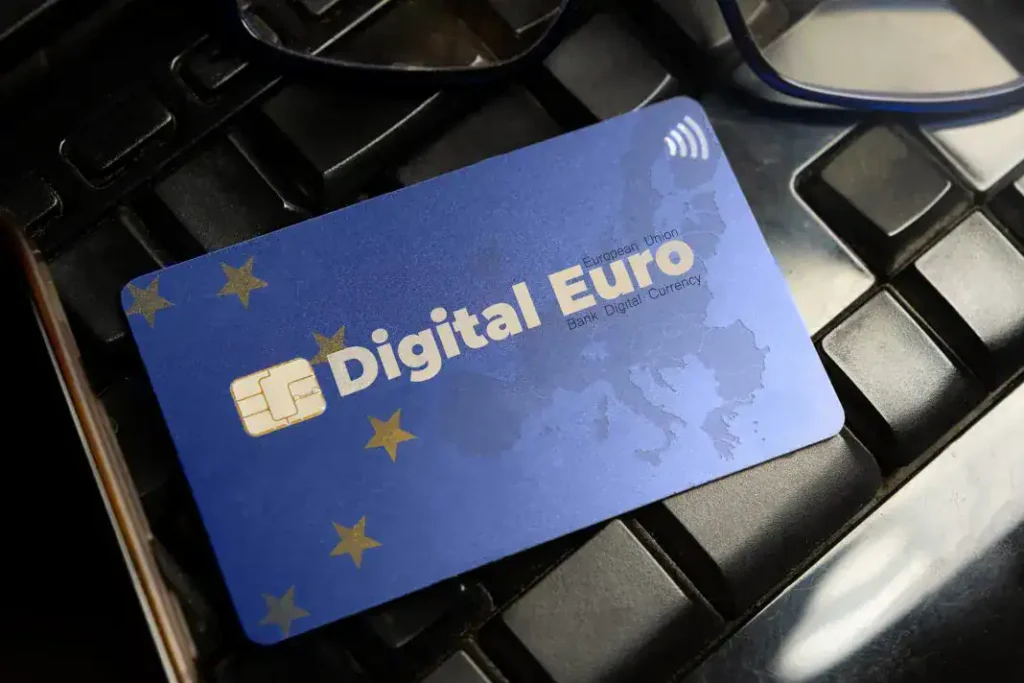
The European Central Bank is accelerating plans to introduce a digital euro, aiming to reduce Europe’s reliance on global payment giants like Visa and Mastercard while strengthening financial sovereignty across the eurozone.
According to a report by the Financial Times, the ECB has approved a new set of technological standards that will allow payment cards and terminals to seamlessly integrate with the proposed digital currency. The move marks a significant milestone in preparations for a potential rollout by 2029.
Europe’s reliance on foreign payment systems
Currently, around two-thirds of card transactions in the eurozone are processed through international payment schemes, underscoring Europe’s dependence on non-European infrastructure. In many EU countries, domestic alternatives remain weak or non-existent, leaving the payments landscape dominated by US-based companies.
The ECB plans for the digital euro to function as a digital equivalent of cash, with full legal tender status alongside physical banknotes and coins. Officials also aim to create a system that allows transactions without user fees, offering a public alternative to private payment networks.
New standards reshape the payments landscape
Under the proposed framework, private payment providers will need to upgrade their point-of-sale systems and infrastructure to comply with ECB standards once the digital euro becomes legal tender across the eurozone’s 21 member states.
The standards build on existing European initiatives such as the European Card Payment Cooperation, Nexo Standards and the Berlin Group. National schemes like Germany’s Girocard and France’s Carte Bancaire have already begun aligning with these frameworks.
By contrast, current global standards are largely set by EMVCo, a US-based consortium that includes major players such as American Express, Discover, JCB, China UnionPay, as well as Visa and Mastercard.
Political hurdles and industry concerns
Despite backing from the European Commission and several member states, the digital euro still requires approval from the European Parliament, leaving its timeline uncertain.
Banks and payment providers have also expressed reservations. Some question whether the digital euro will offer enough added value, while others warn it could undermine existing private European initiatives designed to compete with international schemes.
If legislation is approved later this year, negotiations with EU member states are expected to follow, with the goal of reaching a final agreement by late 2026 or early 2027.
Source: TornosNews.gr / Financial Times