You can see why it struck a jarring chord with your cornball correspondent, eh?
Anyway, there wasn’t much time to lounge around and mull over a kitchen sink drama because I still had some seasonal shopping to do.
Rather like the opening few paragraphs of this column, I’ve been struggling for inspiration, so I popped along to one of those artisan markets to see if I could find some. I didn’t.
In fact, the only thing I discovered as I peered at the prices of the myriad wares on the stalls is that artisan is derived from the Italian word, artigiano, which presumably means, “25 quid for some decorative bloody soap?”
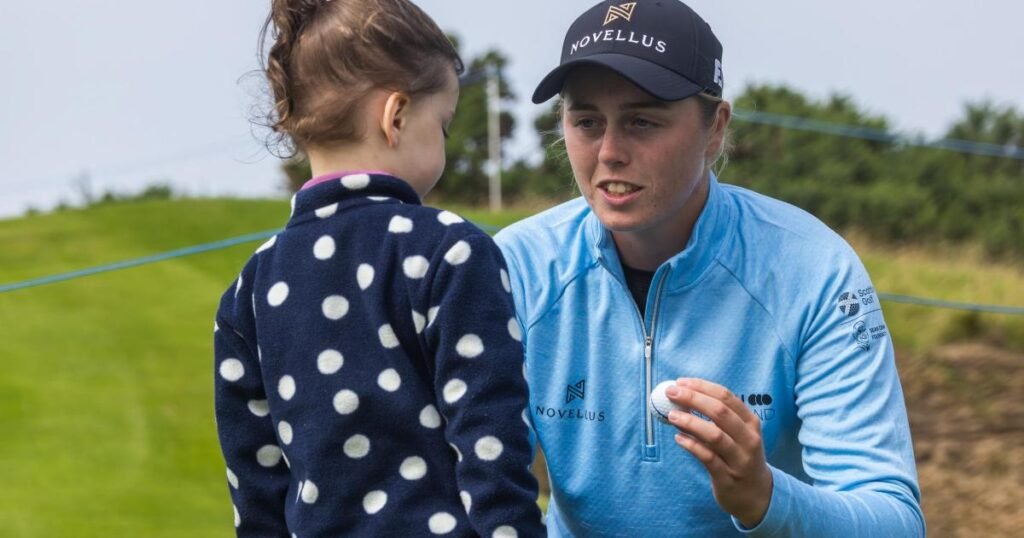
At least we got something of an early Christmas present with Hannah Darling’s success in the Ladies European Tour (LET) qualifying school at the weekend.
As we all know, negotiating your way through one of golf’s q-school processes can be as treacherous as zig-zagging a panicked path through an artisan market and trying not to spend a fortune on organic bloomin’ honey and a ceramic hinged trinket box.
Darling, one of the real bright hopes of the Scottish women’s game, earned it the hard way, coming through both stage one and a weather-disrupted final stage to claim a spot on the European circuit.
With plenty at stake in the nail-nibbling cut-and-thrust, Darling showed what she is made of and covered her closing 36-holes in 10-under to finish in a share of fifth and qualify comfortably.
Onwards and upwards? Well, let’s hope so. Those of you who keep a keen eye on the amateur game will be well aware of Darling’s considerable talents.
After becoming the youngest winner of the Scottish Girls’ Amateur Championship at the age of just 13 back in 2017, the Edinburgh golfer would go on to lift more shimmering pieces than the Yeoman of the Silver Pantry.
A mainstay of three GB&I Curtis Cup teams, the 22-year-old enjoyed a successful stint on the ultra-competitive US college scene before making her inevitable switch into the professional game in the summer.
She faced a daunting introduction. A pro debut among some of the world’s best in the Scottish Women’s Open at Dundonald ended in a missed cut.
Unlike the men’s professional game, with its various opportunities in the lower realms, the women are not really blessed with the same proliferation of stepping stones and pathways.
Getting an early toehold on the main European circuit, then, is vitally important. It can be very easy, after all, to spiral into hand-to-mouth obscurity.
Making it to the tour is one thing, of course. Staying there, and thriving, is another.
Glory-laden amateur dramatics are never a guarantee of success on the pro stage but, six months into her career in the paid ranks, Darling has passed her first big test and can head into 2026 with a spring in her step.
While her elevation to the tour is to be commended, we should be careful about hanging up the bunting.
Scotland desperately needs some flagbearers on the Ladies European Tour. While Gemma Dryburgh ploughs a lone furrow on the LPGA Tour in the US, Darling will be doing something similar on this side of the pond.
The small posse of Scots on the LET all lost their cards this year and failed to regain their full status at the qualifying school. Others are treading water on the second-tier Access Tour.
The shallowness of the talent pool remains a concern. While developing nations prosper, the country that gave the tour the likes of Catriona Matthew, Janice Moodie and Kathyrn Imrie has become something of a backwater.
Given how highly rated Darling is, she’ll probably now have to shoulder the kind of burden that would buckle the legs of Atlas.
While the tight-knit men on tour, like Robert MacIntyre, Grant Forrest, Ewen Ferguson and Connor Syme, have all talked about the value of friendly peer pressure and being driven on by collective success, it looks like Darling will have to go it alone on the women’s front.
I’m sure she’ll relish the various challenges that are coming her way during her rookie campaign, but a bit of competitive company and camaraderie would’ve been nice.
On the wider female scene, Scottish Golf, the amateur governing body, continues to champion the women’s game as part of a strategy which includes a drive to double female membership at clubs to 38,000 by 2035.
A possibility or a pipe dream? Given Scotland’s female membership rates have always been woefully low compared to the rest of Europe, it’s a big ask.
As long as young girls are coming in at the grassroots, then there’s always hope of some green shoots and a healthier future at all levels, from the club scene through to the professional arena.
For the time being, though, there’s plenty of catching up to do.
Now, how much is that artisan soap again? I wish you all a Merry Christmas.