


*This article is intended for those who want to understand the impact of the digital deficit and stablecoins on the yen.
This article takes about 5 minutes to read.
[My Stance]
Rather than explaining the depreciation of the yen through a single cause, I will track how cross-border payments for digital services and global currency demand are changing using numerical data.
Instead of arguing for shutting out overseas services, I will consider how Japan can increase its receipts from abroad and maintain the scope for settlements in yen.
Conclusion First
The United States is not only earning service revenue through AI and cloud computing, but is also attempting to cultivate dollar-pegged stablecoins as a ‘dollar payment network on the internet.’
If Japanese companies use dollar-pegged stablecoins for settlements and working capital, the flow of selling yen to hold dollar-based assets may become routine, potentially strengthening pressure for a weaker yen and a stronger dollar.
However, the use of yen-pegged stablecoins and the movement to exchange dollars received as export proceeds into yen will work in the opposite direction. The spread of stablecoins alone does not determine the depreciation of the yen.
What Happened
In July 2025, the GENIUS Act, which establishes a regulatory framework for payment stablecoins, was enacted in the United States.
Stablecoins are digital assets designed to have their value pegged to a fiat currency such as the dollar.
U.S. Treasury Secretary Scott Bessent has expressed the view that stablecoins will create an internet-based payment network for the dollar, thereby strengthening the dollar’s status as a reserve currency and demand for U.S. Treasuries.
In August 2026, the U.S. Treasury Department began soliciting comments on the proposed implementation rules. The main provisions are expected to take effect on January 18, 2027.
Meanwhile, Japan’s ‘digital deficit’ is the excess of payments to overseas entities for advertising, cloud services, software, licenses, and the like. Currently, digital service platforms in Japan are dominated by companies such as Amazon, Apple, Alphabet, and Microsoft.
A proprietary model from the Ministry of Economy, Trade and Industry (METI) indicates that if the current industrial structure does not change significantly, the deficit could expand to 18 trillion yen by 2035, or 28 trillion yen in a pessimistic scenario heavily influenced by AI.
This is not a fixed future prediction, but a scenario based on certain assumptions.
Key Figures for This Analysis
Figure to Check | What it Represents | Notes for Reading the Figures. Approx. 6.7 trillion yen | 2024 actual digital deficit value. | 18 trillion yen | 2035 conservative scenario | Proprietary estimate by the METI team. | 28 trillion yen | Pessimistic scenario including the impact of AI. | 18 trillion yen plus 10 trillion yen | Approx. 183.4 billion dollars | USDT issuance balance | Confirmed value as of September 18, 2026. | Fluctuates daily | January 18, 2027 | Expected effective date of the main provisions of the GENIUS Act | Implementation rules are currently being formulated.
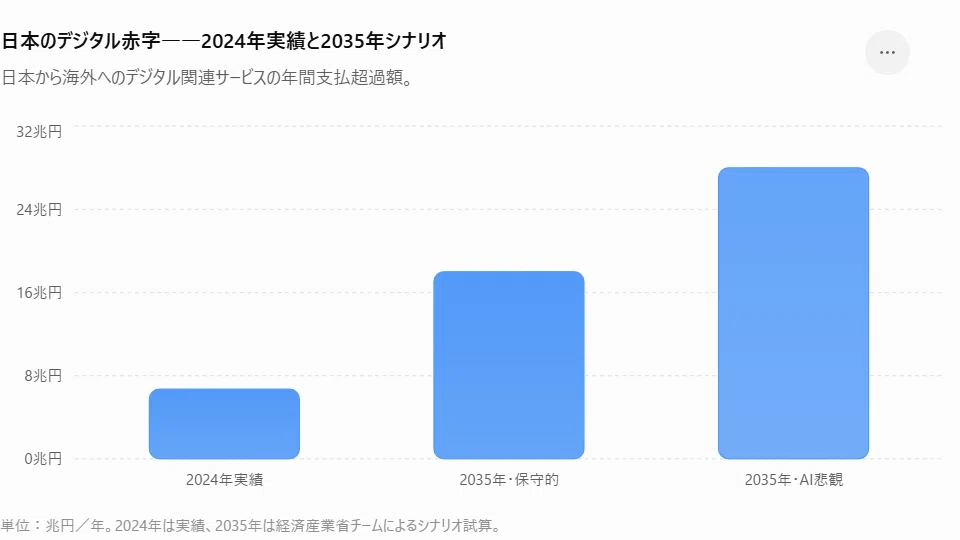
*Graph 1 compares Japan’s digital deficit, showing actual 2024 figures and two scenarios for 2035. The unit on the vertical axis is ‘trillions of yen per year’.
Why it matters
In this issue, it is necessary to distinguish between three types of money flows.
The first is the ‘service balance’.
When Japanese companies and households pay fees to U.S. companies for AI, cloud services, advertising, and video streaming, payments to overseas entities occur as current transactions.
The second is ‘asset and settlement currency’.
The movement of exchanging yen for USDT (a unit of stablecoin) and holding it is not a service import, but primarily a financial transaction.
Even so, if global users shift their daily payments and savings to dollar-pegged stablecoins, it could support demand for the dollar and for U.S. Treasuries used as backing assets.
The third is ‘corporate working capital’.
If Japanese companies hold USDT or USDC continuously in preparation for future payments, rather than exchanging only the necessary amount for each overseas remittance, temporary yen selling turns into structural dollar demand.
If business partners also start using the same currency, a network effect kicks in where convenience increases as the number of users grows.
In other words, the strength of the U.S. lies not only in sales of AI and cloud services, but also in its ability to control the currency and payment networks used for those payments.
How it relates to Japanese readers
If the yen weakens, dollar-denominated fees for overseas AI and cloud services will rise in yen terms.
An increase in payment amounts could widen the digital deficit, potentially creating a cycle that generates further demand for foreign currency.
In addition, if Japanese companies begin using dollar-pegged stablecoins for overseas remittances, trade settlements, and fund transfers between group companies, exchanges from yen to dollar-based assets may increase.
If more companies maintain balances for settlement at all times, dollar demand will be incorporated not just at the moment of transaction, but also into corporate cash management.
If, in addition to payments for AI and cloud services, inter-company settlements and working capital also become dollar-denominated, it could accelerate the speed at which pressure toward a weaker yen and stronger dollar intensifies.
This is not just a change in payment methods; it is a question of which currency zone companies choose to conduct their business in.
On the other hand, if Japanese companies receive dollar-pegged stablecoins as payment for exports and exchange them for yen, yen buying will occur.
If yen-pegged stablecoins expand into overseas payments, it will also work to broaden the scope of yen usage.
Furthermore, Japan has a primary income surplus from receiving interest and dividends from overseas investments. The digital deficit alone does not determine Japan’s overall current account balance or exchange rates.
How should Japan respond?
I believe the solution is not to domesticate all services, nor to collide head-on with the US and China using massive foundation models.
It is realistic to cultivate applications and middleware in B2B and public sectors where Japan has data and customer bases, such as manufacturing, healthcare, finance, logistics, and administration. Whether the current administration can invest firmly in these areas will determine Japan’s future landscape 10 to 20 years from now.
If possible, it is also necessary to export to markets outside the US and China, such as ASEAN and Latin America, rather than keeping everything within Japan.
Even if using overseas clouds, if you can earn foreign currency through services built on top of them, the digital balance can be improved.
At the same time, it is necessary to develop yen-pegged stablecoins and yen-denominated international payment networks to ensure that Japanese companies have options that do not rely solely on dollar-pegged ones.
The important thing is not to ban dollar-pegged stablecoins.
It is to utilize them for streamlining overseas payments while also fostering an economic zone where Japanese companies can receive sales in yen and hold funds in yen.
[Author’s Perspective]
One such strategy is for Japanese companies to partner with e-commerce and payment services that already have users in Southeast Asia, such as Shopee and Grab.
Rather than trying to popularize yen-pegged stablecoins directly to consumers from the start, it is better to start small with things like employee welfare points for Japanese companies, expense reimbursement, purchases of Japanese products, and tourism to Japan.
The mechanism is for users to use local currency or points, while the underlying business-to-business settlements utilize yen, local currency, and in the future, yen-pegged stablecoins.
Chinese services are expanding their international payment networks by connecting existing wallets and stores in each country. Rather than trying to popularize a new payment app on its own, wouldn’t it be more realistic for Japan to invest in and partner with local companies to connect Japanese e-commerce, logistics, tourism, and trade finance?
However, this is the author’s proposal, not a policy that Japan is currently implementing on a large scale.
The goal is not to force Southeast Asian users to hold yen. It is to increase the places where goods, services, and funds move between Japan and Southeast Asia, and to keep the yen as one of the payment methods for that.
Things to be aware of
Stablecoins have the following risks.
• Creditworthiness of the issuer
• Safety and transparency of reserve assets
• Ability to redeem at face value
• Cyberattacks
• Money laundering and sanctions evasion
• Capital flight from bank deposits
The 2035 forecast for the digital deficit is also not a statistically confirmed value. It is an estimate that changes based on assumptions such as industrial structure, market growth rates, exchange rates, and the speed of AI adoption.
Even if the use of dollar-pegged stablecoins by Japanese companies increases, the impact on exchange rates will vary depending on the purchase amount, holding period, the amount received from exports, and the percentage converted back into yen.
It cannot be concluded that ‘increased corporate use will inevitably lead to a weaker yen.’
Things to check next
• Final rules of the GENIUS Act and the treatment of foreign issuers
• Breakdown of stablecoin issuance balances and reserve assets
• Purchase amounts and holding balances of dollar-pegged stablecoins by Japanese companies
• The difference between import payments and export receipts, and the percentage exchanged into yen
• Performance of Japan’s digital-related service balance
• Overseas sales of domestic B2B and public AI companies
• Scale of use of yen-pegged stablecoins and yen-denominated international settlements
• Number of proof-of-concept projects by Japanese companies and Southeast Asian e-commerce/payment firms
As soon as this information is updated, I would like to write a follow-up to this article. The stance of this news outlet is not to predict the future, but to continuously record how key figures change. I post this in the hope that it will serve as material for readers to understand changes without being swayed by market trends or the atmosphere of current topics.
Sources
[Primary Information]
• U.S. Department of the Treasury, “Statement from Secretary Bessent on Enactment of the GENIUS Act”
https://home.treasury.gov/news/press-releases/sb0197
Date of announcement: July 18, 2025
• U.S. Department of the Treasury, “Treasury Seeks Public Comment on GENIUS Act Proposed Rulemaking”
https://home.treasury.gov/news/press-releases/sb0605
Date of announcement: August 17, 2026
• Ministry of Economy, Trade and Industry, “Digital Economy Report: A World Swallowed by Data, Survival Strategies for the Digital Market Without Sanctuaries”
https://www.meti.go.jp/policy/it_policy/statistics/digital_economy_report/digital_economy_report.pdf
Date of announcement: April 30, 2025
• Tether, “Transparency”
https://tether.to/en/transparency/
Date of verification: September 18, 2026
[Supplementary Materials]
• JIPDEC, “Overview of the Digital Economy Report and Actions Required in the Field”
https://www.jipdec.or.jp/library/report/20250722-r01.html
Date of publication: August 21, 2025