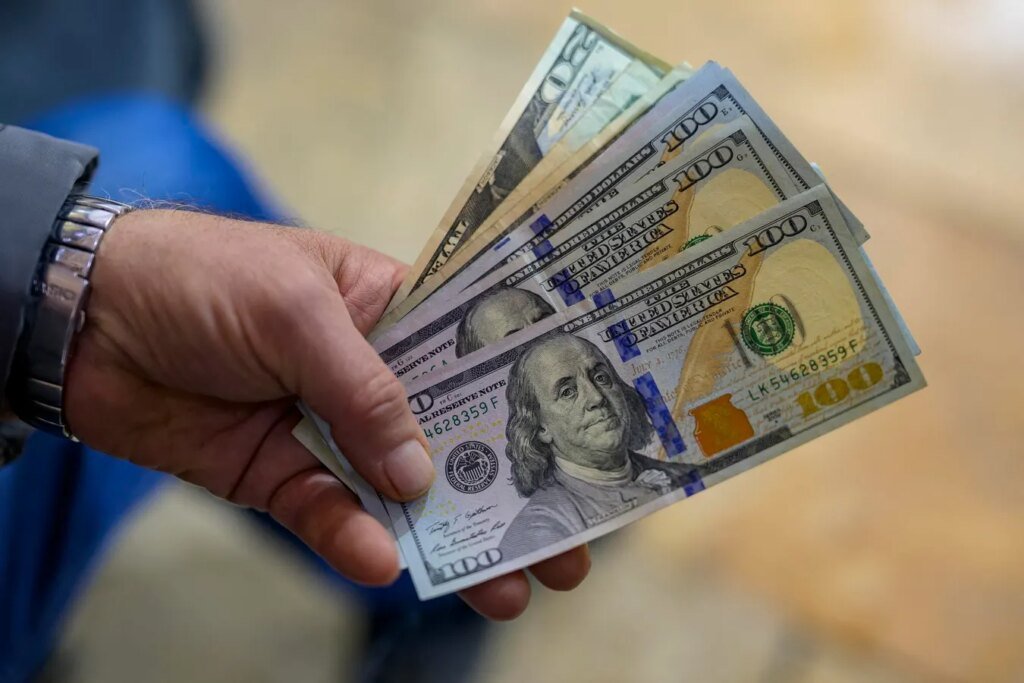

A teller shows US dollar bills at an exchange office at the Grand Bazaar in Istanbul on November 28, 2024. In recent weeks, the Turkish market has been increasingly unsettled by growing concerns over the circulation of counterfeit $50 and $100 bills. (Photo by Yasin AKGUL / AFP) (Photo by YASIN AKGUL/AFP via Getty Images)
AFP via Getty Images
The U.S. dollar index has fallen below 97.0, reaching a four-year low against a basket of major currencies. For most investors whose portfolios are denominated in dollars, this shift has been easy to overlook — the domestic equity market has been strong enough to paper over the currency story. But the dollar’s decline is not a footnote. It is one of the more consequential macro developments of 2026, with direct portfolio implications that run from international equity returns to commodity prices to Treasury market dynamics.
The drivers of the decline are well-documented. ING’s analysis from February 2026 cited a combination of cyclical and structural forces: slowing U.S. economic growth, narrowing interest rate differentials as the Fed moves toward additional cuts, persistent and growing fiscal deficits, and elevated political uncertainty around Federal Reserve independence. Morningstar’s December 2025 research described it as “one of the most notable episodes of dollar weakness in recent memory,” driven partly by global investors reversing years of reduced currency hedging on U.S. exposures. The question that matters now is whether the weakness is a cyclical episode — likely to reverse once U.S. growth reaccelerates or the Fed pauses — or the early stages of a more structural decline in dollar dominance.
Cyclical vs. Structural: The Key Distinction
ING and Morningstar both lean toward the cyclical interpretation as the baseline. Private investors — who account for more than 80% of foreign holdings in U.S. securities — remain net buyers. Their annual net purchases rose from roughly $1 trillion per year in 2022-2024 to $1.5 trillion in 2025, predominantly in equities and Treasuries. Foreign ownership of U.S. securities reached approximately 20.2% of the total market as of late 2025, its highest level in nearly a decade. These are not the capital flow patterns of a structural retreat from dollar assets.
The structural risk, however, is real and worth taking seriously as a tail scenario. ING’s analysts noted explicitly that Fed independence is “the cornerstone of global financial stability” and that if the Fed were perceived to be cutting rates for political rather than economic reasons, it could trigger a run on the dollar that would be self-reinforcing. MUFG’s FX research forecast a further 5% DXY decline through 2026, projecting EUR/USD at 1.2400 at year-end, with the key risk variable being the new Fed chair’s posture toward the Trump administration’s repeated demands for faster easing. A new chair perceived as politically compromised is, in their view, the most underappreciated tail risk in currency markets.
Portfolio-Level Implications
For U.S.-based investors, the dollar’s decline creates a straightforward mechanical boost to international equity returns. When foreign stocks rise in local currency terms and the dollar simultaneously weakens against those currencies, the dollar-denominated return to the U.S. investor is amplified. This is part of why international equities have outperformed the S&P 500 on a dollar-adjusted basis in 2026 — it is not purely about European or Japanese fundamentals being superior. The currency tailwind has done meaningful work.
Commodities are priced globally in dollars, which means dollar weakness is generally supportive of commodity prices in dollar terms. Gold is the most visible beneficiary: the metal posted over 50 all-time highs in 2025 and returned more than 60% for the full year, with Goldman Sachs targeting $4,900 per ounce by year-end 2026. Oil, industrial metals, and agricultural commodities also receive structural support from a weaker dollar, which partially explains why energy prices have remained elevated even as demand concerns have mounted.
The Treasury market is where dollar weakness intersects most directly with macro risk. A weaker dollar reduces the attractiveness of U.S. Treasury holdings to foreign investors, which matters because those investors have historically been significant buyers of U.S. government debt. If foreign participation in Treasury auctions softens meaningfully — not the current case but a risk worth monitoring — it would pressure long-duration yields higher even as the Fed cuts short-term rates. This yield curve steepening dynamic would be adverse for long-duration bonds, favorable for financials, and broadly inflationary through its effect on borrowing costs.
What to Do About It
Morningstar’s practical guidance for investors in comparable economies — UK, Australia, and similar — is to consider measured currency hedging on U.S. equity exposure. For U.S.-based investors, the mirror image applies: unhedged international equity exposure is currently more attractive than it has been in years, and investors who have maintained structural underweights to non-U.S. equities are paying a growing opportunity cost.
The nuance is that simply adding broad international ETF exposure is not the same as adding exposure to the specific tailwinds driving outperformance. European fiscal stimulus, Japan’s corporate governance reform story, and selective emerging market plays each carry distinct characteristics. A weakening dollar is a tailwind for all of them, but the underlying equity fundamental stories differ substantially. Investors who take the time to understand which international markets are benefiting from country-specific catalysts — rather than just the currency translation effect — will likely generate better risk-adjusted returns than those who treat international exposure as a monolithic currency bet.
The dollar may stabilize. A strong U.S. growth print, a hawkish surprise from the new Fed chair, or a geopolitical shock that triggers flight-to-safety buying could all arrest or reverse the decline in short order. But as a structural allocation question, the case for diversifying away from full dollar concentration in a portfolio looks stronger today than it has at any point in the past decade. That is a conversation worth having regardless of what the DXY does next month.