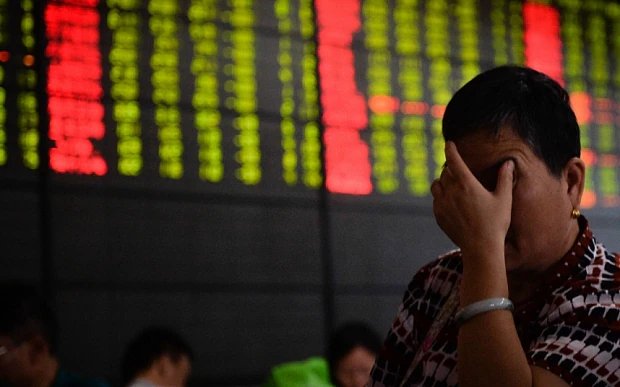
It has been a tumultuous week of trading for global stock markets, which at one point saw $2.5 trillion wiped off their value in just four trading days.
2016 is now officially the worst start to a calendar year since the aftermath of the dotcom crash in 2000.
Yesterday, stocks around the world sunk, gripped by renewed fears that China’s economy was engineering a devaluation of its currency and weak economic data from the world’s second largest economy.
The FTSE closed down 1.96pc, having fallen 3pc at one point. European markets all closed in the red, led by Germany’s DAX, which declined 2.29pc. France’s CAC40 lost 1.72pc and Italy’s FTSE MIB fell 1.14pc.
Thursday was also the worst one-day drop on Wall Street since late September, and the main US benchmark, the Standard & Poor’s 500 index, had its worst four-day opening of a year in history. The Dow Jones plummeted 392 points, or 2.3pc.
This morning, however, things seem a little calmer (relatively). Investors were cheered by news that China has strengthened its currency and scrapped a “circuit breaker” mechanism which halts trading when stocks plummet and has been blamed for aggravating market crashes all week. The circuit breaker system had only been in place for four days.
The People’s Bank of China also raised its guidance rate for the yuan for the first time in nine trading days, having allowed the currency’s biggest fall in five months on Thursday.
To calm currency markets, the PBOC set its daily midpoint rate for the yuan at 6.5636 per dollar prior to market open, firmer than Thursday’s fix at 6.5646 and closing quote of 6.5929. Under China’s currency regime the yuan is allowed to deviate 2pc either side of the midpoint.
As a result, China’s main indices have closed up, with the Shanghai Composite Index ending the day 2pc higher. The CSI 300 Index of large-cap companies in Shanghai and Shenzhen also advanced 2pc.
However, it’s worth noting that the Asian markets have been yo-yoing all morning and a sense of panic remains, particularly among retail investors.
Chinese stocks rose more than 2pc in early trade, only to reverse those gains minutes later.
By early afternoon in Beijing, the benchmark Shanghai Composite Index had added 2.39pc, or 74.56 points, to 3199.56. It had opened up, then dropped to a session low of 2.18pc, before climbing, falling, and rising again.
Despite the market fluctations this morning, today’s stability – relatively speaking, at least – is being attributed to an intervention by the People’s Bank of China. However, analysts are sceptical as to how long authorities can continue to intervene to pacify the markets and support the currency.
As Ambrose Evans-Pritchard says in his analysis here, China is trying to reconcile impossible objectives: “In economic parlance, it is the Impossible Trinity. No country can have an open capital account, a managed exchange rate and sovereign monetary policy. One must give.”
Enjoy the calm while it lasts.