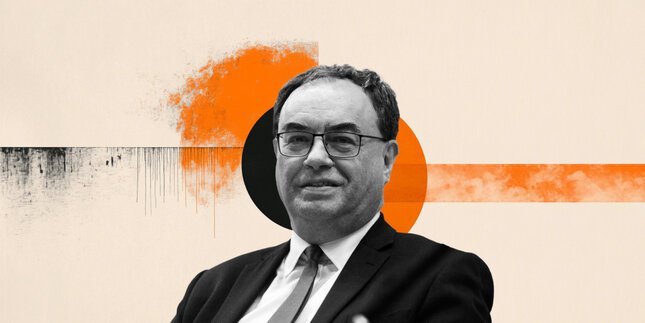

MUFG analysts say the Bank of England’s hawkish hold is supportive for Pound Sterling, but Governor Bailey’s pushback against an imminent rate hike limits how far GBP/USD can rise.
The Pound to US Dollar (GBP/USD) exchange rate ended July at 1.3482, up 1.75% over the month after recovering sharply from lows near 1.3220.
The pair gained in each of the final three sessions, including a 0.70% rise on 30 July and a further 0.16% advance on Friday.
MUFG’s reading of the Bank of England meeting is supportive, but not outright bullish.
Its sentiment analysis describes the decision as a “hawkish hold”, with policymakers still focused on inflation persistence, second-round effects and the risk that higher energy prices feed into domestic inflation.
At the same time, Governor Andrew Bailey made clear that the Bank was not preparing markets for an immediate rate rise.
That leaves Pound Sterling with some support from a still-restrictive policy stance, but less room to rally on expectations of rapid tightening.
MUFG Finds the MPC Modestly Hawkish, but Bailey Pushes Back Against a Near-Term Hike
MUFG analysed both the written contributions from Monetary Policy Committee members and the Governor’s press conference using its own textual sentiment framework.
The written material produced a score of 23.3, compared with 17.0 for the press conference, where minus 100 represents the strongest dovish conviction and plus 100 the strongest hawkish conviction.
That gap matters.
The statement itself leaned hawkish, but Bailey’s remarks were more restrained.
“The latest member contributions point to a hawkish hold stance,” MUFG says.
“While members acknowledged softer growth dynamics and a gradually easing inflation backdrop, members remained focused on inflation persistence, second-round effects and the potential inflationary consequences of higher energy prices and geopolitical risks.”
The split across the Committee was also clear.
MUFG assigned Catherine Mann a hawkish score of 80, followed by Huw Pill at 71 and Megan Greene at 65.
At the other end of the spectrum, Swati Dhingra scored minus 28 and Alan Taylor minus 33.
The remaining members sat closer to neutral, leaving the Committee “modestly hawkish overall”.
The most notable shift came from Mann, whose contribution placed greater emphasis on energy-price volatility, geopolitical uncertainty and the inflation risks coming from the Middle East.
Yet the press conference softened the overall message.
“Importantly, however, the press conference delivered a more balanced message than the written statement,” MUFG says.
“Governor Bailey pushed back against any interpretation that the Bank was preparing to raise rates, explicitly stating that markets should not leave the meeting believing the MPC was ‘edging towards a hike’.”
That line is the central one for the Pound.
We think MUFG’s analysis points to a policy stance that can stop Sterling from falling sharply, but may struggle to generate another sustained leg higher.
The Bank remains worried about inflation, which keeps rate cuts off the immediate agenda.
But it is also unwilling to validate the idea of a near-term hike.
For GBP/USD, that removes some of the upside surprise that would normally be needed to drive the pair decisively above recent highs.
The written statement therefore offers Sterling support through relative rates, while Bailey’s remarks cap the extent to which markets can price a more aggressive tightening cycle.
MUFG sums up the balance neatly:
“For GBP, the communication remains supportive, but the deliberate pushback against rate hike expectations limits the scope for upside.”
That is consistent with the price action.
GBP/USD finished July strongly, but the exchange rate remains below the month’s high at 1.3558 and below the May peak near 1.3658.
The pair has recovered most of the late-July decline, yet it has not broken free of the broader three-month range.
GBP/USD Recovery Has Improved the Technical Picture, but 1.3550-1.3650 Still Caps the Advance
The three-month chart shows a clear recovery from the late-June low near 1.3140.
GBP/USD climbed back through 1.3300 in early July, briefly reached above 1.3500 in mid-month and then recovered again into the close of July.
The latest price near 1.3482 is above both the rising 20-day moving average and the 50-day average, which has started to flatten.
That is constructive.
It suggests the pair has moved out of the weakest phase of the June decline and is attempting to rebuild a broader upward structure.
We would nevertheless stop short of calling this a full breakout.
The first important resistance area is 1.3500-1.3550.
A sustained move above there would open the way towards 1.3600 and the May high around 1.3650.
That is the zone which would need to break before a more durable bullish case could take shape.
On the downside, initial support is located around 1.3400.
Below that, the 20-day moving average near 1.3380 and the 50-day average around 1.3360 provide the next areas to watch.
A break beneath both would weaken the recovery and bring 1.3300 back into view.

We think MUFG’s policy interpretation fits the chart well.
The Pound has enough support to hold above the moving averages and retest 1.3500, but the BoE message does not yet provide a convincing reason for GBP/USD to break through the May highs.
A stronger move would probably require one of two things: a renewed increase in UK rate expectations, or a broader weakening of the US Dollar.
Without either, the most likely outcome is further consolidation with a mild upward bias rather than a clean breakout.
The July close at 1.3482 leaves GBP/USD in better shape than it was a week earlier, but the pair is still trading inside a wide 1.3140-1.3650 range.
For now, we would treat 1.3550 as the first upside test and 1.3650 as the level that would confirm a more meaningful advance.
Failure below those levels would leave MUFG’s conclusion intact: the BoE’s hawkish hold supports the Pound, but Bailey’s restraint limits how far it can run.