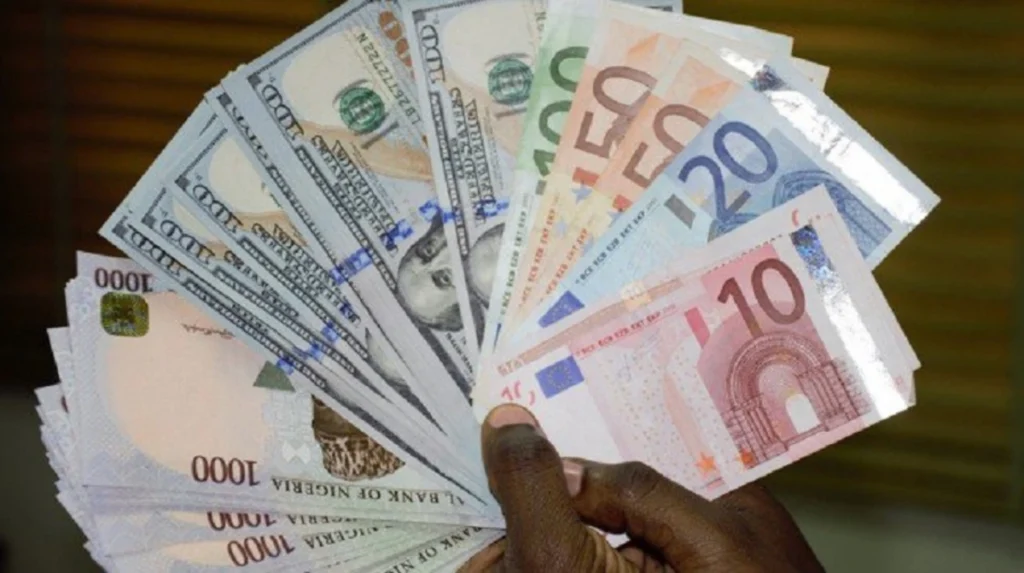
Nigerian Naira rebounded strongly against the British pound at the Nigerian currency market window at N1,814/£ on Monday, its highest level in July.
The naira has maintained significant gains against the British pound sterling this year as it was off the N1,950/£ levels it reached at the close of last year.
The cross last settled within proximity of the N1,814-prior zone prior to the overnight session during consolidations around mid-July before rallying sharply; the rate remains well within the tight N1,810/£ – N1,830/£ short range of support and resistance.
Reforms in the FX market as well as swift clearing of FX backlogs by the Apex Bank have narrowed arbitrage opportunities between the official market segment and the parallel exchange window.
The CBN retained its tight monetary policy framework to curb inflation, keep interest rates high, and encourage FPI inflows to naira-based instruments amid the country’s inflation outlook.
Nigerian Central bank interventions in the local foreign exchange market have supported increased dollar inflows and reduced the build-up of FX payment backlogs across many segments of the market; it is seen to continue to narrow the differential against the parallel market premium.
Still, structural demand in the economy (trade, refined imports, external debt) continues to lend weight to continued appreciation against the British pound sterling over medium to long term.
Nigeria’s Gross FX receipts are supported by crude oil output volume, alongside price support in the international oil market, and general external inflows support market liquidity and the accumulation of foreign reserves.
Bank of England (BoE) rate trajectory. The Bank Rate remains at 3.75% as higher services CPI and wage growth conditions have prompted more caution from the BoE in loosening policy.
These yields support relative to other large economies and, generally, have limited outright sterling weakness against the broadest measure.
UK Growth and fiscal prospects, with UK output showing limited progress of around 1.0-1.2 percent a year, fiscal pressures limiting spending and investment, the outlook seems limited by these developments and a generally slower overall move lower against stronger currencies, while it still appears to carry a risk against frontier currencies if domestic inflation surprises on the upside in the UK economy.
British pound sterling holds the dollar near $1.3 levels as BoE decide on interest rates in UK
The British pound sterling sustained positive terrain, holding the upward gap around 1.3290 levels throughout the early Tuesday Asia session.
The American dollar appears to be on firm footing for the day, supporting the cable to trade with underlying negative pressures amid the wait for the Fed’s monetary policy announcement this Wednesday.
The resumption of Middle Eastern geopolitical tensions could see the US Dollar (USD) be supported as a safe-haven currency. CENTCOM stated Thursday morning it had launched its 13th night running against Iranian targets.
U.S. President Donald Trump stated that he would make Iran responsible for the actions of the Houthis, and that Iran and the Houthi militant group would soon pay “a big military price” themselves.
The Bank of England (BoE) is widely expected to hold the interest rate at 3.75%. Traders will be waiting for the BoE to evaluate the conflict in the Middle East. The Bank is unlikely to alter interest rates until later in 2026, with market traders anticipating one or maybe two rate hikes of 0.25% before then, relatively little changed since Tuesday, reports Reuters.
A drop in retail sales numbers is expected later this week, and if such a forecast proves to be inaccurate, it may support the Bank of England (BoE) in adopting a more hawkish stance on tightening. UK Retail Sales forecast at -0.3% MoM to be released on Friday, from +1.2% in May.