Stay informed with free updates
Simply sign up to the Foreign exchange myFT Digest — delivered directly to your inbox.
After Donald Trump’s “liberation day” tariffs led to a weaker dollar last year, expectations rose of an “FX avalanche” of Asian exporters’ currencies rapidly appreciating.
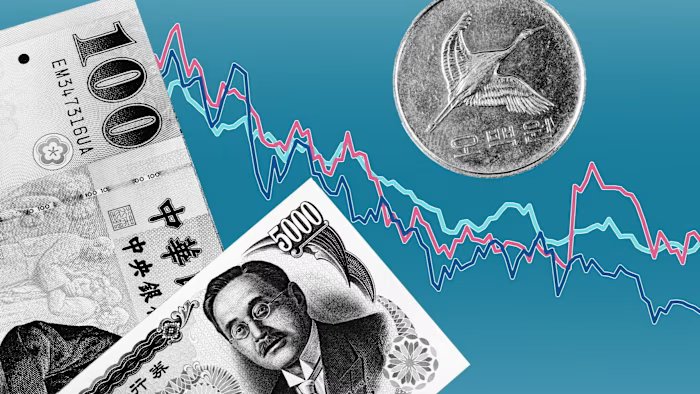
Instead, the opposite has happened, with Japan’s yen and South Korea’s won trading around multi-decade lows, while Taiwan’s dollar has given up most of its gains against the US currency after a sharp appreciation in May.
Weakness in the yen and won has become such an issue that US Treasury secretary Scott Bessent has publicly expressed concerns over their depreciation. Since Friday, the yen has surged on speculation that the US and Japan are lining up co-ordinated intervention in the currency.
The question for traders is what explains the declines at a time when the dollar has weakened against G7 counterparts such as the pound and euro; east Asian exporting countries are running large trade surpluses; and their interest rate gap with the US is at its narrowest in years.
Among the possible explanations are capital outflows chasing the AI boom in the US, fears of fiscal irresponsibility in Japan and the impact of investment deals that countries have struck with Trump.

A resilient dollar in the second half of last year, supported by strong economic growth in the US and heavy buying of American assets by Asian investors, has kept the region’s currencies weak, said Mitul Kotecha, head of Asian foreign exchange and emerging markets macro strategy at Barclays.
In Taiwan, life insurers’ massive purchases of US debt put downward pressure on their own currency, especially after proposed accounting rule changes that reduce requirements to hedge their foreign investments. In South Korea, retail investors’ frenzied buying of US stocks has similarly weakened the won.
Pledges from Japan, South Korea and Taiwan to invest $550bn, $350bn and $250bn in the US, respectively, as part of trade deals negotiated with the Trump administration have added pressure, as the agreements would involve massive capital outflows.
On Monday, Trump threatened to raise tariffs on South Korea as a bill to implement the deal stalls in parliament.
“There’s a lot of worry in terms of satisfying the US trade deal,” said Vincent Chung, a fixed-income portfolio manager at T Rowe Price. “How is Korea going to pay for all its investment? I think Japan is to some extent under that same pressure.”
Amid concerns about the currency impact, South Korea last month substantially increased its headroom for issuance of foreign-exchange bonds used to defend the won’s value.

Jason Pang, a senior portfolio manager and Asia local rates and foreign exchange lead at JPMorgan Asset Management, said South Korean and Taiwanese chipmakers would need to keep dollars in the US for new plants instead of repatriating them in their home currencies.
Japanese Prime Minister Sanae Takaichi’s expansionary fiscal policies have further rattled the yen, an effect that is “spilling over” to the region’s other currencies, said Richard Yetsenga, chief economist and head of research at ANZ.
Last year’s bets on appreciation were partly driven by expectations that Washington would pressure its Asian allies to strengthen their currencies, which remain cheap based on real effective exchange rates, a trade-weighted measure that accounts for inflation.
Long-term currency weakness has fuelled the countries’ trade surpluses with the US, the source of much of Trump’s ire against the global trading order. Structural issues such as east Asia’s ageing populations are further increasing the region’s dependence on exports for growth.
“If I’m part of a bloc of countries that have ageing populations, excess savings and export-driven economies, I’m going to have a bloc of countries that need weak currencies,” said Kit Juckes, chief foreign exchange strategist at Société Générale.
Some traders still expect the region’s currencies to perform better in 2026.
“We are still constructive on Asian currencies this year,” said JPMorgan’s Pang.
In the past six months, the only major regional currency to strengthen against the dollar has been China’s renminbi. Beijing’s swelling trade surplus has stoked global tensions and prompted more urgent calls for its currency to appreciate.
“It wasn’t an avalanche,” said Pang. “What ended up happening is you needed to pick the right country.”