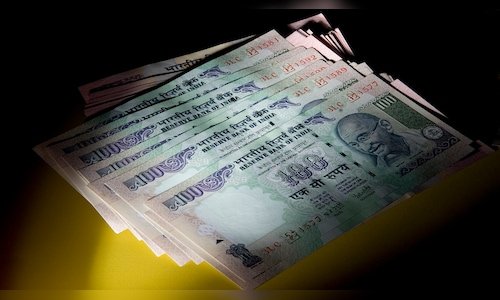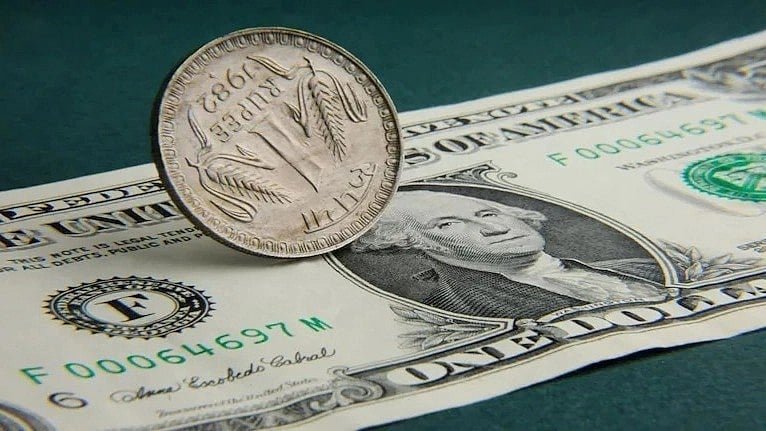
The Indian rupee continues its losing streak. The currency hit a new intraday record low for Monday’s session at 96.39 per dollar. With this the rupee is down nearly 7% so far in 2026.
The domestic currency closed at an all-time low of 96.34 against the dollar, down 0.4% from its previous close of 95.97 against the greenback. The decline was seen on the back of rise in US bond yields, coupled with a rise in crude prices which surged towards the $111 per barrel mark over the prolonged West Asia conflict.
Strong US Dollar adds to the downside
The US Dollar index which gauges the strength of the dollar against a basket of six other currencies has advanced by more than 1% over the past week, trading above the 99 mark. Alongside, yields on US 10-year government bonds rose to a 15-month high.
This added to the steep fall for the currency as a strong greenback, diverts investors away from emerging market currencies like rupee.
“The strong US dollar at 99.15 kept rupee lower as RBI stepped in at 96.34 to calm down the market which was biddish for dollar for the entire day with no chance of a fall,’ said Anil Kumar Bhansali, head of treasury at Finrex Advisors.
Market participants reported that the rupee would have extended even sharper declines had the RBI not intervened.
Brent rises adds to the pressure on rupee
Brent crude futures were hovering near the $111 per barrel mark in early Asian trade, while US benchmark West Texas Intermediated was quoted near the $109 per barrel level. The surge came as US President Donald Trump threatened military action on Iran, and reports of Tehran launching missiles on UAE emerged.
These geopolitical developments added to the rise in oil prices, as the chokepoint- Strait of Hormuz, remains largely closed. Oil is predominantly traded in dollars, so a surge in oil means increased dollar demand, which weighs negatively on rupee.
FII outflow keeps the pressure
Since March, foreign investors have pulled out over $23 billion worth of equities from domestic markets, adding pressure on the country’s ballooning current account deficit. Since the start of the West Asia conflict, which began in late February, the currency has slumped by nearly 5.5%.
Indonesian Rupiah and Philippine peso join the fall
It’s not just the Indian rupee, other emerging market currencies which are net oil importers too shredded steep declines weighed by the surge in oil and energy prices. The Indonesian Rupiah fell to a record low of 17,665 per dollar, sliding by over 1%
While the Philippine peso too felt the heat, as it plummeted to a low of 61.75 against the greenback. “Asian EM currencies have borne the brunt of a stronger dollar, with oil importers such as the rupee and the Philippine peso facing a double hit and yield-sensitive units like the rupiah also pressured by domestic headwinds, Michael Wan, analyst at MUFG, told Reuters.
Outlook for Rupee
“The broader trend for the rupee remains weak, with markets closely watching India’s strategic efforts to secure lower-cost oil and gas supplies to ease pressure on the import bill and forex reserves. Continued FII selling and global risk aversion are also adding to volatility in the currency market, “ said Jateen Trivedi, VP Research Analyst – Commodity and Currency, LKP Securities.
“For tomorrow, the range will be between 96.00 to 96.75 unless we see some developments on Iran front or fresh steps being taken by RBI/GOI to control the fall,” added Bhansali.