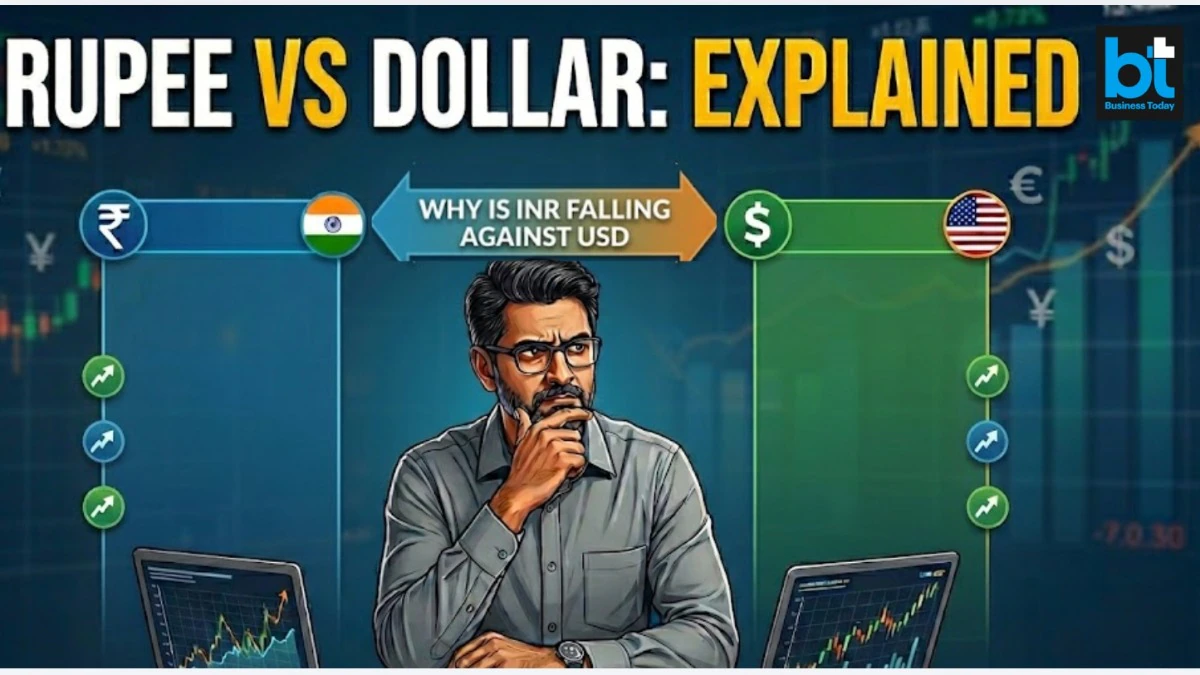


The pressure on the rupee has come from a variety of factors, including global uncertainty, crude oil price hikes and fast-exiting foreign institutional investors
The Indian rupee, currently trading at 94.81 to the dollar, was Asia’s worst-performing currency till a week ago, declining 7 per cent over the past nine months (following a 5 per cent decline over calendar 2025), before a spate of RBI measures helped the currency recover a bit. In May this year, the rupee had touched 96.71 to the dollar, flirting dangerously close to the psychological 100 to a dollar mark.
The sceptical reader would be right to wonder: what is the worst that would have happened if the currency had crossed 100? Nothing terrible, really. 101 or 103 is just another number. But it would have been a bit embarrassing for a country claiming to be the fastest-growing large economy and wanting to flex muscles in the global arena. A currency number that’s substantially market determined has the uncomfortable ring of final diagnosis of an economy’s performance and its relative standing vis-a-vis other peer economies.
THE SACROSANCT 100
Fearing a breach of that sacred level, an uneasy government got the RBI to invite more dollars to India through the FCNR(B) deposits scheme in June this year and defray the currency depreciation risks faced by banks. The RBI duly mopped up $133 billion, and that temporarily stemmed the decline of the rupee.
The pressure on the rupee has come from a variety of factors, including global uncertainty, crude oil price hikes and fast-exiting foreign institutional investors (FIIs). In the 10 months of the calendar year so far, net FII outflows have been at $32.8 billion. In 2025, net FII outflows were at $16 billion.
The RBI has certainly tried all usual measures to defend the rupee. It sold plenty of dollars in the market over the past two years. Net dollars sold (sales of dollars less purchases of dollars) in the spot market was $53 billion last fiscal (FY26) after net sales of $35 billion in FY25.
In the first two months of this fiscal, the RBI sold $15 billion. Last week, the RBI raised interest rates (repo rates) by 0.25 percentage points to 5.50 per cent after nearly two years. They have tightened controls on importers’ payments and forex derivative contracts, and opened a special window for oil-importing companies, which create the bulk of demand for dollars on a daily basis, given that India imports 90 per cent of its fuel requirements. Last week, RBI Governor Sanjay Malhotra also suggested that the rupee was undervalued.
The list of measures, while necessary, are insufficient and palliative at best. The real issues that need to be addressed are attracting FII inflows again and retaining them. FII money is exiting India as capital gets reallocated to newer sectors (AI/ semiconductors/data centers), as well as due to higher interest rates in the US. Some are leaving after encashing handsome gains.
stable currency
A more stable currency in the immediate future is, however, contingent on sorting out some issues. Most critical would be taxation of FIIs. They pay both capital gains tax and securities transaction tax in India, which eat into their gains when compared to investments in other peer economies where the rates are zero.
In addition, FIIs also have to factor an average annual decline of 4 per cent in the Indian currency value over the long term, which makes us relatively uncompetitive. The Finance Minister has hinted at a possible re-look at the rates for long-term capital gains for FIIs and that would be a welcome move.
Improving ease of doing business, along with speedy decision-making by the government in tandem with an attractive tax regime, will help the rupee find the right level when the sentiment turns positive once again.
The writer is a former journalist
Published on October 21, 2026