

- The Indian Rupee extends its advance against the US Dollar, supported by sustained foreign inflows into Indian equities.
- The unwinding of AI trades could lose momentum following Nvidia’s robust Q4 revenue forecast.
- The Indian currency remains supported by softer oil prices.
The Indian Rupee (INR) strengthens against the US Dollar (USD) for a third consecutive trading day on Wednesday, with steady foreign inflows and cheaper oil providing support. Against this backdrop, USD/INR extends its decline towards 93.26.
As the unwinding of Artificial Intelligence (AI) trades continues, overseas investors have steadily expanded their holdings in Indian equities.
Foreign Institutional Investors (FIIs) have added Rs. 88,362.78 crore to their holdings in the Indian equity market so far in November.
Can the global unwinding of AI trades persist?
According to market experts, the substantial foreign fund inflows into Indian equities have been driven primarily by a global rotation away from AI. Foreign investors have been exploring opportunities beyond AI trades after the Republicans’ defeat in the United States (US) midterm elections.
Nvidia’s robust Q3 results could, however, brighten the outlook for global AI stocks. CNBC reported that, on Tuesday, the chipmaking giant announced a doubling of revenue from data centres, a major component of Nvidia’s business, to $107 billion in the quarter ending September. It also forecast total fourth-quarter revenue of $130 billion, exceeding the consensus estimate of $125.1 billion.
Despite the strong revenue forecast, Nvidia’s board made clear that it does not plan to reinstate former CEO Jensen Huang following reports confirming his extramarital affairs, including one with an alleged Chinese spy.
The chipmaker’s higher revenue forecast could ease uncertainty over whether hyperscalers will sustain their spending on AI infrastructure. If so, the AI theme could regain appeal, reducing the relative attraction of Indian markets, which are also viewed as a non-AI trade.
How are lower oil prices supporting India’s economy?
Currencies of net energy-importing economies such as India are becoming more attractive as oil prices remain under selling pressure. The pressure stems from rising outflows of energy products from the Middle East.
During opening trade, the MCX Crude Oil contract due to expire on November 19 is trading near Rs. 7,928, down 2%.
USD/INR Technical Analysis: Where are the key levels?
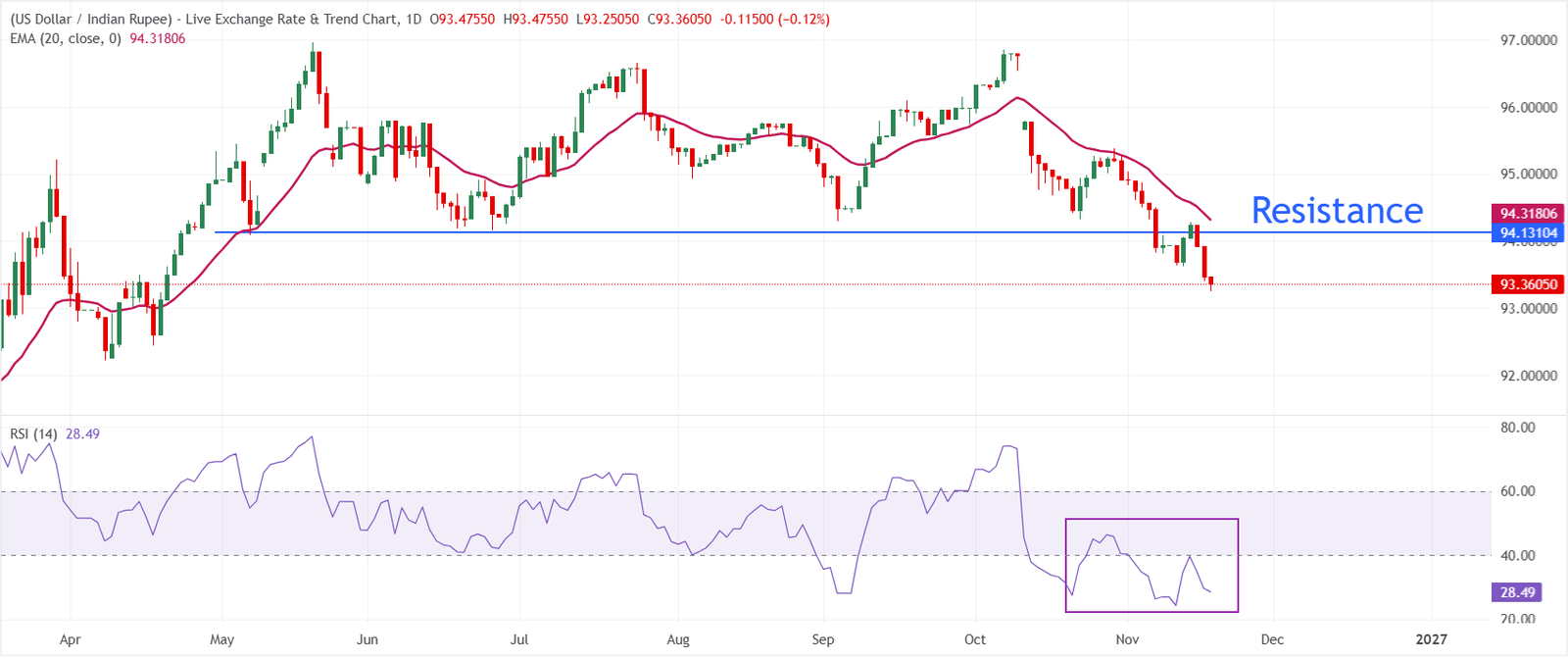
USD/INR retains a bearish near-term outlook on the daily chart, trading at 93.36, well below its 20-day exponential moving average (EMA) of 94.32. Sellers appear to retain control while the pair remains beneath this short-term EMA. Meanwhile, the Relative Strength Index (RSI) stands at 28.49 in oversold territory, suggesting that downward pressure remains dominant but is becoming increasingly stretched.
The 93.00 mark would provide key support on the downside. Any recovery would initially face resistance near the 20-day EMA at 94.32, slightly above 94.13, the level whose breakdown marked the shift to a bearish trend.
(The technical analysis of this story was written with the help of an AI tool. Know more.)
Indian Rupee: Frequently Asked Questions
External developments have a particularly strong influence on the Indian Rupee (INR). Key drivers include Crude Oil prices, given India’s heavy dependence on imported Oil; the US Dollar’s value, since most trade is conducted in USD; and the extent of foreign investment. The Rupee is also significantly influenced by interest rates set by the Reserve Bank of India (RBI) and the central bank’s direct intervention in FX markets to stabilise the exchange rate.
To facilitate trade, the Reserve Bank of India (RBI) intervenes actively in the forex market to keep the exchange rate stable. It also adjusts interest rates in an effort to keep inflation at its 4% target. An increase in interest rates typically supports the Rupee through the ‘carry trade’: investors borrow in lower-interest-rate countries and invest those funds in countries offering comparatively higher rates, earning the difference.
Inflation, interest rates, economic growth (GDP), the trade balance and foreign investment inflows all help determine the Rupee’s value. Faster economic growth can attract additional overseas investment and increase demand for the currency. A narrowing trade deficit will eventually strengthen the Rupee, while higher interest rates, particularly real rates calculated by subtracting inflation from nominal rates, are also supportive. When risk appetite improves, greater Foreign Direct and Indirect Investment (FDI and FII) inflows can provide a further boost to the Rupee.
Inflation generally weighs on the Rupee, especially when it exceeds that of India’s peers, as it signals devaluation arising from excess supply. By raising export costs, inflation also results in more Rupees being sold to pay for imports, adding pressure on the currency. However, higher inflation typically prompts the Reserve Bank of India (RBI) to increase interest rates. This can support the Rupee by attracting greater demand from international investors. Lower inflation has the reverse effect.