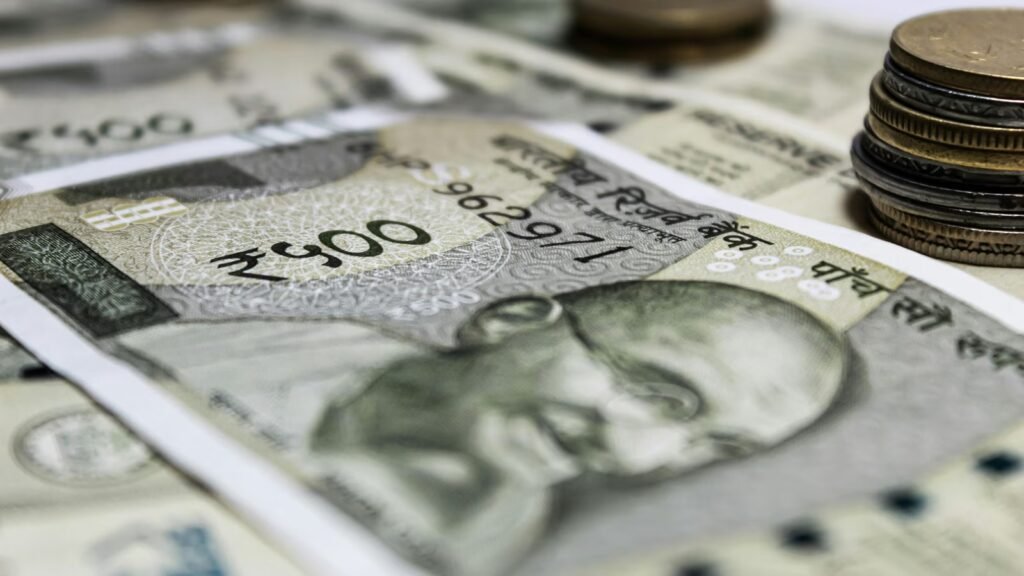
A day after the International Monetary Fund (IMF) reclassified India’s exchange rate regime as a “crawl-like arrangement”, the Finance Ministry said the domestic currency has weakened gradually and in line with those of other emerging market economies.
“The Indian rupee (INR) traded within a narrow range of 87.8-88.8 per US dollar in October, remaining largely unchanged from September levels. This limited volatility reflected a period of relative stability in global currency markets, supported by steady portfolio flows and the RBI’s active management of liquidity and foreign exchange,” the Finance Ministry said in its Monthly Economic Review report for October on Thursday.

“Looking at the longer trend, the INR depreciated by 3.5 per cent against the US dollar from the end of March to the end of October 2025, demonstrating a gradual weakening consistent with broader emerging-market currency trends,” it added.
Exchange rate regime
On Wednesday, the IMF’s annual staff report on India changed its de-facto assessment of India’s currency exchange rate system to ‘crawl-like arrangement’ from ‘stabilised’, saying that greater exchange rate flexibility “would be helpful for absorbing external shocks, with foreign exchange intervention limited to addressing destabilising risk premia”. The IMF had re-classed India’s exchange rate regime from ‘floating’ to ‘stabilised’ in late December, where it stayed until late last year.
A change in the exchange rate regime from ‘stabilised’ to ‘crawl-like’ comes after the rupee has experienced greater volatility over the last one year. This week, the rupee’s exchange rate against the US dollar breached the 89-per-dollar mark for the first time and closed at 89.31 per dollar on Thursday.
As per the IMF, a ‘crawling peg’ is an arrangement wherein a currency’s exchange rate is adjusted periodically “in small amounts at a fixed rate or in response to changes in selective quantitative indicators”.
After selling nearly $400 billion to shore up the rupee in 2024-25, the RBI’s total sales of foreign currency in the first half of 2025-26 has been a mere $44.3 billion, as per latest data from the central bank. The reduced intervention in the foreign exchange market, despite the global trade tensions and the imposition of 50 per cent tariffs by the US, has seen the rupee weaken to record lows. In its report on Wednesday, the IMF said that India is “well positioned to allow greater exchange rate flexibility”, noting that interventions by the RBI have “generally declined in recent months and the rupee/USD exchange rate has exhibited increased two-way movements”.
Story continues below this ad
The RBI’s public stance on the exchange rate is that it does not target a specific level and only tries to reduce undue volatility.
Inflation outlook ‘encouraging’
In its monthly report, the Finance Ministry also said that the domestic inflation outlook “remains encouraging”, with softening global commodity prices, benign energy markets, and targeted domestic supply interventions helping keep price rises in check. At the same time, the ministry’s report warned that the “balance of risks warrants continued vigilance”.
India’s headline retail inflation has fallen to record lows, with data released earlier in November showing that it declined to just 0.25 per cent in October, with some economists expecting it to average under 2 per cent for 2025-26 as a whole, lower than the RBI’s medium-term target of 4 per cent. As such, the central bank’s Monetary Policy Committee (MPC) may lower the policy repo rate next week for the first time since June. So far in 2025, the MPC has lowered the repo rate by 100 basis points to 5.5 per cent.


© The Indian Express Pvt Ltd