

A proposed tire factory near Douala has become the largest international project in the portfolio of Indian construction company GHV Infra Projects Limited, despite uncertainty over whether a final construction contract has been signed. The Bekoko plant, backed by Cameroonian businessman Antoine Ndzengue’s Neptune Holding group, accounts for 42.3% of GHV’s reported order book, according to an investor presentation dated November 17, 2026.
GHV assigns the project a value of 7,000 crore Indian rupees, equivalent to approximately CFA448 billion, out of a total order book of 16,541 crore rupees (CFA1,058.7 billion). Its importance is even greater within the company’s overseas business, where Bekoko represents 89.3% of the 7,840 crore rupees (CFA501.8 billion) in reported international orders. The Indian contractor also includes the factory among six projects listed under “Projects In Hand 2026-27” on its website. Together, those projects are valued at 10,389 crore rupees (CFA664.9 billion), with Bekoko accounting for 67.4%. That percentage applies only to the six projects in this category, rather than GHV’s entire order book.
A 7.6-million-tire factory still awaiting a confirmed contract
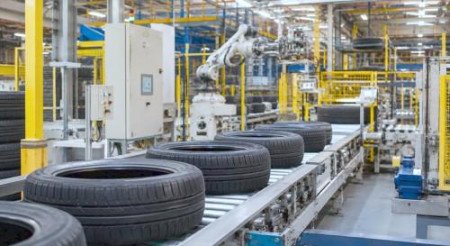
Cameroon Tyres Factory Project SA, a company linked to Neptune Holding, is developing the plant as a turnkey industrial project with annual production capacity of 7.6 million tires. On May 9, 2026, GHV Infra informed the Bombay Stock Exchange that it had received a letter of intent for an engineering, procurement, and construction (EPC) contract worth €630 million before taxes, or approximately CFA413.3 billion. The proposed construction period was 36 months from the issuance of the notice to proceed.
The project has undergone substantial changes since it was first announced. In 2023, Cameroon Tyres Factory proposed a CFA400 billion facility in Bomono, on the outskirts of Douala, with capacity to manufacture 4.6 million tires annually. By May 2026, the proposed site had shifted to Bekoko, while planned output had risen to 7.6 million tires.
The contract value also requires some clarification. GHV had already cited 7,000 crore rupees in its May 2026 stock exchange disclosure as an approximate equivalent of €630 million. At the November 18 exchange rate, the rupee figure converts to roughly CFA448 billion, compared with CFA413.3 billion for the euro-denominated amount.
The difference reflects the currency conversions and does not establish that the proposed contract value has increased. The financing picture is similarly incomplete. The Central African States Development Bank (BDEAC) approved a CFA65.6 billion loan for Cameroon Tyres Factory Project SA on December 23, 2024, according to the bank’s 2024 annual report. The funding was intended to support construction and operation of the tire factory in the Douala/Dibombari area.
Although BDEAC lists the loan among its approved financing operations for 2024, the report does not establish whether a loan agreement was subsequently signed or any funds were disbursed. Nor does the approval confirm that the project has secured all the financing it needs. Cameroon Tyres Factory previously announced that it had appointed Structure Finance Group to arrange a syndicated financing package involving BDEAC, Afreximbank, and commercial banks. Final commitments from the other prospective lenders have yet to be documented. Bekoko therefore occupies a dominant position in GHV’s reported business pipeline, even as two major steps remain unconfirmed: the execution of a definitive construction contract and the completion of the project’s financing arrangements.
Baudouin Enama