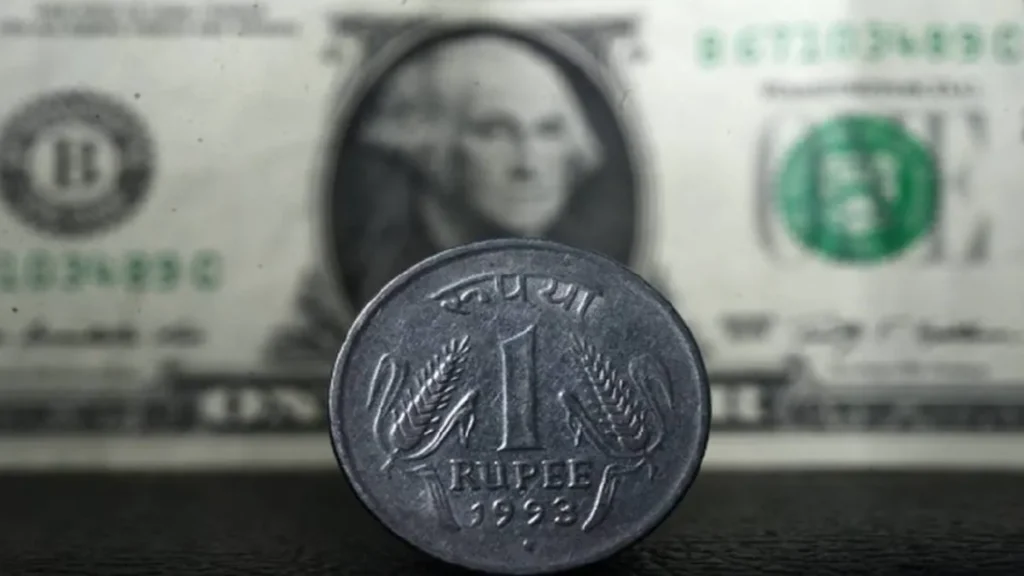
A renewed surge in crude oil towards $100 a barrel rattled Indian financial markets on Tuesday, sending the rupee to its steepest fall in nearly two months and dragging benchmark equity indices to three-month lows.
The rupee ended at 94.82 against the dollar, down 34 paise from its previous close, according to Bloomberg, snapping a week-long rally fuelled by strong FCNR(B) inflows. The currency had gained about 1% over the preceding seven days.
Crude oil climbed as high as $99.5 a barrel intraday before easing to around $98 – still its highest level in six weeks. The surge revived concerns over India’s import bill and inflation, while a stronger dollar added to pressure on the rupee.
Currency traders said the Reserve Bank of India likely intervened by selling dollars to curb volatility, although its intervention was not aggressive.
“Oil prices have moved near $100 a barrel, which has led to the rupee’s decline today. In addition, a strengthening dollar index also weighed on the currency. This has prompted the RBI to intervene to ensure orderly movement in the rupee,” said said Anil Kumar Bhansali, head of treasury at Finrex Treasury Advisors LLP.
He believes that if crude prices stay elevated, the rupee could weaken further and trade below 95. The good part is that the RBI is likely to continue supporting the currency, aided by its ample foreign-exchange reserves. He expects the rupee to trade in a 94.50-95.25 range in the near term.
The risk-off mood spilled over into equities, with the Sensex and Nifty extending losses for a second consecutive session. The Sensex fell 555.23 points, or 0.73%, to 75,577.58, while the Nifty declined 144.05 points, or 0.61%, to 23,635.10. Both benchmarks closed at their lowest levels since June 12.
Market breadth was also negative, with 2,291 stocks declining against 2,096 advancing on the BSE. Private banks, financials and oil & gas stocks were among the biggest sectoral losers, while pharma and healthcare bucked the trend.
“Renewed hostility between the US and Iran over the past few days has turned investors risk-off towards equity assets. Mirroring the weak global cues, domestic markets extended their losing streak amid selling in banking, IT, oil & gas and realty shares,” said Ankur Punj, managing director at Equirus Wealth.
Escalating tensions in West Asia have pushed crude prices sharply higher, while the rupee’s depreciation against the dollar further weighed on investor sentiment, Punj added.
The weakness in the benchmarks did not impact the broader market significant. The BSE Midcap index gained 0.31%, while the BSE Smallcap rose 0.37% to a record closing high of 59,080.20.
“Since the 52-week lows recorded in April for mid-caps and March for small-caps, these segments have delivered strong returns of 20-30%,” said Vinod Nair, head of research at Geojit Investments.
Nair attributed the rally to a recovery in domestic inflows and value buying as concerns over earnings downgrade – stemming from the 2025 global economic slowdown, elevated inflation and geopolitical uncertainties such as trade tariffs – have eased.