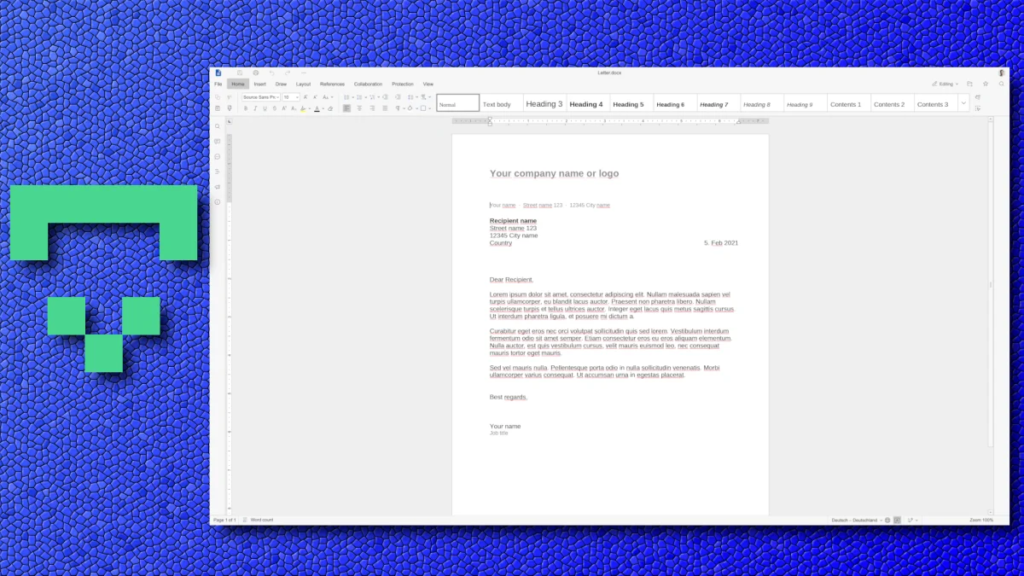
The first stable version of the open-source web office suite Euro-Office has been released. This was announced by the leading project partners Nextcloud and Ionos. Euro-Office aims to enable companies, authorities, and other organizations to jointly create and edit documents, spreadsheets, and presentations, and to become independent of proprietary offerings such as Microsoft Office or Google Docs.
“Our top priority was to provide a version that users can actually work with. Initially, we cleaned up the code, implemented some security updates, and integrated Euro Office into existing solutions,” summarizes Nextcloud CEO Frank Karlitschek on the project status. Local desktop and mobile applications are not yet available; they are the next step on the list. Full support for open standards like ODF is also a priority. “This will be at the very top of the agenda for the next version,” says Karlitschek.
Euro-Office is initially intended to be integrated primarily as an office module in the collaboration tools of the partners. In addition to Ionos and Nextcloud, Eurostack, XWiki, OpenProject, Soverin, Abilian, BTactic, Open-Xchange, and Office.eu are also on board as project partners. Ionos and Nextcloud are building a development team for Euro-Office, according to their own statements, and the first positions have already been filled.
New Office Component at Nextcloud
Nextcloud itself is making the first integration with Nextcloud Hub 26 Spring, also introduced today, Tuesday.
However, the office component Collabora, previously used in Nextcloud, will not disappear, according to Nextcloud CEO Karlitschek. Users will have the choice between Collabora and Euro-Office. The integration of Euro-Office into Ionos’ Nextcloud Workspace offering is planned for late summer. The French company XWiki expects integration in the fourth quarter of this year. Office.eu, based in the Netherlands, also plans to offer a product based on Euro-Office.
Technically, it is a fork of the open-source suite OnlyOffice. At the start of the project, Nextcloud and Ionos justified the decision for the OnlyOffice fork with its more modern architecture and codebase compared to LibreOffice and its browser variant Collabora.
License Violation Allegation Resolved
However, shortly after the project announcement, OnlyOffice raised allegations of license violations. According to Karlitschek, this has now been cleared up, and corresponding source and brand notices have been added to Euro-Office, thus settling the dispute. However, competition from the open-source camp could soon emerge, as LibreOffice announced a strategic shift at the end of May. The free office suite will in the future focus more on web browsers, smartphones, and collaborative work.
Anyone who wants to try Euro-Office on a Docker basis or contribute to the project can find more information in the GitHub repo.
(axk)