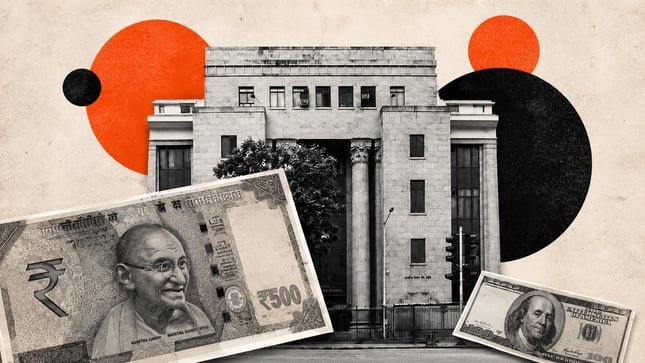
The Indian rupee’s relentless slide to record lows is no longer merely a domestic currency story. It has become part of a much wider Asian market stress signal triggered by the Iran war, soaring oil prices, rising US bond yields and an accelerating flight of global capital toward safer assets.
Since the Iran conflict escalated in late February, the currency has weakened more than 6 per cent, making it one of Asia’s worst-performing currencies.
But the current turmoil is revealing something deeper: the rupee’s direction today is being shaped far more by global markets than by domestic government policy.
Asia’s currencies are flashing stress signals
India is not alone. Across Asia, policymakers are scrambling to contain pressure on their currencies as the closure of key shipping routes around the Strait of Hormuz disrupts energy markets and pushes oil-importing economies into a difficult balancing act.
Asia imports nearly 80 per cent of the oil shipped through the Strait of Hormuz, making the region acutely vulnerable to the ongoing geopolitical shock.
Indonesia has already delivered a surprise 50-basis-point rate hike to defend the rupiah, which too has fallen to record lows. The Philippines has raised rates amid fears of another inflation spike. Central banks across the region are intervening aggressively in foreign exchange markets, burning reserves to slow currency declines.
India’s Reserve Bank of India (RBI), according to banking sources cited by Reuters, is estimated to be spending nearly $1 billion a day to smooth volatility in the rupee market.
Yet despite these interventions, pressure continues to build.
Oil shock is driving the rupee’s decline
The most immediate trigger remains crude oil.
Brent crude prices have surged more than 50 per cent since the Iran conflict intensified, sharply inflating India’s import bill. Since India imports the overwhelming majority of its crude requirement, every spike in oil prices translates directly into higher dollar demand.
This external imbalance is already visible in macroeconomic data. India’s merchandise trade deficit widened sharply to $28.38 billion in April, driven largely by higher crude imports. Wholesale inflation has also accelerated to a three-and-a-half-year high as energy costs feed through into the broader economy.
Economists expect India’s current account deficit to widen significantly if oil prices remain elevated.
The dollar problem is global, not Indian
The second major pressure point is the sharp rise in US Treasury yields.
The US 10-year Treasury yield has climbed to its highest level in more than a year as markets increasingly price in the possibility of another Federal Reserve rate hike later this year. Higher US yields make dollar assets more attractive and pull money away from emerging markets such as India.
This is why the rupee’s weakness cannot be viewed in isolation.
The Indonesian rupiah has fallen to nearly 17,700 per dollar. The Philippine peso is approaching 62 to the dollar. Analysts say the pressure is broad-based across oil-importing Asian economies that are simultaneously facing capital outflows and higher energy costs.
Markets, not policy, are dictating currency direction
Former RBI governor Duvvuri Subbarao, writing in an opinion piece published in the Hindustan Times, argued that the rupee’s weakness is being driven by both global capital rotation and market psychology rather than purely domestic policy failures.
According to Subbarao, global capital is increasingly flowing toward US-led technology sectors such as AI, semiconductors and advanced manufacturing, leaving emerging markets like India under sustained pressure.
He also warned that exchange rate crises are ultimately “crises of confidence”, where expectations themselves begin driving currency moves.
If importers rush to buy dollars, exporters delay bringing export earnings home, and households shift toward gold or foreign assets, depreciation pressures intensify further in a self-reinforcing cycle.
Is RBI intervention enough?
India still retains one major buffer: foreign exchange reserves near the $700 billion mark.
But markets are increasingly scrutinising how those reserves are being used. Reuters reported that RBI’s short forward dollar commitments have crossed $100 billion, raising questions about how aggressively the central bank can continue defending the rupee if global pressures persist.
Bloomberg reported on Thursday that India is considering all available options to stabilise the currency, including the possibility of an interest rate hike.
Yet economists caution that intervention alone cannot reverse a global oil-and-dollar cycle.
Vivek Rajpal, Asia macro strategist at JB Drax Honore, told Reuters that “once reserves become a market focus, the optics matter”, adding that the room for aggressive intervention is becoming increasingly limited.
The bigger message from the rupee’s fall
The current rupee decline is exposing a larger economic reality: in a deeply interconnected global financial system, domestic policymakers can manage volatility but cannot fully control currency direction.
The rupee today is reacting less to local politics or policy announcements and more to oil prices, geopolitical tensions, US interest rates and global capital flows.
That does not mean policy is irrelevant. RBI intervention can reduce panic, while prudent macroeconomic management can preserve investor confidence. But when a global energy shock collides with a stronger dollar cycle, even strong domestic fundamentals struggle to insulate currencies completely.
In that sense, the rupee’s fall is not simply a story of domestic weakness. It is a reflection of how deeply India is tied to the rhythms of global markets.
First Published:
May 22, 2026, 05:22 IST
End of Article