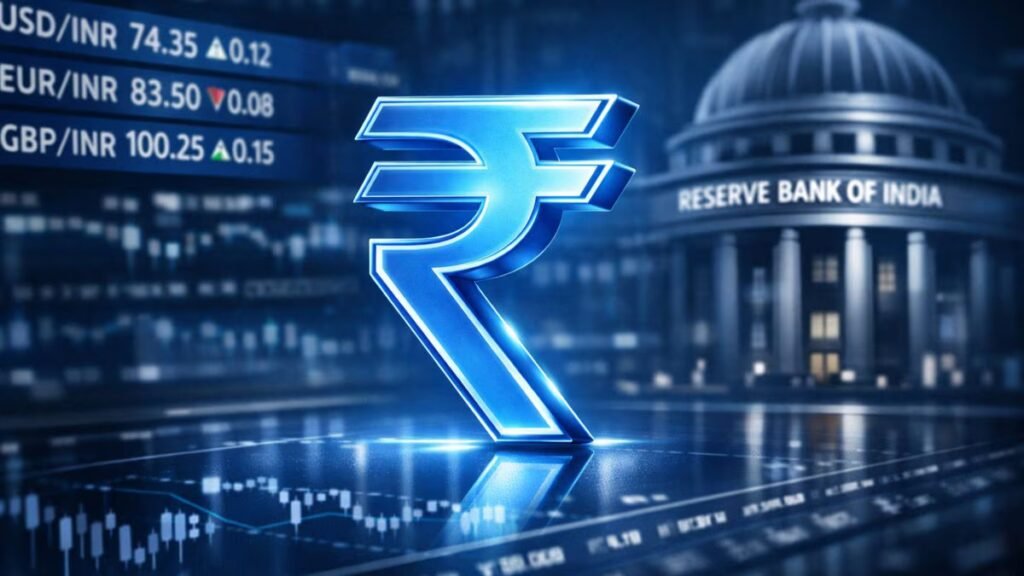
The rupee continued its downward spiral. The currency traded consistently below 96/$ and hit an all-time low of 96.96 per dollar on May 20.
Not only is the currency dangerously close to the 97/$ level, it is also the worst-performing Asian currency so far in 2026.
Experts say surging US bond yields, a strengthening dollar, and the country’s ballooning current account deficit may drive the Indian rupee to the 100 level against the US dollar.
RBI announces $5 billion swap auction to inject long-term liquidity
In a recent development, the Reserve Bank of India (RBI) announced a $5 billion dollar-rupee swap auction aimed at injecting long-term liquidity into the banking system amid pressure on the rupee and foreign investor outflows. In simple terms, the move will allow banks to give US dollars to the RBI in exchange for rupees for a fixed period, helping improve the availability of funds in the banking system.
Rupee continues its 7-day losing streak
However, the currency has been declining closer towards the psychologically important 97 mark before paring some losses intra-day on May 20. Continuing its losing streak for the seventh consecutive session, the Indian rupee ended Wednesday’s session at 96.82 against the US dollar, down 0.3% from its previous close.
Can the rupee slide to 100/$ levels
Economists and money market experts have said the chance of the currency breaching the fundamental 100-level mark is now well within the range of probability. The factors weighing on the currency remain the same: elevated crude prices, FPI outflows, and a firm dollar.
Where is the currency headed?
The outlook for the Indian currency remains extremely cautious, and experts suggest near-term volatility will persist amid global headwinds. According to Dilip Parmar, Senior Research Analyst at HDFC Securities, the currency could depreciate by an additional 2% from its current 96 levels, given the imbalance between US dollar demand and supply.
Experts say in the near term, the USD/INR pair is likely to find some stabilization within the 95 to 97 range.
“In the near term, over the next 1–3 months, the most realistic stabilization band appears to be around 95–97, as RBI is likely to focus more on reducing volatility and preventing disorderly movements rather than defending any specific level aggressively,” said Kunal Sodhani, head of treasury at Shinhan Bank India
However, Tanay Dalal, Senior Vice President II – Business & Economic Research, Axis Bank believes “100/$ is well within the range of probability and broadly in line with the evolving FEER-implied fair value for the rupee.”
According to him “a gradual, calibrated move toward this fair value over the coming months remains the most logical outcome, as it is inherently less disruptive than any sharp adjustment or internal devaluation.”
Chances of recovery ‘unlikely’ for rupee
Most experts have ruled out the possibility of a sharp recovery from current levels as ‘highly unlikely’ in the current geopolitical setup.
According to Sodhani, for the rupee to see the highs of 2025, crude oil prices would need to slide towards the $65 – 75 per barrel mark. Also, meaningful weakness in the US dollar and lower US bond yields would be needed.
“Such a move would imply nearly 10–12% rupee appreciation from current levels, which is historically uncommon for a large oil-importing emerging market currency unless there is a broad global dollar bear cycle,” Sodhani said.
Brent crude prices continue to remain elevated, trading near the $109 per barrel mark. This essentially means crude needs to fall nearly 50% from the current levels to kindle potential recovery hopes for the rupee.
Oil is predominantly traded in dollars, so high oil prices mean increased dollar demand, which weighs negatively on the rupee.
FPI inflows and geopolitical tensions key catalysts for rupee
A recovery in crude prices alone cannot trigger a turnaround for the rupee. Experts say a jump in foreign capital inflows and a meaningful resolution in the West Asia conflict would be required for such currency appreciation.
“A full recovery to the 2025 highs of 84.00–86.00 would require a significant surge in foreign capital inflows (both FPI and FDI), alongside an easing in geopolitical tensions (particularly stability in imported goods and commodity prices),” said Parmar.
The outflow of foreign equities remains a crucial factor adding to the downside for the rupee. FIIs have been net sellers of domestic equities in the cash markets so far this year. They have pulled out $2.6 billion from Indian markets.
Oil the major factor at play
Currency market experts have highlighted that oil still remains a crucial factor in determining the trajectory of the currency.
“Oil prices will likely dictate the year-end price (INR),” said Jamal Mecklai, Managing Director of Mecklai Financial Services.
India is a net oil importer, and the country meets more than 80% of its fuel and energy requirements from the Middle East. As the chokepoint, the Strait of Hormuz, which transits nearly 20% of global energy flows, remains largely closed, the pressure continues to mount on the currency.
“Ultimately, the direction of crude oil prices remains the single most important variable for the rupee. If oil stabilizes, the rupee can stabilize near current levels, but if oil continues to rise sharply, even strong RBI intervention may only delay rupee depreciation,” added Sodhani.
Rupee likely at 98 by 2026-end
As for the end of 2026, these experts say that the base-case expectation is that the domestic currency could settle within the 97 to 98 per dollar zone.
“For year-end 2026, the base-case expectation is that USD/INR could settle around 97–98, reflecting a gradual but controlled depreciation trend,” said the treasury head of Shinhan Bank.
Parmar of HDFC Securities expects the currency to find some ground within the target range of 94 to 98 by year-end.
Is there scope for the rupee to recover over the medium-term?
According to Jamal Mecklai, the current situation of the Indian rupee is very alarming, and there is no sound way of judging where the currency is headed.
“Nobody knows, there is no way of judging,” he said, adding that the root fundamentals weighing on the currency still haven’t been solved. “It certainly looks likely to keep sliding,” he added.
Tanay Dalal of Axis Bank stated that, “underlying depreciation pressures persist until the currency aligns more closely with its fair value benchmarks. Together, these suggest a trajectory that could take the rupee to levels well above 100 over the next 12 months.”
However, he believes that the pace of depreciation will remain managed, with intervention — and potentially some unconventional measures — continuing to smooth volatility and prevent abrupt dislocations.”
Kunal Sodhani of Shinhan Bank adds that over the next 6–12 months, a realistic expectation is for USD/INR to trade broadly within a 93–99 range, with the most probable average zone around 95–97.