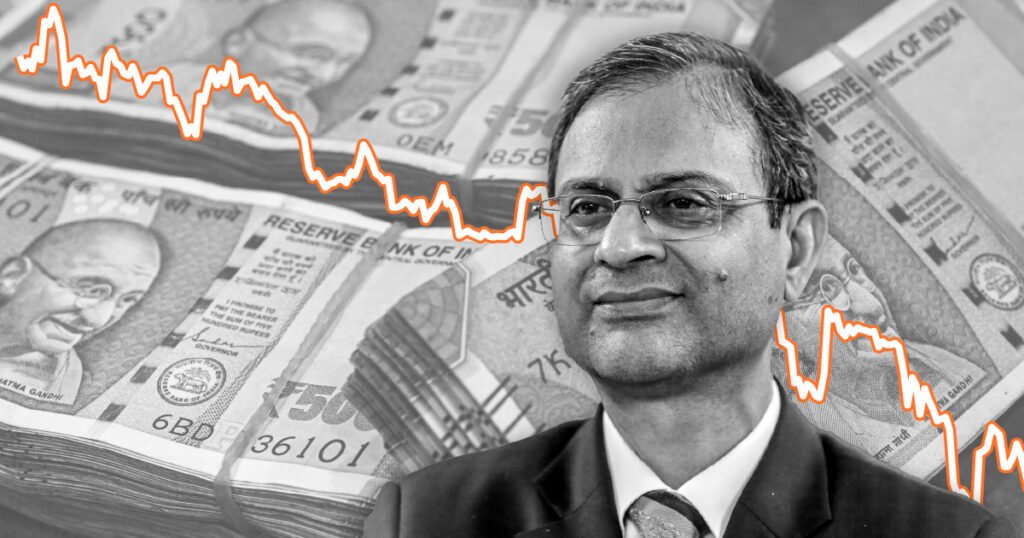
When Sanjay Malhotra took over as the chief of India’s central bank in December 2024, traders noticed the rupee began to move much more freely, after his predecessor had kept a tight lid on volatility.
By the time the International Monetary Fund acknowledged this shift last November, the rupee had already established multiple record lows to become the worst-performing currency in Asia.
In the months since, the rupee pushed even further into uncharted territory, closing in on the unprecedented 100-per-dollar level. That prompted the Reserve Bank of India to step in aggressively in March and April, with some of the strongest measures in decades to defend the rupee. While some of those steps have been quickly rolled back, investors remain wary of one-sided bets against the currency.
Here’s a detailed look at the rupee’s big swings so far under Malhotra’s watch.
84.1
85.1
86.6
87.2
88.2
89.4
90.2
91.0
92.1
93.7
94.8
For most of 2024, the rupee operated within a very tight range…
The stability broke down in the last quarter of the calendar year.
New Delhi rushes to ease trade barriers as US President Donald Trump escalates his rhetoric, labeling India a “very high tariff nation.”
Conflict with Pakistan
The rupee plunges the most in three years as India and Pakistan trade military strikes during a four-day conflict, following deadly attacks in Kashmir.

Trump doubles tariffs on Indian goods to 50%, penalizing the country for purchases of Russian oil.
The rupee’s slide past 88 makes it Asia’s worst performer of the year.
Central bank muscle
The RBI aggressively intervenes into both offshore and onshore markets to squeeze out bears in a firm signal against speculators.
The rupee’s break past 90 triggers unease about one-sided depreciation, with India one of the few major economies left without a US trade deal.
Malhotra expresses confidence in India’s economy, despite a trade impasse with Washington. A 3% annual depreciation in the rupee is natural, he says.
Trade relief, finally
The rupee rallies the most in almost six years as the US slashes tariffs on Indian goods, easing months of escalating tensions.

Iran War
The rupee’s losses steepen as the effective closure of the Strait of Hormuz drives up energy prices and highlights India’s dependence on fuel imports.
RBI steps in
Just hours after the rupee weakens past 94, the RBI announces curbs on currency position limits to quell speculators.
The rupee jumps the most in 12 years as the RBI moves again, with some of its boldest steps in more than a decade to defend the currency.
The RBI’s flurry of moves quieted talk of the rupee’s march toward 100. While the central bank is already rolling back some of those measures, there is at least some optimism the regulator’s done enough.
“The risk of further incremental measures will keep aggressive rupee bears at bay,” says DBS Bank Ltd. senior economist Radhika Rao.