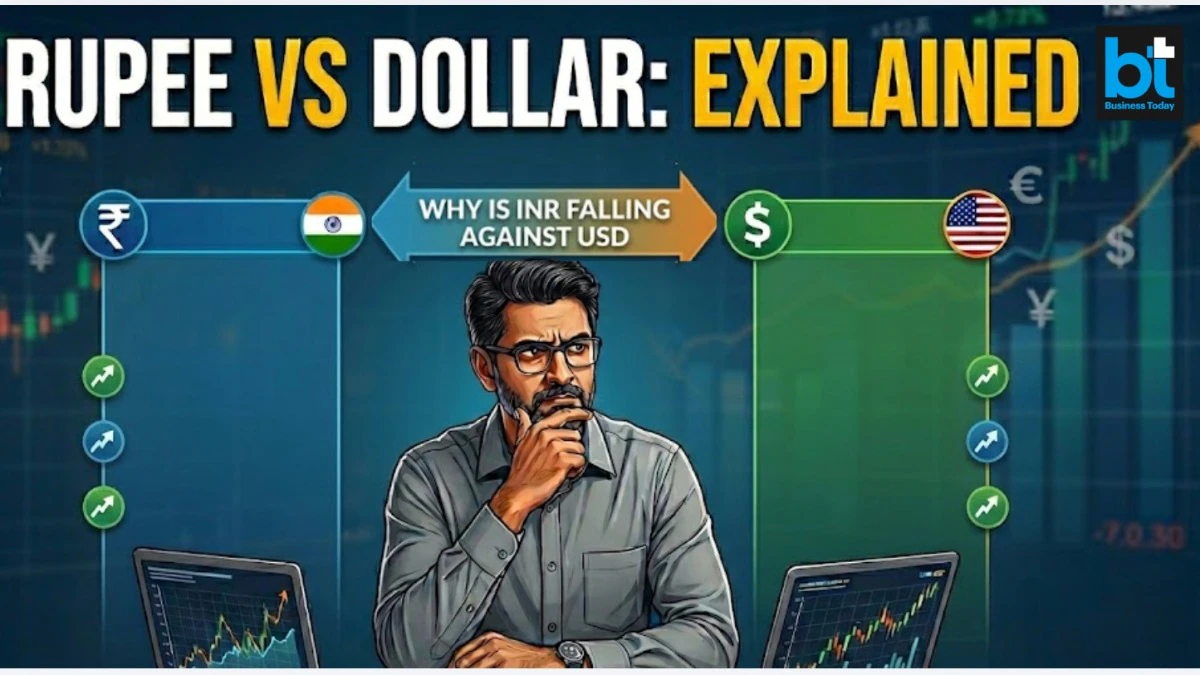
To put the recent weakness in perspective, consider the pace of depreciation over time. Around 2000, the rupee was near 45 to the dollar. Over the past 25 years, it has depreciated at roughly 3% a year. Look further back, however, and the picture changes. In 1975, the rupee stood at about 10 to the dollar. From then to now, the average annual depreciation works out to roughly 4.5%. At independence, when the rupee was on a par with the dollar, the long-term annual depreciation is closer to 6%.
The faster pace in earlier decades is largely a matter of arithmetic. A move from 10 to 20 represents a 100% depreciation on a point-to-point basis. A move from 80 to 90, by contrast, is a 12.5% depreciation. Psychological levels such as 90 or 91 still matter because they are crossed for the first time, but such thresholds were always going to be breached eventually, and that moment has now arrived.
As a ballpark, in calendar year 2025 the rupee has depreciated by more than 5% at closing levels and over 6% at its weakest point, well above its roughly 3% annual average over the past quarter-century.
Reasons for the weakness
There are multiple factors at play, and at the same time. The commonly cited reasons for the rupee’s slide include significant foreign portfolio investor (FPI) outflows in 2025, uncertainty around the bilateral trade agreement with the US, and a slowdown in net foreign direct investment.
At a more structural level, however, the underlying reason is India’s persistent current account deficit. We import more than we export. Over time, currency depreciation helps preserve export competitiveness. The rupee is freely convertible on the current account but not on the capital account, which reinforces this dynamic.
Over the past seven months, another factor has been the relatively lower intensity of RBI intervention compared with earlier episodes. A plausible explanation is that, in the context of renewed tariff risks under Donald Trump’s presidency, the central bank may have chosen a more tolerant stance toward depreciation to support exports.
Impact on your portfolio
A weaker currency is largely a negative for the economy and markets. One channel is “imported inflation”: the landed cost of imports is not just the dollar or euro price but that price converted into rupees. A weaker rupee raises input costs for companies that rely on imported components.
Currency weakness can also dampen investor sentiment. FPIs may hesitate to deploy capital if they expect further depreciation. Those who leave exposures unhedged risk currency losses on exit; those who hedge incur additional costs through forward cover.
That said, currency depreciation has not prevented Indian equities from delivering strong long-term returns. The Sensex, launched in 1979 with a base of 100, has compounded at roughly 15% a year since inception, excluding dividends. The Nifty, with a base of 1,000 in November 1995, has delivered about 11.5% annually, again excluding dividends.
Some investments actually benefit from a weaker rupee. Overseas investments are the most direct example. You invest when the rupee is at one level and, on redemption, receive more rupees per dollar if the currency has weakened. Indian investors can access overseas assets through mutual funds, including feeder funds that invest in foreign mutual funds. From an end-investor perspective, the outcome is broadly similar, though regulatory limits currently cap how much money mutual funds can deploy abroad.
Gold is another beneficiary. Domestic gold prices are essentially the global dollar price converted into rupees. A weaker currency lifts gold prices in India even if international prices are unchanged.
Export-oriented companies, such as IT services firms, also tend to gain from rupee depreciation. That said, equity investing is inherently complex, and decisions should never hinge on a single variable such as the exchange rate.
Conclusion
While rupee depreciation supports certain assets, most notably overseas investments and gold, and merits some allocation, it should not be the sole driver of portfolio decisions. Asset allocation must ultimately reflect your investment objectives, risk appetite and time horizon. Markets are shaped by a confluence of forces; the exchange rate is only one of them.
Joydeep Sen is a corporate trainer (financial markets) and author.