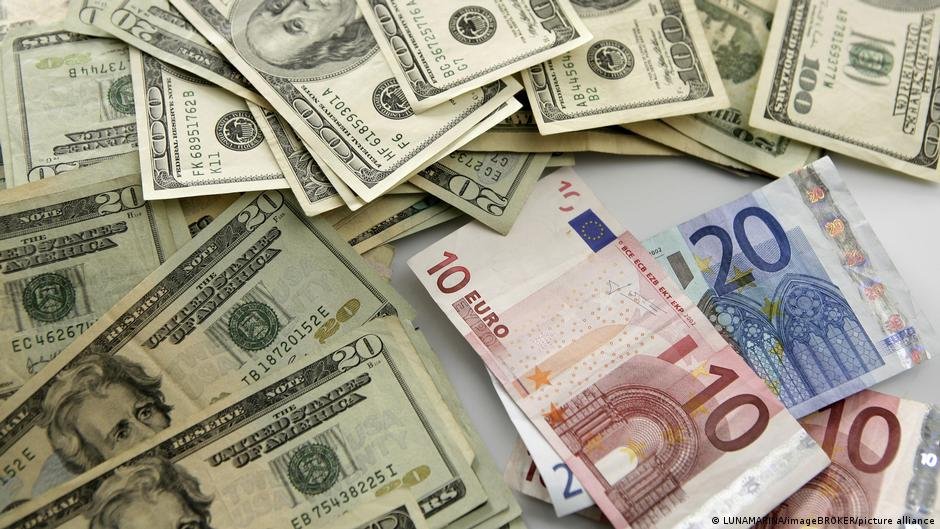
The US dollar continues to fall sharply in value against other major currencies, continuing the trend that saw it have its steepest annual drop in almost a decade in 2025.
The dollar fell by 1.3% against a basket of currencies on Tuesday (January 27), meaning it has already fallen by 2.6% since the start of 2026. It slumped by 9.5% in 2025.
The fall in the dollar has implications for the euro. and other currencies. The single European currency has now hit the $1.2 level for the first time since 2021, while the British pound and Japanese yen have also reached recent highs against the US currency.
Several economists and analysts have attributed the dollar’s continuing decline to a lack of investor faith in the US currency, amid continuing concern over unpredictable policymaking from US President Donald Trump.
There is also the view that Trump and many in his economic team want the dollar to lose value in the hope that it will boost US exports and manufacturing as part of a long-held strategy.
Trump has done little to dispel this. When asked this week if he was concerned by the dollar’s fall in value, he said: “No, I think it’s great.”
Stephen Miran, a former chairman of Trump’s Council of Economic Advisers and now a member of the Board of Governers of the US Federal Reserve, published a “User’s Guide to Restructuring the Global Trading System” in November 2024 with possible tools for correcting the trade deficit, mentioning specifically tariffs and devaluation of the dollar as the main instruments.
Should Europe care?
Whatever about the implications of a falling dollar for the US economy, it has consequences for the eurozone economy and the euro which surged by 13% against the dollar in 2025 already — its best year since 2017.
Jack Allen-Reynolds, deputy chief eurozone economist with Capital Economics says the rise of the euro matters because it plays an “important role in the performance of the economy, the health of the labor market and households’ financial position.”
“A stronger euro makes exports less competitive, harming the region’s manufacturers, while making imports cheaper, lowering prices for consumers,” he told DW.
Ricardo Amaro, lead eurozone economist for Oxford Economics, notes that if the euro continues to rise in value against the dollar, it would make European companies which export a lot to the US less and less competitive.
Although this would be offset by cheaper prices for US products on European shelves, he believes the current exchange rate, if maintained, would have a negative impact on European growth.
“Our global economic model suggests Eurozone GDP would be around 0.2% lower by year-end should the Eur/USD exchange rate remain at current levels, rather than around the $1.16 level that acted as a reference point post EU-US trade deal in late July,” Amaro told DW.
A mixed picture for exporters
However, Zsolt Darvas points to the fact that during periods when the euro was valued significantly higher than it is now, European exports still performed well.
The latest value of $1.20 is still below levels observed during 2021, and significantly lower than the $1.30 to $1.50 range frequently seen from around 2004 to 2014, the macroeconomics specialist with the Bruegel think tank in Brussels, Belgium, told DW.
“The recent slight decline in the dollar is unlikely to cause significant economic troubles in Europe,” said Darvas, adding that widespread media coverage of the falling US dollar may even “encourage investors to shift their focus from US investments to the EU.”
But given how exporters have already been jolted by Trump’s trade tariffs last year, there are concerns that the exchange rate could “deal another blow,” he cautions.
Companies in the STOXX Europe 600 stock market index of major European companies derive around 30% of their revenues from the US, according to Goldman Sachs.
While the stronger euro is already tied to more optimistic growth estimates, certain European sectors could be vulnerable to a cheaper dollar.
Ricardo Amaro says the pharmaceutical and automotive sectors are especially at risk, although he thinks the US reliance on European pharmaceutical products may offset any potential damage.
Jack Allen-Reynolds, meanwhile, points to generally weak eurozone exports in recent years, particularly due to intensifying competition across a range of sectors from China.
“We doubt that the moves seen so far would have a very big impact on export demand, but it certainly won’t help,” he said.
Time for ECB market intervention?
The surge in the euro against the dollar has prompted speculation as to whether the European Central Bank (ECB) should intervene in some form.
Austrian central bank governor Martin Kocher thinks the euro’s recent gains were “modest” but said the ECB would have to intervene if the exchange rate started to lower inflation forecasts.
Most analysts agree that now is not the time for any significant intervention in monetary policy, but warn further hikes in the value of the euro may force ECB policymakers’ hands if inflation goals were to be impacted.
Ricardo Amaro already sees ECB policymakers trying to influence market expectations by stating they are “monitoring the situation and voicing some concern about recent moves.”
“This brings rate cut discussions back into the table and acts against the euro appreciation momentum,” said Amaro.
For Jack Allen-Reynolds there’s also no need to act based on the exchange rate changes so far seen in January. However, further changes could see the ECB cutting interest rates later this year, he believes.
And Zsolt Darvas argues the current inflationary impact is close to zero and that no sector is especially vulnerable. “Exchange rates have fluctuated widely over the past decades, and companies have adapted to manage much larger swings in exchange rates than what we are currently observing,” he said.
Edited by: Uwe Hessler