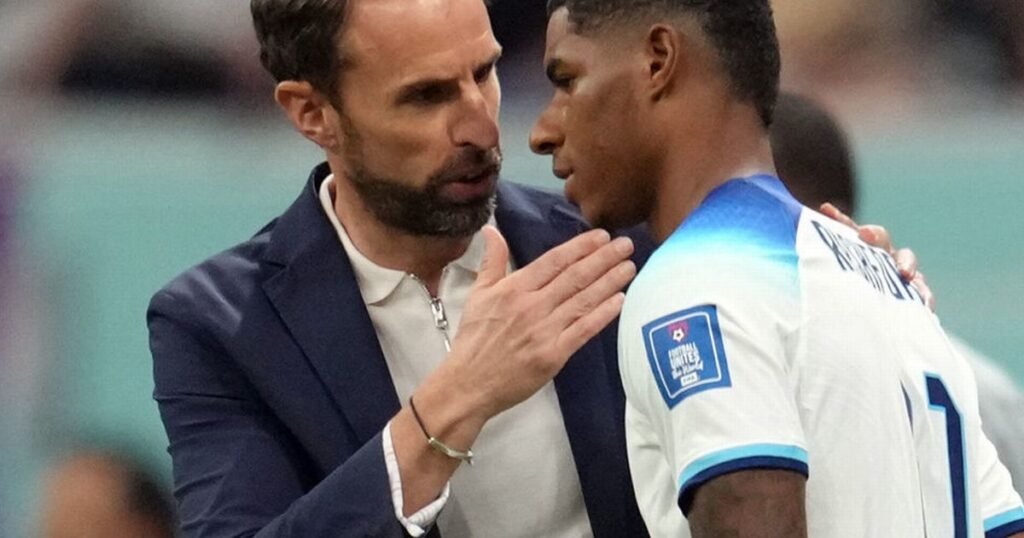
Speaking ahead of his book launch, the former England manager reveals why losing 3-2 to Italy on penalties saw him change strategy for the entire team team
Too much practice made Marcus Rashford imperfect, according to Gareth Southgate, who says this is the reason why the striker missed the infamous Euro 20 final penalty.
In fact, the former England boss was so sure that he changed the strategy for the entire team after Italy won 3-2 on penalties.
He says: “We actually practiced a little bit less.”
Southgate, whose book Dear England is out this month, was speaking to Jake Humphrey and Damian Hughes on the High Performance podcast – explaining his reason for bringing on Rashford late to take the controversial penalty, which resulted in him receiving terrible racist abuse.
He says: “I didn’t put Raheem [Sterling] in that position on that night. He was a more experienced player but his penalty record was 33%. Marcus Rashford’s was 87%.
“Clearly only being on the pitch for a very short period isn’t helpful, but that’s a big percentage shift.
“I think one of the things in 2021, Marcus had practised almost too many times. He was trying to be too perfect in practice, because the goalkeepers had started to read where he’d go.
“Normally people talk about rushed penalty kicks – he actually takes longer.”
Jadon Sancho and Bukayo Saka also failed with penalties in the Wembley final against Italy – leading to the three players being racially abused. But the nation rallied behind them, the FA condemned the trolls and one abuser was later jailed.
Consulting poker expert Caspar Berry on how to change things was one of the rather off-beat strategies adopted by Southgate following the Euro 20 defeat.
He also changed where players stood and reviewed how late and short his talk would be in the few minutes between the end of extra-time and penalties.
Recalling the poker expert’s advice, he says: “His point to us was you had a good hand there, you were right to play the hand. You lost it, but if you play that hand ten times you’ll win eight of them.”
Deciding to refine things slightly, which included practicing less, Southgate adds: “Of course we win the (next) shootout.”
That next success in 2024 helped England to another final, their first on foreign soil, but they lost 2-1 to a late Spanish goal.
But, despite some enviable achievements during his reign as England manager – from September 2016 to July 2024 – he quit two days later.
And he maintains he would have left even if England had beaten Spain, as he felt “just eight minutes” of joy after beating Holland in the semi final.
Feeling that attacks on him were heaping pressure on players and worrying his family, Southgate says: “Expectations had changed around the team.
“If we don’t win it [Euro 24] I just knew the narrative would be a desire for change externally. The crowd is turning in the stadium.
“You’re thinking probably win or lose this is probably the right time to go, because further down the line this is going to ramp pressure on the team.
“The enjoyment from the wins was getting even shorter and shorter. Even the semi-final against Holland, I made changes – one sub sets up the other sub to score the winner – it’s about as good as it gets as a coach. First final on foreign shores.
“Loved watching the players celebrate in the dressing room for five minutes and then suddenly I thought ‘No, no, I lived all this in the last Euros, and then three days later it was carnage’.
“Even the semi-final win I probably enjoyed it for eight, nine minutes. And if the joy’s gone, then you’re going to find it hard to give that feeling you need to give the players.”
He admits people were saying: “‘You’re the person holding the team back.’”
Married to Alison Bird, with whom he has two children, Southgate, who lives in Harrogate, didn’t let his family come to matches until the final – concerned about how any negative comments would affect them.
He says: “I had brilliant people that look after me that would have helped my family with their travel and everything else, but a small part of you would have still been saying ‘hope they’re alright, I don’t know who’s sitting around them, what are they saying’. So we avoided that issue.
“When we won the semi-final I said ‘you might be alright now’. You might as well come, you never know we might have an incredible night’.”
He wanted to protect his kids especially as much as he could, adding: “They haven’t elected to be in that environment and they are living it, and they are reading about their dad.”
While he has received both praise and criticism for his time as England manager – and his approach to penalty shootouts, Southgate explains: “We needed to get the British public out from behind the sofa every time we go to one.
“It was about the process that gives us the best percentage chance of winning.”
And he has no regrets about taking the top job.
“God no, the life experience I’ve had, the things I’ve been able to do,” he says. “I’ve met Royal Family, Prime Ministers, travelled the world, had the most amazing nights in professional sport, been involved in some of the biggest games in world football, [had] amazing relationships with players and staff.
“We focused a little bit on a period where it’s hard and that leaves a few scars – there’s no doubt about that – but what a life experience to do that position for the length of time that I had.”
Elsewhere, Southgate has also praised Wayne Rooney’s dignity and “humility” when he was left out of the 2018 World Cup finals.
England’s most capped outfield player quietly conceded – completely avoiding the kind of confrontation that had ensued when Glenn Hoddle dropped Paul Gascoigne from the 1998 World Cup squad.
Southgate says: “Wayne’s one of our greatest ever players. He could have made that incredibly difficult, because we know that one of the hardest things for an athlete is to accept they’re on the decline.
“One of the reasons they are as good as they are is because they’ve got unbelievable self-belief, so they won’t want to admit they’re coming towards the end.
“For a top player, his humility and his awareness was incredible really. He said ‘No look, I’m not getting into Manchester United’s team, I don’t expect, therefore, just to start for England’.
“Delivering bad news is difficult. I could have left with a very different view of Wayne. He comes out with enormous credit.”