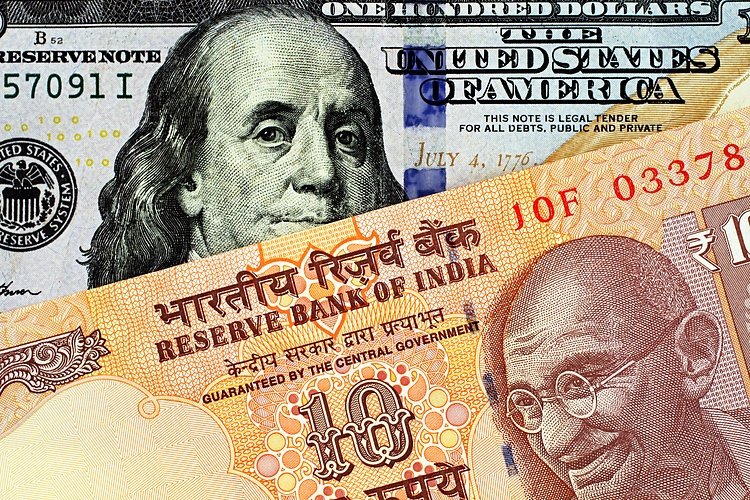
The Indian rupee crashed to its lowest level on record as the ongoing war in the Middle East sent shockwaves in Asia and other continents. The USD/INR exchange rate rose to 92.50 as it crossed the previous all-time high at 92.42. It has jumped by over 10% from its lowest level in April last year.
Indian rupee and stocks crash amid war in the Middle East
The USD/INR gained momentum on Tuesday as the fallout of the ongoing war in the Middle East gained steam. The blue-chip Nifty 50 Index tumbled by over 1.7%, while the Sensex fell by 1.66%. Indian bond yields continued rising.
The ongoing Indian rupee crash happened as crude oil prices continued rising amid the ongoing military strikes in the Middle East. Brent, which was trading at $55 earlier this year, has jumped to $84. Natural gas prices have also continued the upward momentum, and there is a risk it may climb further as the war continues.
India is highly exposed to these geopolitical issues as it imports most of its oil. Higher oil and gas prices risk stoking inflation, which has been subdued in the past few months. Recent data showed that the headline Consumer Price Index (CPI) stood at 2.75% in January.
Additionally, the rising energy prices pose a risk to the Indian economy, which is experiencing a higher trade deficit. Data released in February showed that the country’s deficit widened to $34.68 billion in January from $25 billion a month earlier.
Therefore, according to Bloomberg, the Reserve Bank of India (RBI) intervened by selling dollars once the USD/INR breached the key level at 92.
Further compounding the rupees woes is the fact that the US dollar strength has accelerated this week as investors embrace its role as a safe-haven asset and as market participants predict that the Federal Reserve will maintain higher interest rates for longer.
A report released on Friday showed that the US producer price index (PPI) rose to over 3% in January, moving further away from the Federal Reserve’s target of 2.0%. Rising energy and shipping costs will likely push inflation further away from the Federal Reserve’s target of 2.0%.
USD/INR technical analysis

USD/INR chart | Source: TradingView
The USD/INR pair is under the spotlight as the bull run gains steam. Looking at the weekly chart, we see that the climb has been going on for years. A pair that bottomed at 72 during the pandemic has now jumped to 92.25.
This chart shows that bulls have always come back in to buy the dip whenever the pair falls. For example, it recently fell to 90 after the US and Indian trade deal only for bulls to come back in and buy the dip.
Looking at the technical indicators, we see that the Average Directional Index (ADX) has settled at 36, indicating that the trend is still strong. ADX is one of the most common trend indicators and is based on the true range.
The pair also continues to move above the dynamic support of the 50-week Exponential Moving Average (EMA). In trend following analysis, an asset remains in a rally as long as it is above this moving average.
Therefore, what these technical mean is that the USD/INR has more room to run in the coming months, potentially to the resistance at 95. This view will be canceled if it starts falling and moves below the 50-week moving average. Such a drop will imply that bears have prevailed.