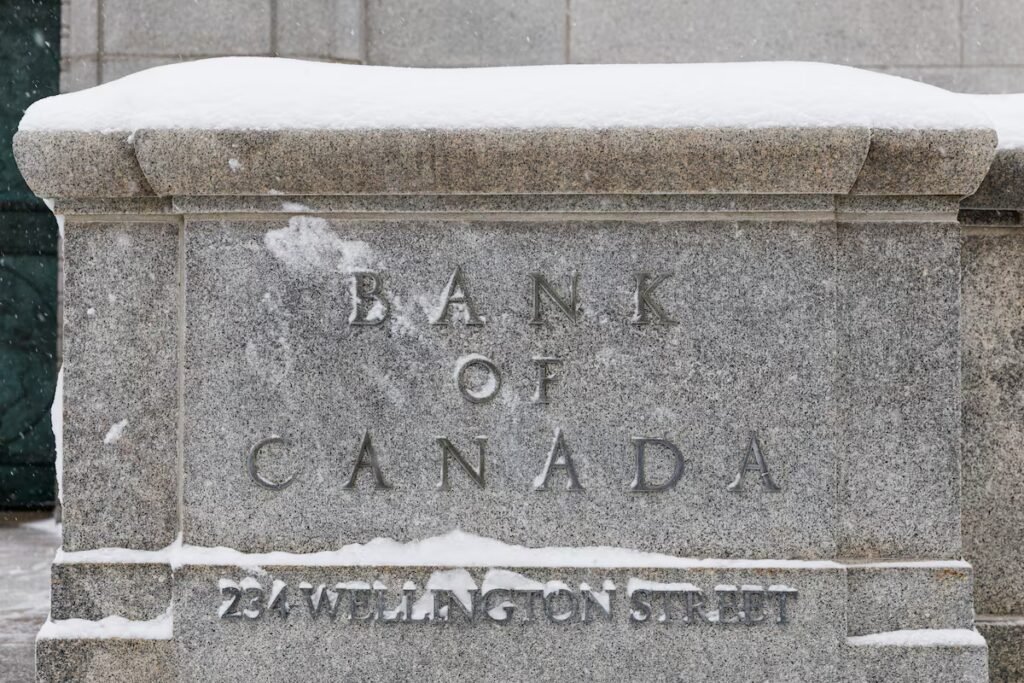
The Bank of Canada has shelved plans for a central bank digital currency, likely under pressure from banking institutions worried about their profit margins.Keito Newman/The Globe and Mail
Claude Lavoie is a contributing columnist for The Globe and Mail. He was director-general of economic studies and policy analysis at the Department of Finance from 2008 to 2023.
Ottawa’s new framework for regulating stablecoins has cryptocurrency advocates celebrating.
The federal legislation will allow companies to issue loonie-backed stablecoins – cryptocurrency pegged to the Canadian dollar. Tetra Digital, a financial services group, plans to launch one early next year.
The government’s move comes after the United States passed the GENIUS Act, raising concerns that Canada might fall behind in the digital currency race.
But Ottawa missed a much better opportunity: introducing a central bank digital currency that would make Canada’s banking system more inclusive, stable and efficient. Yet the Bank of Canada has shelved plans for a CBDC, likely under pressure from banking institutions worried about their profit margins.
Given that nearly 90 per cent of transactions already happen electronically through e-transfers, credit cards and debit cards, why bother with stablecoins?
Ottawa’s new stablecoin framework a key step toward monetary sovereignty, advocates say
The answer lies in efficiency. Stablecoin transactions don’t need to pass through multiple domestic and foreign institutions before settlement, enabling faster processing, lower fees, greater privacy and easier international transfers. By pegging to the Canadian dollar, they avoid the wild volatility of cryptocurrencies like Bitcoin, which has fallen more than 30 per cent in recent months.
Yet significant risks remain. A private stablecoin’s value depends on the issuer’s trustworthiness and ability to maintain adequate high-quality reserves. “De-pegging” incidents have occurred, where stablecoins meant to equal $1 have dropped to 90 cents or lower.
Users must also find someone willing to accept their stablecoin or convert it to traditional currency, which is particularly complex in cross-border transactions. Unlike credit cards and electronic banking, stablecoins offer no fraud detection or consumer protection. A transaction to the wrong address, a hack or a lost private key means the money is gone.
A central bank digital currency would provide the same settlement benefits and eliminate the risks posed by private alternatives.
As legal tender issued by the Bank of Canada, a CBDC would be accepted anywhere Canadian dollars are currently accepted. It would carry the same backing as the current dollar, with zero de-pegging risk.
BoC’s Macklem lays out high-level vision for stablecoin regulation
International agreements between central banks would facilitate fast, cheap conversion between countries’ CBDCs, simplifying transfers to friends and family in Europe, Japan or elsewhere. Controlling illicit activities would be easier than with private digital currencies.
Holding a CBDC would essentially equal holding deposits at the central bank (or at some kind of new national public deposit bank) accessible via card, computer or smartphone. The government could create an account for every Canadian using social insurance numbers, extending electronic payment benefits to the underbanked – the homeless, elderly and people in remote areas. Federal transfers could become faster and more efficient.
With all the advantages of CBDCs, the Bank of Canada abandoned the idea. The decision, of course, ultimately rests with the government. Launching a CBDC would require legislative changes, notably the Bank of Canada Act and Currency Act. So why isn’t the government pursuing it? The answer likely lies in the BoC’s stakeholder consultation report.
The Bank of Montreal, Bank of Nova Scotia, CIBC, and TD Bank in Toronto’s Financial District.Fred Lum/The Globe and Mail
One key factor emerging from these consultations is financial institutions’ concerns about a CBDC’s impact on their operations. A CBDC would remove incentives for holding money in banks’ deposit accounts. Why keep money in accounts that earn virtually no interest – and charge fees – when you could hold it more securely at the central bank with no fees? Banks would lose a stable source of low-cost funding.
Banks argue that this threatens financial stability. But if Canadians moved from bank deposits into CBDCs, this would simply level the playing field between banks and other non-deposit-taking financial institutions.
Most financial institutions lack access to bank deposits as funding (e.g. First National, Wealthsimple, Manulife) yet operate successfully. Moreover, the Bank of Canada has tools to address any financial stability problems that emerge.
The real reasons for resistance are simple: a CBDC would hurt large deposit-taking institutions’ bottom lines and would eliminate the market – and profits – for privately issued stablecoins.
Other concerns include privacy issues and the complexity of the required regulatory framework. Although it is worrisome that some people trust private cryptocurrency issuers more than their public institutions, these challenges are manageable. A CBDC could also coexist with physical cash.
With more than 130 countries exploring central bank digital currencies – many in pilot and development phases – shelving this idea may be a missed opportunity that future generations will regret.