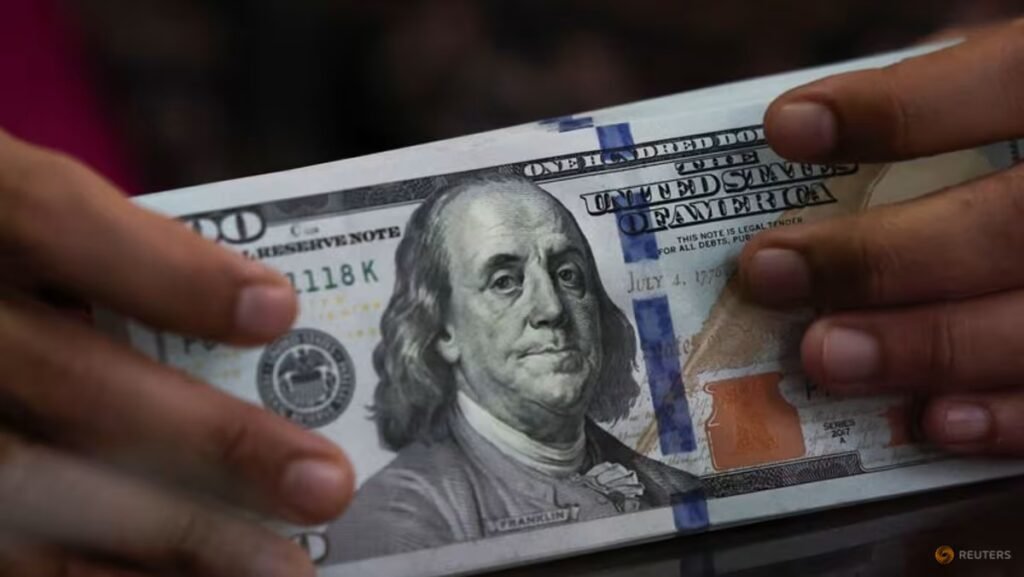
Jan 29 : The dollar remained on shaky ground on Thursday, as uncertainty over U.S. economic policies and geopolitical moves was only partially offset by supportive comments from the White House and European officials following a rout in the currency.
On the monetary policy front, the Federal Reserve struck a more sanguine tone on the U.S. labour market and inflation risks overnight, which investors took to imply that rates could be on hold for longer.
The greenback was in free fall earlier this week and hit a four-year low after U.S. President Donald Trump seemed to shrug off the currency’s weakness, though it found a floor after Treasury Secretary Scott Bessent said a day later that Washington has a strong-dollar policy.
Federal Reserve Chair Jerome Powell signalled a prolonged wait before any further reductions in borrowing costs, and some economists say the U.S. economy shows little need for additional policy easing.
“While the outlook remains uncertain, particularly given the appointment of a new Fed Chair in coming months, our baseline remains that the rate cutting cycle is complete, as labour improvement lies ahead,” said David Doyle, head of economics at Macquarie Group .
“We see the next move as a hike, potentially occurring in the fourth quarter of 2026.”
The euro, which broke above the key $1.20 level on the back of the dollar’s decline, traded just below that at $1.1980 after European Central Bank (ECB) policymakers flagged growing concerns over the deflationary effect of its quick appreciation.
However, ECB board member Isabel Schnabel reiterated on Wednesday monetary policy was in a ‘good place’ and interest rates are expected to remain at their current levels for an extended period.
Financial markets keep pricing steady rates through early 2027 even if the dollar’s recent weakness could lower imported inflation just as price growth is set to undershoot the ECB’s 2 per cent target.
While the heavy dollar selling abated on Thursday, the currency remained on the back foot against major currencies.
It fell 0.33 per cent against the Swiss franc to 0.766, close to an 11-year low, while sterling hovered near a 4-1/2-year high at $1.3844.
The Australian dollar, which has drawn additional support from bets of a rate hike at home as soon as next week, scaled a three-year peak and was last up 0.45 per cent at $0.7073.
The U.S. dollar selloff earlier this week had been the sharpest since Trump’s tariff blitz rocked markets last April.
Already down 2 per cent for the year, its weakness has been driven by concern over Trump’s erratic policymaking, attacks on the Fed and what it could mean for the rate outlook and, most recently, signals on Friday the U.S. was willing to sell dollars to help Japan to boost the yen.
NAB’s Attrill said the dollar’s performance will hinge crucially on how issues around Fed independence play out, including a U.S. Supreme Court ruling on Trump’s bid to fire Fed Governor Lisa Cook.
“Loss of independence is far and away the biggest risk to ongoing dollar hegemony,” he said.
Against a basket of currencies, the dollar was at 96.06, languishing near Tuesday’s four-year low of 95.566.
Its slide has provided some reprieve for the ailing yen, which rose 0.13 per cent to 153.23 per dollar on Thursday.
The Japanese currency has tracked around the 152 to 154 per dollar range for most of this week thanks to talk of rate checks from the U.S. and Japan last week – a move often seen as a precursor to intervention.
Elsewhere, the New Zealand dollar scaled close to a seven-month top of $0.60925. The Chinese yuan held near a 32-month peak and was steady at 6.9471 per dollar.