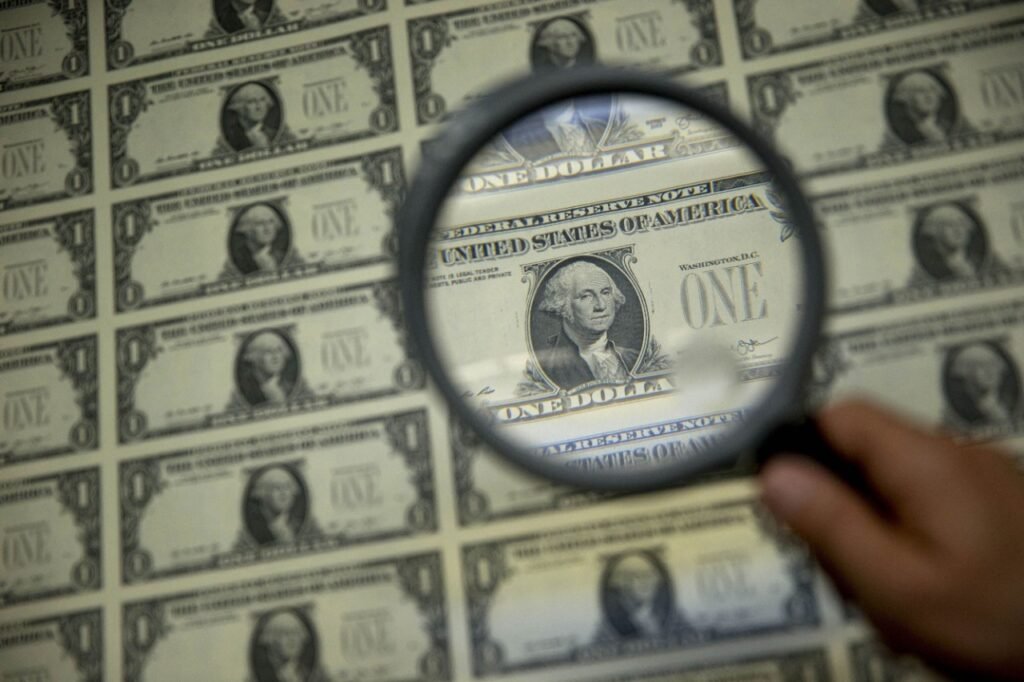
The strongest currencies in the world
If you’re wondering which currency is the strongest in the world and what the top 10 are right now, have a look at our list below. See how they perform when compared to USD.1
This article is accurate as of 25 November 2024.
1. Kuwaiti dinar (KWD)
The KWD is the national currency of Kuwait and is the world’s strongest currency due to the country’s tax-exempt economy and vast oil reserves. Kuwait is one of the richest countries in the world measured by gross domestic product (GDP) per capita.2
Here’s how it compares to USD:
1 USD = 0.031 KWD
1 KWD = 3.25 USD
2. Bahraini dinar (BHD)
The BHD is the official currency of Bahrain, an island in the Persian Gulf off the coast of Saudi Arabia. Its strength comes from its expansive oil wealth, much like Kuwait. It has a low inflation rate and a strong economy. Coupled with political stability, it’s an extremely strong currency. It’s pegged to the USD, giving it an anchor for monetary policy.3
Here’s how it compares to USD:
1 USD = 0.38 BHD
1 BHD = 2.65 USD
3. Omani rial (OMR)
Oman is located between the United Arab Emirates (UAE) and Yemen – at the tip of the Arabian Peninsula. Much like its neighbours and others on this list, it’s a major gas and oil exporter. Because these are such high-demand products worldwide, there’s a lot of money and investment into the currency, driving up its value.1
Here’s how it compares to USD:
1 USD = 0.38 OMR
1 OMR = 2.60 USD
4. Jordanian dinar (JOD)
The JOD entered circulation in the 1950s and is the national currency of Jordan, a landlocked country in the Middle East.
JOD is pegged to USD rather than depending on the strength of the Jordanian economy. This leads to foreign direct investment in Jordan and is why it’s such a strong currency – because USD is strong. This pegging has proven to be good for the JOD, as the country’s political system is unstable and its economy is stagnant.4
Here’s how it compares to USD:
1 USD = 0.38 JOD
1 JOD = 0.54 USD
5. British pound (GBP)
The British pound sterling has been in circulation since the 15th century, making it the world’s oldest currency still in use.
It’s stronger than USD for a few reasons – it’s maintained its interest rates fairly steadily since 2023, exceeded GDP growth targets and has received heightened investor sentiment in the pound.1
Here’s how it compares to USD:
1 USD = 0.79 GBP
1 GBP = 1.26 USD
6. Gibraltar pound (GIP)
The Gibraltar pound is the official currency of Gibraltar, a country located at the southern tip of Spain. It’s officially a British territory.
Its value is pegged to GBP, meaning it always moves in the same way as the pound sterling. This is why it’s so strong.1
Here’s how it compares to USD:
1 USD = 0.79 GIP
1 GIP = 1.26 USD
7. Cayman Islands dollar (KYD)
The Cayman Islands is in the Caribbean and is well known for being an offshore financial centre. Despite being a British territory, its currency is pegged to USD, which gives it its strength. Because it’s pegged to another currency, the local economy is stable as it has reduced exchange risk and heightened trade and investment.1
Here’s how it compares to USD:
1 USD = 0.83 KYD
1 KYD = 1.21 USD
8. Swiss franc (CHF)
This is the currency of both Switzerland and Liechtenstein and is seen as a safe haven because of Switzerland’s political stability and low inflation rate. Even at the start of the Russia-Ukraine war, Switzerland’s inflation rates stayed relatively low compared to other European Union (EU) countries and the US.5
Here’s how it compares to USD:
1 USD = 0.89 CHF
1 CHF = 1.12 USD
9. Euro (EUR)
The euro entered physical circulation in 2002 and is the official currency of the eurozone, which consists of 20 countries out of the 27 in the EU. Some of these countries include:
- Germany
- Austria
- Ireland
- Latvia
It’s a strong currency for several reasons. It promotes trade and travel between EU member states as travellers don’t need to exchange currency; it supports cross-border investments within the eurozone, minimising foreign exchange risk and it gets mutual support from other member states should a crisis occur.1
Here’s how it compares to USD:
1 USD = 0.95 EUR
1 EUR = 1.05 USD
10. United States dollar (USD)
While we can’t compare it to itself, we felt it important to include USD as it’s number 10 in world currency strength. All other currencies aside from those listed here are weaker than the dollar.
USD is one of the oldest currencies in the world, having been created in the 1700s. Its strength comes mostly from its economy, as the US has the largest in the world (measured by gross GDP). It’s also the most-traded currency across the globe. In addition, it’s currently the largest reserve currency and is the one of choice in pricing markets like precious metals and oil.1