- EUR/USD trades higher as the US Dollar faces offers after soft US PPI data for April.
- Beijing has rolled back non-tariff measures on 45 US entities.
- The EU is prepared with countermeasures if trade talks with the US fail.
EUR/USD is up 0.25% above 1.1200 during North American trading hours on Thursday. The major currency pair reflects strength as the US Dollar (USD) faces selling pressure following the release of the United States (US) Producer Price Index (PPI) and Retail Sales data for April.
The US Dollar Index (DXY), which gauges the Greenback’s value against six major currencies, trades 0.3% lower around 100.70.
The US Bureau of Labor Statistics has reported that producer inflation cooled down. The headline PPI rose at a slower pace of 2.4% on year, compared to estimates of 2.5% and the March reading of 2.7%. In the same period, the core PPI – which excludes volatile food and energy prices – grew by 3.1%, as expected, slower than the prior release of 4%, upwardly revised from 3.3%. Month-on-month, the headline and core PPI surprisingly deflated by 0.5% and 0.4%, respectively. On Tuesday, the US Consumer Price Index (CPI) data for April also came in softer-than-expected.
Technically, soft PPI and CPI data discourage the need to maintain a restrictive interest rate stance by the Federal Reserve (Fed). However, the Fed is more concerned about elevated consumer inflation expectations than providing temporary relief to the economy by announcing sudden interest rate cuts in the wake of the tariff policy announced by US President Donald Trump.
The US Retail Sales data, a key measure of consumer spending, for April has come in slightly better than expectations. The consumer spending measure rose by 0.1%, while it was expected to remain flat. On year, the data rose steadily by 5.2%.
Daily digest market movers: EUR/USD reflects strength as Euro trades firmly
- EUR/USD trades higher as the Euro (EUR) performs strongly among its risky peers despite European Central Bank (ECB) officials signaling that there is room for more interest rate cuts due to decelerating inflationary pressures.
- On Wednesday, ECB policymaker and Governor of the Bank of France François Villeroy de Galhau stated that protectionist policies announced by the US President Trump administration will lead to a “restart of inflation in its economy, not in Europe”, a scenario that paves the way for another rate cut by the summer.
- Going forward, the key trigger for the Euro is trade talks between the European Union (EU) and the US, which have not progressed in a while. During European trading hours, German Finance Minister Lars Klingbeil told the parliament that the continent is prepared with countermeasures if talks with the US do not succeed. However, his comments indicated that the EU’s first priority is securing a deal with Washington. “We expect that the negotiations will lead to a good result,” Klingbeil said, adding that “we must respond to the US tariffs with unity and determination.”
- During European trading hours, revised Eurozone Gross Domestic Product (GDP) data for the first quarter have shown that the economy grew at a slower pace of 0.3%, compared to the preliminary estimate and the prior release of 0.4%. Year-on-year, the GDP growth remained 1.2%, as expected. Additionally, the Employment Change in the January-March period has come in higher at 0.3% quarter-on-quarter, compared to flash estimates and the former reading of 0.1%.
- On the US-China trade front, some signs of further de-escalation in the trade war between the United States (US) and China have been observed. During the European trading session, US Treasury Secretary Scott Bessent stated that Washington is going into a “series of negotiations” with China to “prevent escalation” in trade tensions again. The comments from Bessent have increased investors’ confidence that the world’s two largest powerhouses are actively focusing on reaching a trade deal, a scenario that will lift global economic growth. “We [US] now have a mechanism with China counterparts,” Bessent added.
- Before comments from US Treasury Bessent, Beijing suspended non-tariff measures taken against 45 US entities, which it imposed on April 4 after the imposition of reciprocal tariffs by US President Donald Trump on April 2, Reuters reported. The decision from the Chinese Commerce Ministry came in the wake of the agreement between Washington and Beijing for a 90-day pause in the trade war, in which they lowered tariffs by 115%.
Technical Analysis: EUR/USD aims to return above 20-day EMA
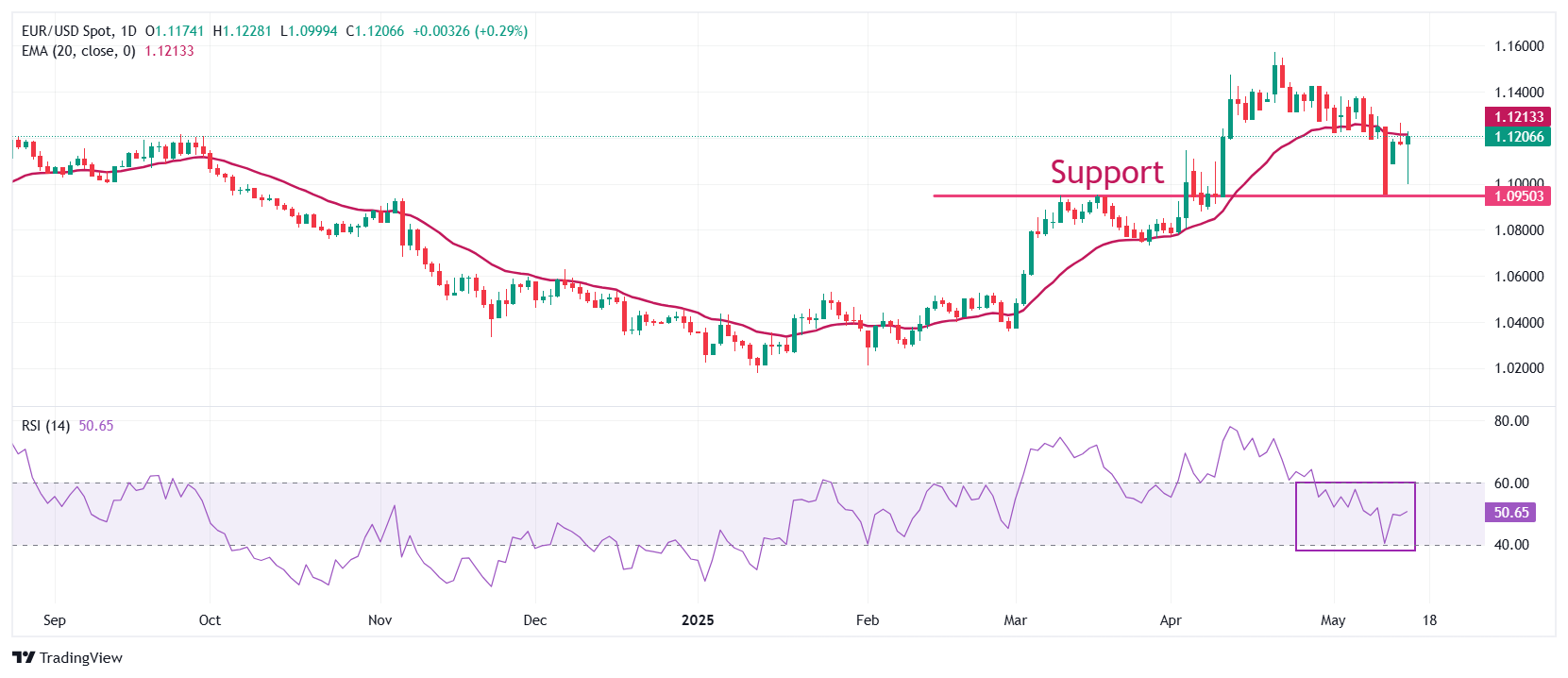
EUR/USD rises above 1.1200 on Thursday. However, the near-term outlook of the pair is still uncertain as the 20-day Exponential Moving Average (EMA) is acting as a key barrier around 1.1210.
The 14-period Relative Strength Index (RSI) recovers strongly to 50.00 after sliding to near 40.00, suggesting indecisiveness among traders.
Looking up, the April 28 high of 1.1425 will be the major resistance for the pair. Conversely, the psychological level of 1.1000 will be a key support for the Euro bulls.