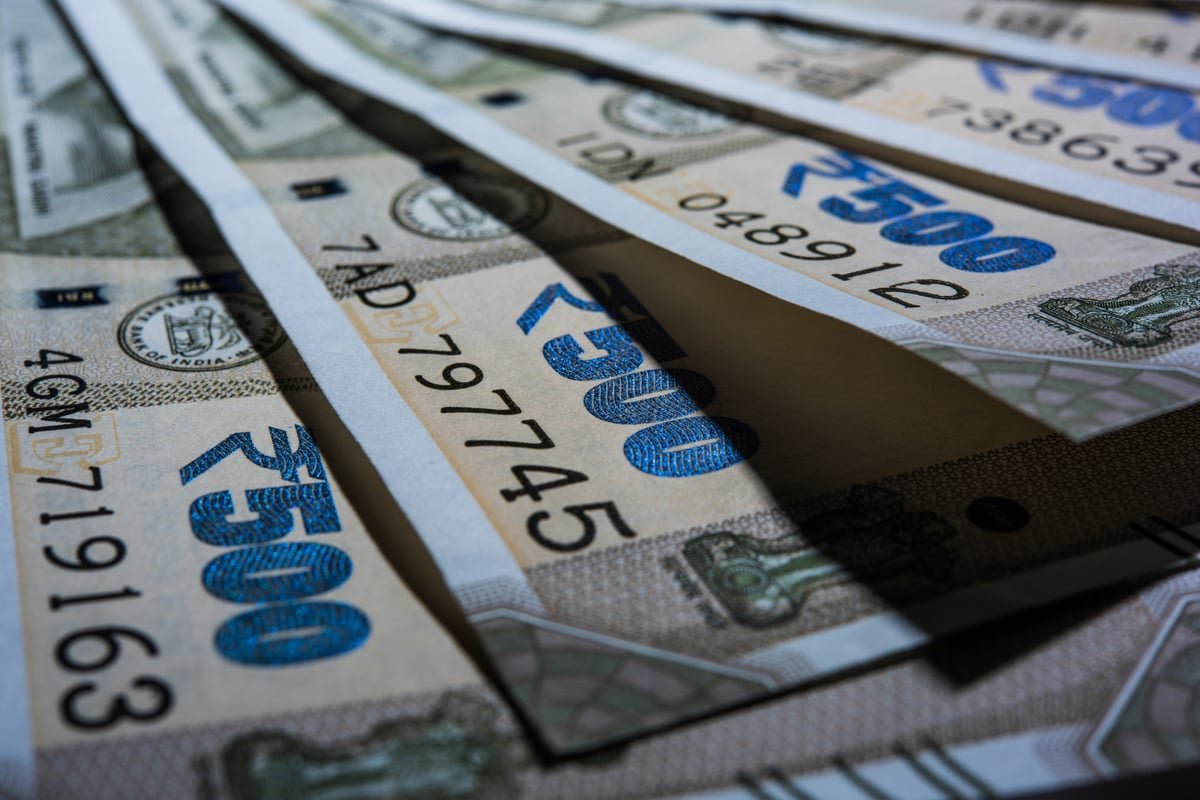
India’s economy may be expanding at a robust 8.2 per cent, but the Indian rupee is sliding faster than at any time and the State Bank of India (SBI) is urging markets not to confuse this rapid fall with underlying weakness. Earlier, Chief Economic Adviser (CEA) V Anantha Nageswaran stated that the government is unconcerned about the rupee’s recent decline against the US dollar
In its Ecowrap report, SBI stated the rupee’s breach of the psychologically important 90-per-dollar level on 3 December is being misread as a sign of deteriorating fundamentals. Instead, the fall is largely the consequence of a series of external shocks and market distortions, even as domestic economic momentum remains strong.
The bank stressed that “a sliding rupee is not a weak rupee”, and warns that calls for interest-rate cuts to stem depreciation could rattle financial stability.
Industry experts also attributed the rupee’s recent slide to the impact of higher US tariffs, a pick-up in core imports, moderating nominal growth and the Reserve Bank of India’s (RBI’s) foreign exchange operations. The 10 per cent year-on-year fall in the Real Effective Exchange Rate (REER), they note, largely shows a correction from the currency’s relative overvaluation in 2023–2024.
“The magnitude and pace matter, but some depreciation is a necessary macroeconomic cushion. It aids exports (particularly as India’s exports face higher US tariffs vs. most other emerging market peers) and disincentivises imports (generally and in the context of higher imports from China), lowering the trade deficit. We must see at what levels the rupee reflects the evolving macroeconomic backdrop, making domestic assets attractive again for foreign investors,” stated Sreejith Balasubramanian, Senior Vice President & Economist– Fixed Income, Bandhan AMC.
Fastest Slide in Years
According to the SBI report, the rupee’s decline from 85 to 90 per USD has occurred in under a year, making it the second quickest fall since the 2013 Taper Tantrum. By comparison, the currency previously took 1,815 days to weaken from 65 to 70, and around 800–900 days to move between 75 and 85.
The report attributed the current pace of decline to a “trifecta”, stalled US-India trade negotiations, renewed foreign portfolio investor (FPI) outflows after two years of robust inflows, and the Reserve Bank of India’s reluctance to defend specific exchange rate levels.
“It is not a one-day event but the culmination of sustained capital outflows, persistent trade imbalances, trade deal [US] and a stronger global dollar. While the RBI has stepped in periodically to smooth volatility, the broader trend reflects a recalibration of India’s external sector under tighter global financial conditions,” stated Rahul Gupta, Chief Business Officer (CBO), Ashika Group.
In the near term, Gupta added that the rupee is likely to remain under pressure and could trade in the 89.50–91.20 range, especially if crude oil prices stay elevated and foreign investors remain risk-averse. A meaningful recovery will depend on a revival in foreign inflows, clarity on global rate-cut cycles, and improvement in India’s export momentum. Until then, the currency is expected to stay weak but orderly, guided by selective RBI intervention.
SBI noted that the offshore non-deliverable forward (NDF) market is under intense pressure. One-month NDF contracts are trading 7–8 paise above the interest-rate differential, signalling panic among FPIs that are rushing to hedge open positions. The triggering of exotic option barriers once the rupee crossed 90 has further magnified volatility.
Trade War, Not Trade Deficit
A key argument advanced by SBI is that the market has overplayed India’s trade deficit as a cause. The goods-and-services deficit for April to October stands at USD 78 billion, only marginally higher than USD 70 billion in the same period last year. “Negative trade data has been oversold to the market,” the report said
Instead, the report identified the sharp escalation in the US-India trade conflict as the biggest trigger. Since 2 April 2025, when the United States imposed sweeping tariffs, the rupee has depreciated about 5.5 per cent, the highest among major economies.
The United States has imposed a 50 per cent tariff on Indian goods, significantly higher than the duties levied on China (30 per cent), Vietnam (20 per cent), Indonesia (19 per cent) and Japan (15 per cent). SBI estimates that roughly USD 45 billion worth of Indian exports, largely labour-intensive, are directly affected.
Despite the sharp fall, the rupee remains one of the least volatile currencies when measured by the coefficient of variation, at 1.7 per cent since April. The state bank also stated that rupee depreciation should have a central place and focus of the current ongoing monetary policy committee (MPC) meeting, and the MPC is not expected to reduce the policy rate now.
SBI noted that RBI is likely to give further clarity on liquidity measures. The Indian rupee is expected to recover some of its losses against the US dollar in the next three months, a Reuters poll of FX strategists showed, though a full turnaround depends on India and the US reaching a trade agreement.
Notably, uncertainty over the timing of a trade deal is contributing to rupee volatility, and a delayed agreement could see the currency fall to 92 per dollar, Arup Rakshit, group head of treasury at HDFC Bank, told Reuters. He highlighted that rising current account deficits and outflows from local equities are straining the dollar supply.
Economists at HDFC Bank expect India’s current account deficit to widen to 1.4 per cent of GDP in the second half of fiscal year 2026, up from 0.8 per cent in the first half, while foreign investors have withdrawn USD 17 billion from Indian stocks so far this year, Reuters reported.
Rupee Is Undervalued, Not Weak
SBI pointed to REER data to argue that the rupee is undervalued rather than structurally weak. India’s 40-currency REER index, which remained above 100 until May 2025, has now fallen below that level for three consecutive months as the trade war distorted currency outcomes. The REER hit a seven-year low of 97.40 in September, while the Nominal Effective Exchange Rate (NEER) has declined to 84.6 in October from 92.1 in June 2024.
Historically, India’s REER averages about 103–105, usually correcting within a few months after breaching the 100-mark. The current stretch of undervaluation is the longest since 2018, which SBI attributes to India losing relatively more ground than other emerging-market currencies during the tariff standoff.
Another key factor distorting the currency, according to the SBI report, is the unprecedented excess demand for dollars. Between July and October, merchant markets saw USD 102.5 billion of combined excess demand in spot and forward markets. Importers, anticipating lower devaluation relative to interest differentials, are increasingly leaving positions unhedged, adding strain to the market. FPIs, too, have held open dollar positions to capitalise on volatility.
With the market’s ability to supply USD greatly constrained, the RBI has effectively become the supplier of last resort. SBI estimates the central bank intervened with roughly USD 30 billion between June and October. During this period, forex reserves fell from USD 703 billion in June to USD 688 billion by late November, partly due to these interventions and capital outflows. The correlation between RBI interventions and reserve movements since January 2023 stands at a high 0.80.
SBI Opposes A Rate Cut Amid Stellar GDP Growth
One of the most pointed sections of the report warns against a policy-rate cut during the Monetary Policy Committee’s current deliberations. A rate reduction, SBI said, could be misread as an attempt to defend the rupee, a “knee-jerk reaction” that would only heighten nervousness.
The central bank’s credibility, the report argues, rests on inflation management rather than currency targeting. It also noted that banks have little room to cut deposit rates further at a time when investors are shifting towards alternative assets. Instead, SBI expects the RBI to offer clarity on liquidity measures rather than altering interest rates.
India’s economic growth accelerated sharply in the July-September quarter of FY 2025-26, with GDP rising 8.2 per cent year-on-year, driven by strong momentum in the secondary and tertiary sectors. The data, released by the NSO and based on current methodology using 2011-12 as the base year, shows the sharpest quarterly expansion in recent quarters, surpassing the 5.6 per cent recorded in the same quarter last year.
However, the International Monetary Fund (IMF) has given India’s national accounts statistics a ‘C’ grade, the second-lowest rating on its four-tier scale, indicating shortcomings that limit the data’s usefulness for economic surveillance. The assessment forms part of the IMF’s annual Article IV consultation, with the executive board concluding its review this week.
A ‘C’ grade signifies that data “have some shortcomings that somewhat hamper surveillance,” according to the IMF’s definition. The report noted that India’s national accounts data, which include gross domestic product (GDP) and gross value added (GVA), are available with adequate frequency and timeliness but contain methodological weaknesses that affect their reliability.
Meanwhile, SBI expects continued bouts of volatility as geopolitical factors shape the market. Russian President Vladimir Putin’s visit to India may influence oil flows, but India’s crude imports are likely to stay muted due to tightened US sanctions. Uncertainty over a US-India trade deal will persist, although it expects a settlement before March 2026. Until then, traders should brace for “frequent pullbacks” as negotiations ebb and flow, with the rupee likely to move in a narrow but volatile band.