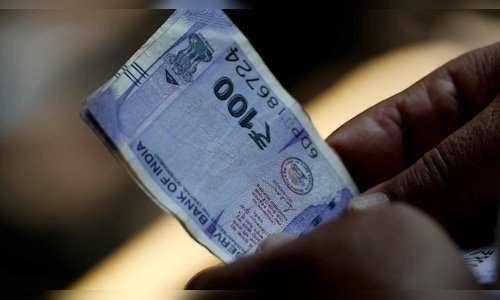
US Dollar and indian Rupee money exchange concept
| Photo Credit:
th-online Administrator
The rupee started the new financial year (FY27) with a bang due to the RBI’s recent twin measures — capping the net open position limits and tightening forex derivative rules — to curb speculative pressure on the domestic currency,
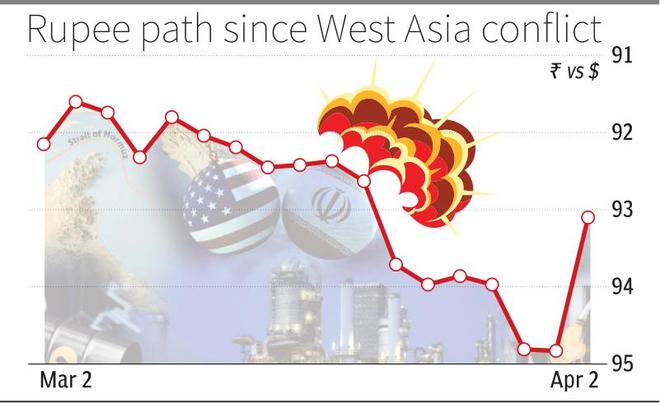
The central bank’s measures had the desired effect, with the rupee, which depreciated 9.8 per cent in FY26 against 2.5 per cent in FY25, on Thursday notching up the biggest single day gain in more than a decade. It gained 173 paise to close at 93.10 per US dollar, making a smart recovery from the previous (March 30) closing level of 94.83, which was a record closing low. The forex market was closed on the following two days – March 31 (Mahavir Jayanti) and April 1 (annual closing of accounts for banks).
Opening 130 paise stronger at 93.53 against the previous close, the rupee tested an intraday high/ low of 92.82/93.6575.
West Asia conflict
The rupee has been under pressure as the West Asia war has led to spike in global energy prices and disruption in supply chains, triggering demand for safe-haven dollar assets (resulting in FPI-related outflows from Indian equity markets) and strengthening of the dollar.
Barclays, in a report, said the RBI has delivered a double whammy to speculators, effectively bifurcating the rupee market. The rupee could rally further in the near term though there could eventually be some offshore convergence, per the report.
Amit Pabari, MD, CR Forex Advisor, opined that the rupee is currently going through a phase of tighter regulatory control, with the RBI stepping in to calm volatility and reduce excessive market positioning.
RBI’s intervention
In its March 27 circular, the RBI capped the Net Open Position in INR (NOP-INR) for banks at $100 million.
“Simply put, this measure forces banks to cut large dollar bets, leading to an unwinding of positions. As these trades get reversed, Dollars come back into the market, which helps ease immediate pressure on the Rupee and brings some near-term stability,” Pabari said.
He underscored that the RBI went a step further and tightened rules in the derivatives market to address the root cause of volatility. So, Banks can no longer offer non-deliverable forwards (NDFs) to clients, and participants are restricted from maintaining offsetting offshore positions. Rebooking of cancelled contracts is also no longer allowed.
“In simple terms, the RBI is closing the gap between offshore and onshore markets and reducing arbitrage opportunities. This means the market will now be driven more by real hedging needs rather than speculative trades, making price movements more controlled and transparent,” Pabari said.
Following the aforementioned moves, the Clearing Corporation of India Ltd (CCIL), in a precautionary move, increased the volatility margin from 20 per cent to 25 per cent across forwards and USD-INR options.
“When positions are being unwound forcefully, markets can become choppy with sharp gap-up or gap-down moves. Higher margins act as a safety buffer, ensuring participants have enough capital to manage this increased risk.
“However, there are some side effects. Forward premiums have moved higher, making hedging more expensive — especially for importers. At the same time, higher margin requirements mean more capital is tied up, which can be a disadvantage for hedgers,” Pabari said.
Challenging phase
Jahnavi Prabhakar, Economist, Bank of Baroda (BoB), said going ahead, given the challenging global environment, RBI may not actively intervene just as it did last year; and can even take a step ahead and stop with trimming its forward book.
She cautioned that this can be a double-edged sword – on the one hand it will indeed lead to further depreciation, on the other it will be positive for exports, which could see an adverse impact due to the ongoing geopolitical conflict. Overall, the BoB Economist expects the rupee to trade in the range of 93-95/$ in the near term, with downside risks.
Buoyed by the rupee and short-covering, equities wiped out the day’s losses to end higher, with the Nifty50 swinging up over 500 points from its day’s low to close 0.2 per cent up, and Sensex 0.3 per cent.
Published on April 2, 2026