

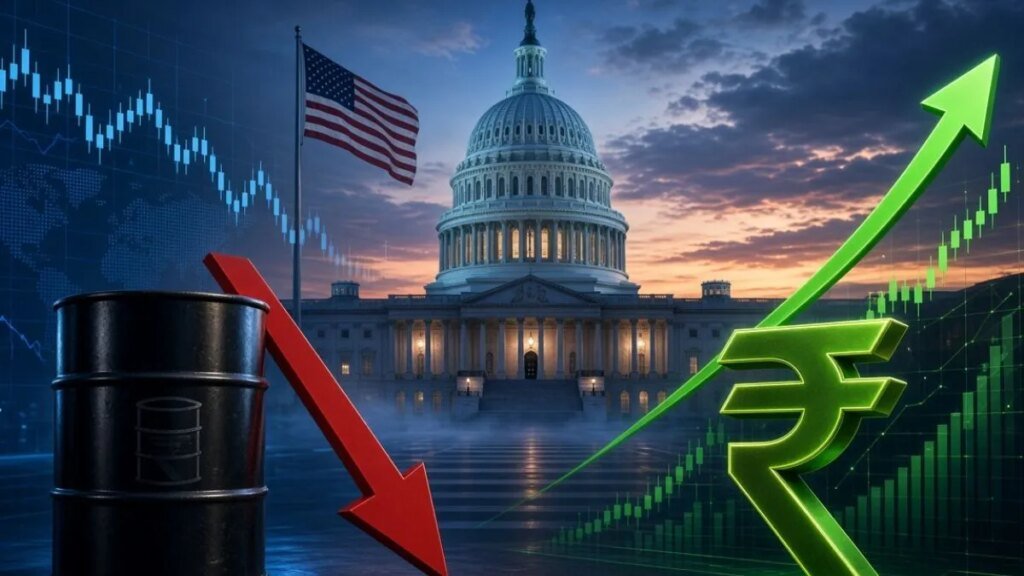
The Indian rupee rose to its strongest level in nearly two weeks on Wednesday, helped by a sharp fall in the US dollar after Democrats made major gains in the US midterm elections, Reuters reported. Early signs of foreign investors returning to Indian stocks also supported the currency.
The rupee touched 94.51 against the dollar in early trade before settling for reduced gains. It was last trading at 94.63 per dollar, up 0.1% during the day.
The weaker dollar, a fall in crude oil prices and fresh buying by overseas investors helped the Indian currency. However, demand for dollars from importers at more favourable rupee levels limited its gains.
Democrats’ election gains put pressure on US dollar
The US dollar fell sharply against major global currencies on Wednesday after Democrats made strong gains in their bid to take control of Congress from President Donald Trump‘s Republican Party.
Democrats secured majorities in both the Senate and the House of Representatives on Tuesday, winning several seats even in traditionally Republican strongholds. The results marked a major setback for Trump, with millions of voters delivering a strong message against his administration.
The election outcome also affected currency markets across Asia.
“A Democratic sweep of both the House and Senate would likely be modestly positive for Asian FX, as stronger fiscal gridlock would reduce expectations for further US fiscal expansion, weighing on US yields and the USD,” MUFG told Reuters.
The US dollar index, which measures the greenback against a basket of six major currencies, fell 0.3% on Wednesday. The decline helped most Asian currencies gain between 0.1% and 0.3%.
Why the Democratic victory matters for the Indian rupee
Analysts at ING said in a note that the election results were unlikely to bring major long-term changes to currency markets. However, the dollar could face some pressure in the short term if Democrats take control of both chambers of Congress.
Carol Kong, currency strategist at Commonwealth Bank of Australia, told Reuters that “a Democratic sweep would limit government spending over Trump’s term.”
Expectations of lower government spending and reduced concerns about the US fiscal deficit could weigh on the dollar. A weaker dollar generally makes things easier for the Indian rupee, as it reduces pressure on the currency.
However, some of the expected impact may already have been factored into the market. Alex Cohen, FX strategist at Bank of America, told Reuters before the election that “a strong Democrat showing should be well in the price.”
Trade Brains reported that the rupee was trading near 94.75 at midday, almost unchanged from Tuesday’s closing level. Indian stock markets also lost their early gains, with both the Sensex and Nifty falling around 0.24% at midday.
Bank of Baroda expects the rupee to trade between 94.75 and 95.75 against the dollar in the near term. According to its report, cited by ANI, “Higher oil prices are a major factor” affecting the currency’s movement. The report also pointed to foreign portfolio investor outflows and support from the Reserve Bank of India as other factors influencing the rupee.
Foreign investors return to Indian stocks after two months of selling
Early signs of foreign investors returning to Indian equities also supported the rupee.
Overseas investors have bought around $1 billion worth of Indian shares so far in November, according to stock depository data. This comes after two consecutive months of selling in the domestic stock market.
The return of foreign money has improved market sentiment and provided some support to the Indian currency.
A fall in crude oil prices on Wednesday also helped the rupee. However, traders said demand for dollars from importers prevented the currency from making bigger gains.
Importers were looking to buy dollars when the rupee was at more favourable levels, limiting its rise during early trade.
For now, the rupee is drawing support from a weaker US dollar, lower oil prices and signs of foreign investors returning to Indian markets.
Crude oil prices fall, but Iran war remains the bigger concern
Crude oil prices edged lower on Wednesday as the US election results came in. Brent crude futures fell 0.4% to $103.2 a barrel, while US benchmark West Texas Intermediate (WTI) declined 0.5% to $95.6 a barrel.
The fall came despite some support from a larger-than-expected decline in US crude inventories. Data from the American Petroleum Institute showed that US crude stocks fell by 5.27 million barrels.
However, the bigger decline in oil prices had already taken place a day earlier.
CNBC reported that crude prices fell sharply on Monday after the US and Iranian presidents signalled that they were open to diplomatic talks. Brent crude settled at $104.77 a barrel, down 7.6%.
Before this, oil prices had risen by more than 10% in October as traders worried that the conflict could turn into a much bigger military confrontation after the US elections.
There may also be limited changes to US energy policy despite the Democrats’ gains. Multibagg reported that a presidential veto could restrict the party’s ability to restore clean-energy tax credits that were removed under the 2025 law.
What does the US election result mean for the rupee and crude oil?
The rupee’s next move will depend on whether foreign investors continue to bring money into Indian markets and how crude oil prices behave in the coming days.
According to PSU Watch, sustained equity inflows and developments in international energy markets will play an important role in deciding the currency’s direction.
The Democrats’ projected control of both chambers could make it harder for Trump to push through his domestic political agenda. However, analysts do not expect the change in Congress to immediately alter the course of US policy towards Iran or the wider Middle East.
If diplomatic talks between Washington and Tehran continue, crude oil prices could remain under pressure. This would be positive for India as lower oil prices would reduce the country’s import bill and ease pressure on the rupee.
However, if the talks fail and military tensions rise again, crude prices could climb sharply. Such a move would put the Indian currency under fresh pressure.