The ongoing West Asian conflict is not the first instance of India facing pressure on the rupee and foreign exchange reserves. Since the 1991 balance of payments crisis in India, the country has encountered similar stresses on multiple occasions.
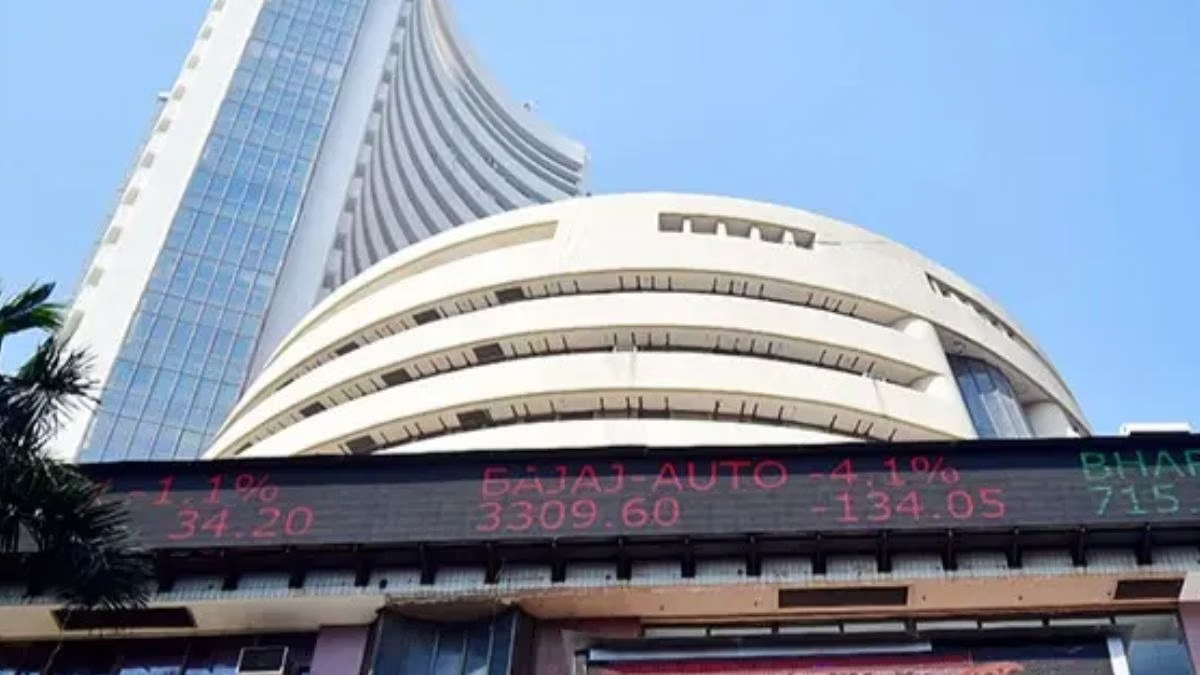
After the escalation of the West Asia conflict on February 27, its aftershocks have begun to ripple through India’s economy. Foreign exchange reserves shrank by $19 billion in just two weeks, the rupee weakened by 2.9 per cent to 93.72 and stock markets fell by nearly 9 per cent after the war hit the financial markets.
In 1991, during the balance of payments crisis, India’s foreign exchange reserves had fallen to critically low levels — barely enough to cover about 2–3 weeks of imports. Since then, the Asian financial crisis, global financial crisis, the taper tantrum in the US, the COVID pandemic and the Russia-Ukraine war have put pressure on the rupee and forex reserves.
Forex reserves were at $709.75 billion as of March 13, 2026, according to RBI data This can cover roughly over 12 months of imports, which is considered very comfortable — anything above 8–10 months is typically strong by global standards.
There are growing concerns. Foreign investors have pulled out Rs 1.03 lakh crore ($ 11 billion) from India so far in March. How the supply disruption due to the conflict and high crude oil prices will affect trade, balance of payment and the current account deficit (CAD), and in turn impact forex reserves, remains to be seen.
BoP crisis in 1991
A sharp jump in oil prices in August 1990 had led to an acute economic crisis, turning the balance of payment situation unmanageable, depleting foreign exchange reserves along with massive capital outflows and pushing India closer to a possibility of default.
By mid-1991, the balance of payments (BoP) crisis turned into a crisis of confidence in the country’s ability to manage the BoP. The loss of confidence undermined the Government’s capability to deal with the crisis by closing off all recourse to external credit. A default on payments for the first time in Indian history became a serious possibility in June 1991, according to RBI History Volume IV.
Story continues below this ad
Signs of the payment crisis became evident in the second half of 1990–91 when the Gulf war led to a sharp increase in the oil prices. Foreign exchange reserves began to decline from September 1990. The reserves declined by 71.2 per cent between the end of August 1990 and January 16, 1991, from a level of $ 3.1 billion to $ 896.0 million. NRIs pulled out deposits on a massive scale.
In April 1991, the Government raised US$ 200.0 million from the Union Bank of Switzerland (UBS) through a sale (with a repurchase option) of 20 tonnes of gold confiscated from smugglers. Again, in July 1991, India shipped 47 tonnes of gold to the Bank of England (BoE) to raise another US$ 405.0 million. This action helped the country repay its international donors and creditors, though it was not sufficient to completely absolve the country of the crisis.
The rupee devaluation was done in two tranches of 9 per cent and 10 per cent in quick succession in a matter of three days, taking the total downward adjustment in terms of pound sterling to be 17.38 per cent and 18.7 per cent in terms of the US dollar. It then fell from 20-21 to 25-26 against the dollar.
The crisis then forced the government — led by then Prime Minister PV Narasimha Rao and Finance Minister Manmohan Singh — to announce the new Industrial Policy Resolution, abolition of most trade licences, full rupee convertibility on the current account, providing freedom to enterprises, opening up the country to foreign direct investment and the capital market liberalisation that facilitated the entry of foreign investors.
Story continues below this ad
Asian financial crisis spillover (1997–98)
The Asian financial crisis led to pressure on the Indian rupee due to competitive devaluations in East Asia, which reduced export competitiveness and triggered capital outflows from emerging markets like India, resulting in increased volatility in the forex market and a fall in forex reserves as the Reserve Bank intervened by selling dollars to stabilize the currency.
Forex reserves fell by $2-3 billion to roughly $26–27 billion in 1998. The RBI had to intervene to stabilise the currency and tighten liquidity. The rupee declined from 35-36 to 41-42 in 1997-98 despite the tightly regulated market. India was largely insulated from this crisis as the country had not fully opened its capital account and its regulatory framework was much stronger than other Asian countries.
The crisis began in Thailand in July 1997 when the Thai government was forced to stop supporting its currency, the baht. This triggered panic among investors, who quickly pulled money out of other Asian economies like Malaysia, South Korea, Indonesia and Philippines.
Global financial crisis impact (2008–09)
The global financial crisis led to significant capital outflows and pressure on the rupee, resulting in a decline in India’s forex reserves from around $315 billion in early 2008 to about $250–255 billion by early 2009, implying a fall of roughly $60–65 billion, as the Reserve Bank intervened to stabilise the currency. There were massive outflows by foreign institutional investors (FIIs) and the rupee depreciated sharply from 39 to 50 against the dollar. The RBI then used reserves and eased monetary policy to stabilise markets.
Story continues below this ad
The global financial crisis began in the US when banks issued large numbers of risky home loans, or what is generally known as sub-prime lending. When housing prices fell, borrowers defaulted and these assets lost value. The collapse of Lehman Brothers in September 2008 triggered panic, freezing global credit markets and causing a worldwide economic downturn.
Taper Tantrum (2013)
Taper tantrum was one of the most severe forex stress episodes post-1991. The trigger was the US Federal Reserve hinting at reducing quantitative easing, which it had followed after the global financial crisis in 2008-09. The rupee came under intense pressure. The Taper Tantrum led to sharp capital outflows from India as investors pulled funds back to the US, putting severe pressure on the rupee, which depreciated rapidly from around 55 to nearly 68 per dollar, while India’s forex reserves declined by roughly $10–15 billion even as the Reserve Bank intervened in the forex market to curb volatility and stabilise the currency.
India was labelled among the “fragile five” economies and the country witnessed sharp capital outflows and CAD concerns. The RBI, then led by Raghuram Rajan, took strong measures including rate hikes, forex swaps and NRI deposit schemes to stabilise the rupee and boost reserves. India since then started accumulating reserves as a war chest to tackle uncertainties on the global front.
COVID-19 pandemic shock (2020)
The COVID-19 pandemic triggered global financial panic leading to sudden capital outflows from India, which put downward pressure on the rupee causing it to depreciate from 71 to around 75–76 per dollar, while India’s forex reserves initially fell by about $10–12 billion during early 2020 as the Reserve Bank of India intervened to stabilise the currency, although reserves recovered quickly later due to strong capital inflows.
Story continues below this ad
With volatility hitting the forex markets, the RBI intervened aggressively and used large reserves to stabilise markets. The central bank slashed the Repo rate by 115 basis points to support the economy. However, this led to a spike in inflation in the economy.
Russia–Ukraine war shock (2022)
The Russia–Ukraine War led to a sharp rise in global commodity prices, especially crude oil, which increased India’s import bill and widened the current account deficit, putting significant pressure on the forex market and causing the rupee to depreciate to record lows of around 82–83 per dollar.
India’s forex reserves declined by about $70–80 billion from their peak of around $640 billion in 2021 as the Reserve Bank intervened aggressively to stabilise the currency, and more broadly, the economy faced higher inflation, fiscal pressure due to fuel subsidies, and slower growth due to rising input costs and external uncertainties. Aided by sharp appreciation in gold holdings, the RBI since then raised the forex reserves to over $ 700 billion.
The RBI increased the Repo rate six times to 6.50 per cent from 4.40 per cent between 2022 and 2023 to bring down inflation and stabilise the forex market.